SOLUTION: If −𝜋 ≤ 𝑥 ≤ 0, then cos−1(cos 𝑥) is:
A)𝑥 B)𝜋−𝑥 C)2𝜋+𝑥 D)2𝜋−𝑥 E)None
Algebra.Com
Question 1197163: If −𝜋 ≤ 𝑥 ≤ 0, then cos−1(cos 𝑥) is:
A)𝑥 B)𝜋−𝑥 C)2𝜋+𝑥 D)2𝜋−𝑥 E)None
Found 2 solutions by Theo, greenestamps:
Answer by Theo(13342) (Show Source): You can put this solution on YOUR website!
if you graph the equation, you can see what's going on.
the graph is shown below:
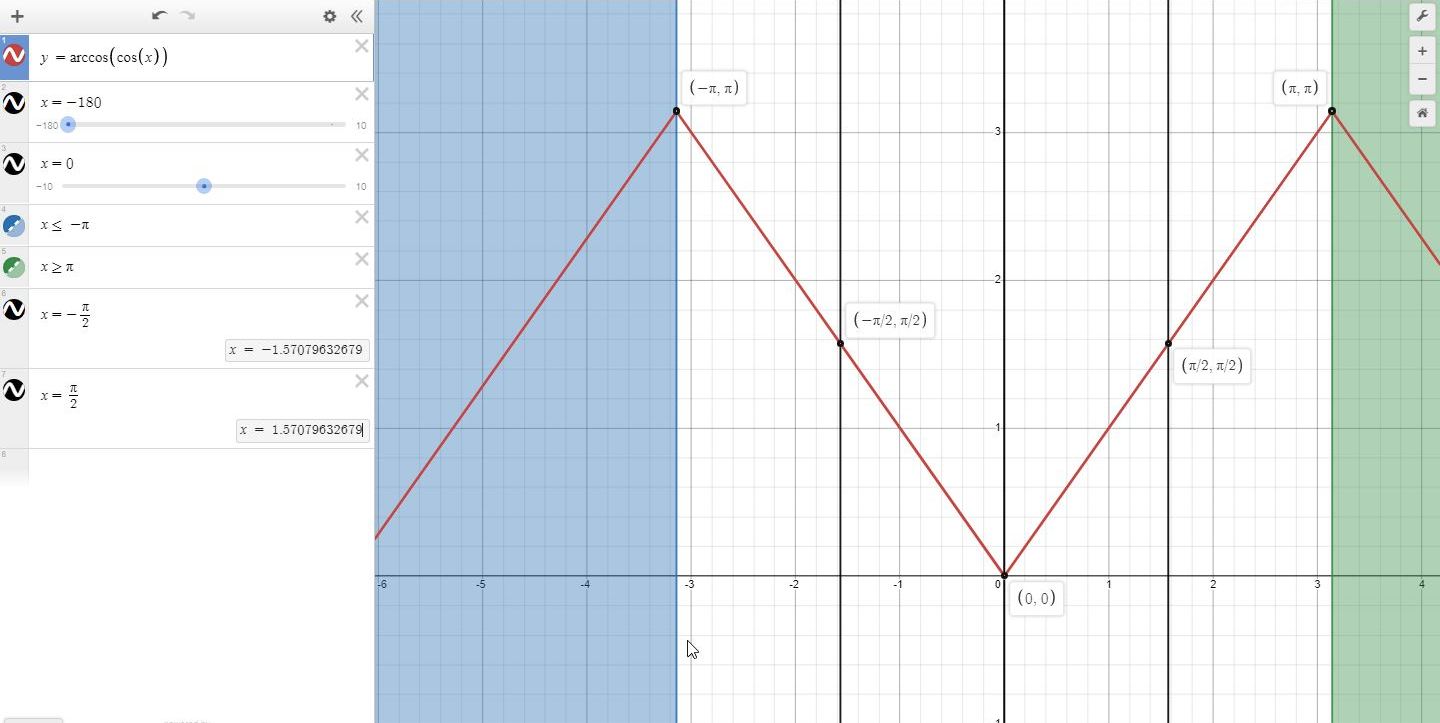
you can see from the graph that when x = pi/2, y = arccos(cos(x)) = arccos(cos(pi/2)) = pi/2.
that would indicate that arccos(cos(x)) = x.
that's true when 0 < x < pi.
arccos(cos(-pi/2)) = pi/2 as well.
however, since the angle is -pi/2, then the coordinate pair is (-pi/2,pi/2) which indicates that arccos(x) = -x when -pi < x < 0
the equivalent positive angle of -x is equal to -pi/2 + 2pi = 3pi/2.
that would be 2pi + x because 2pi + (-pi/2) = 3pi/2.
this is very tough to see unless you can graph it.
the graphing software i used is at https://www.desmos.com/calculator
it looks to me that your solution is selection C which is 2pi + x.
you didn't have -x as a solution.
you needed to now that -x was equivalent to 2pi - (-x) = 2pi + x.
arccos(cos(-pi/2) = pi/2.
arccos(cos(2pi+pi/2) = pi/2.
let me know if you have any questions.
theo
Answer by greenestamps(13241) (Show Source): You can put this solution on YOUR website!
For the inverse cosine function, the input is a real number between -1 and +1, and the output value is in a range which is the interval closest to 0 in which cos(x) takes on all it values.
cos(x) takes on all its values on [0,pi), so the output of the inverse cosine function is on that interval. Note cos(x) also takes on all its value on [-pi,0); but the convention is to use the interval where the numbers are positive.
cos(x) has a period of 2pi, so cos^(-1)(cos(x)) returns a value equal to x, plus or minus the multiple of 2pi that makes the output value between 0 and pi.
Since in this problem the input value x is between -pi and 0, the output value needs to be x+2pi.
ANSWER: C
RELATED QUESTIONS
If 0 is an acute angle and sin 0 =1/2,then cos 0=
A.-1
B.0
C.1/2
D.√3/2... (answered by jim_thompson5910)
. If cosθ + sinθ = 2 cosθ ,then cosθ − sinθ = ?
A. 2... (answered by Edwin McCravy)
If y=e^x (x-1) then y''(0) equals
(A) -2
(B) -1
(C) 0
(D) 1
(E) none of... (answered by drk)
Which of the following is correct?
(a) cos(.1) < sin(.1) < sin(.1)cos(.1)
(b)... (answered by jsmallt9)
If sin α = ½ and α is acute, then (3cosα- 4 cos²α) = ?
(a.) 0 (b.) (answered by brysca)
If the graph of y=cos(pix)-2 is shifted up by 3 units, left by 1 unit and vertically... (answered by Theo)
If sin(x) + sin^2(x) = 1, then the value of cos^12(x) + 3cos^10(x) + 3cos^8(x) + cos^6(x) (answered by ikleyn,Edwin McCravy,AnlytcPhil)
What is {{{ cos(t) }}}if {{{ t }}} corresponds to the point (-2, 0)?
A.) {{{ 0 }}}... (answered by Edwin McCravy)
If (answered by stanbon)