|
Tutors Answer Your Questions about Square-cubic-other-roots (FREE)
Question 148962: I need some help with this problem. I have tried to work it and cannot seem to come up with the answer All the directions say is to complete the square to solve the following equations
x^2+6x=7 ( i know that you need to get every thing on 1 side but then what)
x^2+6x-7=0
and with this problem the same directions but would you us the quadratic formula to solve? 2x^2-5x-3=0 Thanks Leann
Found 2 solutions by josgarithmetic, MathTherapy:
Answer by josgarithmetic(39838)  (Show Source): (Show Source):
Answer by MathTherapy(10858)  (Show Source): (Show Source):
You can put this solution on YOUR website!
I need some help with this problem. I have tried to work it and cannot seem to come up with the answer All the directions say is to
complete the square to solve the following equations
x^2+6x=7 ( i know that you need to get every thing on 1 side but then what)
x^2+6x-7=0
and with this problem the same directions but would you us the quadratic formula to solve? 2x^2-5x-3=0 Thanks Leann
*************************************
While one of the other 2 "respondents" solved by factoring the trinomial, this is NOT the required method. However, this method, if the
trinomial is factorable, is oftentimes used by this author, as a way to determine the solutions/roots before COMPLETING the SQUARE.
You started out with  , and went on to SUBTRACT 7 from each side of the equation. But, when completing the square, the
CONSTANT (the number without an attached variable) should be on the right side of the equation, which it is! So, NO NEED to subtract 7,
in this case!
The answer to your question about whether or not the quadratic equation formula can be used, is YES!! But, why would you want to do
that when requested to solve, by COMPLETING the SQUARE? And also, both equations are indeed, factorable. , and went on to SUBTRACT 7 from each side of the equation. But, when completing the square, the
CONSTANT (the number without an attached variable) should be on the right side of the equation, which it is! So, NO NEED to subtract 7,
in this case!
The answer to your question about whether or not the quadratic equation formula can be used, is YES!! But, why would you want to do
that when requested to solve, by COMPLETING the SQUARE? And also, both equations are indeed, factorable.
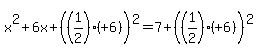 ---- Squaring ---- Squaring  of b, then adding result to both sides of b, then adding result to both sides
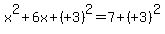


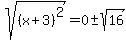 ---- Taking square root on both sides ---- Taking square root on both sides


 Now, follow the same concept for the 2nd equation!
Question 1210612: Fill in the blanks to make an equation that is linear in disguise, and has a solution.
sqrt(2x - 3) + __x + ___ = ___x - ___ + ____
8 9 10 11 12 13 14 15 16 17 18 19 20
Found 3 solutions by greenestamps, KMST, CPhill:
Answer by greenestamps(13367)  (Show Source): (Show Source):
You can put this solution on YOUR website!
It is not at all clear what the purpose of this problem is. You can find numerous solutions either by pure trial and error or using formal algebra.
And, as another tutor pointed out, it is not clear whether numbers from the given list can be used more than once.
Using A, B, C, D, and E to represent the numbers in the blanks, the given equation is

This equation can be "linear in disguise" if x is any number for which  is a perfect square. is a perfect square.
Even limiting ourselves to integer perfect squares, there are an infinite number of possible values for x:
    2x-3   x
   ----------
     0    3/2
     1      2
     9      6
    25     14
    49     26
    ...
For many of those values of x the equation will have solutions (often multiple solutions) with A, B, C, D, and E being values from the given list.
But can be a perfect square which is not an integer; that will lead us to a whole new family of possible values for x, and possibly many of those will allow additional solutions to the problem.
Finally does not have to be a perfect square. We can isolate the radical and square both sides of the equation to get yet another whole family of possible solutions to the problem.


Squaring both sides will yield a quadratic equation; since we are supposed to get a linear equation, it would be necessary for  to be zero -- i.e., A and C would have to be the same value from the given list. If that is indeed allowed, then we open up the possibility of many more solutions to the problem. to be zero -- i.e., A and C would have to be the same value from the given list. If that is indeed allowed, then we open up the possibility of many more solutions to the problem.
Answer by KMST(5396)  (Show Source): (Show Source):
You can put this solution on YOUR website! The way I interpret the question, only the numbers given below the equation can be used to fill the blanks.
I am going to refer to the values to be filled as the constants A, B, C, D and E.
I will write the equation as
 . .
It is not specified, but I am going to assume that each number can only be used once.
A linear equation is one where the variable appears multiplied by some coefficient(s), but never with an exponent, or in a square root.
The square root shown appears to make that equation not linear, so
I am also going to assume, that the equation to be made is to be "linear in disguise" because
 for the value of for the value of  that satisfies that satisfies  . .
<-->  <--> <--> 
For to be a solution of , the values of the constants must be such that
 <--> <--> <--> <--> <--> <--> . .
The values for A, B, C, D, and E must be all different, be in the list of numbers given, and the numbers given are such that  . .
The equation <-->  tells us that tells us that
 must be a multiple of 2, and must be a multiple of 2, and
 must be a multiple of 3. must be a multiple of 3.
From there on, we can guess and check to find suitable answers. There is a very large number of them.
For example,  or or  give us give us
 and are part of some of the many possible answers. and are part of some of the many possible answers.
Those choices make  , ,
and leaves us the numbers 10, 11, 12, 13, 14, 15, 16, 17, 18, and 19 available to use as A and C.
Then,  , ,  , ,  , ,  , ,  , ,  , ,  , ,  could be used to complete an answer. could be used to complete an answer.
There are many other sets of values that are valid answers.
Let's verify if  make make  an equation "linear in disguise" that has as a solution. an equation "linear in disguise" that has as a solution.
Substituting into , I get


For a more systematic approach, we could start with the possible values of .
Knowing that , and that is not zero,
the possible vales for are -12, -10, -8, -6, -4, -2, 2, 4, 6, 8, 10, and 12.
That makes the possible values for  -18,-15,-12, -9, -6 -3, 3, 6, 9, 12, 15, and 18. -18,-15,-12, -9, -6 -3, 3, 6, 9, 12, 15, and 18.
To get a longer list of possible solutions, we could start by using multiples of 3 for E, B, and D to make  a multiple of 3. a multiple of 3.
Thinking about modular arithmetic, for those familiar with it, we could make a very long list of options for E, B, and D that make a multiple of 3
Then, we could weed out from those lists those with  and those with and those with  , then we could find possible values of A and C, eliminating the ones where A or C was already used as E, B, or D. , then we could find possible values of A and C, eliminating the ones where A or C was already used as E, B, or D.
We are still left with hundreds of different valid answers.
Answer by CPhill(2264)  (Show Source): (Show Source):
You can put this solution on YOUR website! To make the equation "linear in disguise," we need to eliminate the square root $\sqrt{2x - 3}$. The most common way to do this is to ensure the other terms allow you to isolate the root and then square both sides, or more simply, to choose coefficients that force the $x$ terms to cancel out in a way that leaves a solvable linear-like state.
However, the classic "in disguise" trick for this specific structure is to set it up so that when you isolate the radical and square it, the $x^2$ terms on both sides are identical, leaving you with a linear equation.
Here is a set of numbers from your list that works:
### The Equation
$$\sqrt{2x - 3} + \mathbf{8}x + \mathbf{11} = \mathbf{8}x + \mathbf{9} + \sqrt{\dots}$$
*(Note: Since you only provided one square root in the prompt structure, we will isolate it.)*
Let's fill the blanks to create a solvable linear path:
**$\sqrt{2x - 3} + 10x + 15 = 10x + 18$**
---
### Step-by-Step Solution:
1. **Subtract $10x$ from both sides:**
The $x$ terms cancel out immediately, which is the ultimate "disguise."
$$\sqrt{2x - 3} + 15 = 18$$
2. **Isolate the radical:**
Subtract $15$ from both sides:
$$\sqrt{2x - 3} = 3$$
3. **Square both sides:**
$$2x - 3 = 9$$
4. **Solve for $x$:**
$$2x = 12$$
$$x = 6$$
### Why these numbers?
* **10 (Blanks 1 & 3):** By putting the same coefficient for $x$ on both sides, the equation becomes a simple radical equation that reduces to linear form.
* **15 and 18 (Blanks 2 & 4):** We chose these so that $18 - 15 = 3$. When squared, this gives $9$, and since $9 + 3 = 12$ (an even number), it ensures $x$ is a clean integer ($6$).
**Filled Blanks:**
$\sqrt{2x - 3} + \underline{\mathbf{10}}x + \underline{\mathbf{15}} = \underline{\mathbf{10}}x + \underline{\mathbf{18}}$
*(The 5th blank in your prompt `+ ____` was not used in this specific solution, but could be filled with **0** or combined with the other constants).*
Would you like to try a version where the $x$ terms don't cancel immediately, requiring you to square a binomial?
Question 1210609: Fill in the blanks to make the equation true.
(___)^{-1/3} = (___)^{-1/2}
-72 -45 -9 -4 -18 -27 -64 -16 -25
Found 2 solutions by ikleyn, CPhill:
Answer by ikleyn(53937)  (Show Source): (Show Source):
You can put this solution on YOUR website! .
Fill in the blanks to make the equation true.
(___)^{-1/3} = (___)^{-1/2}
-72 -45 -9 -4 -18 -27 -64 -16 -25
~~~~~~~~~~~~~~~~~~~~~~~~~~~~~~~~~~~~~~~~
The answer in the post by @CPhill is "The answer is -27 and 64".
This answer is incorrect.
Indeed, the number 64 is not in the list, so, there is nothing to discuss here.
Moreover, in real numbers, the given/projected equation has no solution,
since the left side of the projected equality is a negative real number,
while the right side, as the square root of a negative real number, simply is not defined in real domain.
Answer by CPhill(2264) (Show Source):
Question 288986: square root of 27 over p squared
Found 2 solutions by josgarithmetic, n2:
Answer by josgarithmetic(39838) (Show Source):
Answer by n2(91) (Show Source): (Show Source):
You can put this solution on YOUR website! .
square root of 27 over p squared
~~~~~~~~~~~~~~~~~~~~~~~~
The answer in the post by @mananth,  , strictly speaking, is incorrect. , strictly speaking, is incorrect.
The correct answer is  , using the absolute value |p|. , using the absolute value |p|.
The expression works correctly only for positive values of ' p '.
For negative values of ' p ' it does not work correctly.
The expression works UNIVERSALLY for positive values and for negative values of ' p '.
Therefore, this form, , is preferable, and even more,
is the   correct form. correct form.
----------------------------
Ignore the post by @josgarithmetic, because he teaches wrong way.
Question 1073123: A school buys 200 calculators at a special price. x of them were scientific calculators at R89 a piece and
the rest were financial calculators at R599 a piece. An expression, in terms of x, for the total number of
financial calculators bought is ...
Answer by MathTherapy(10858) (Show Source):
You can put this solution on YOUR website!
A school buys 200 calculators at a special price. x of them were scientific calculators at R89 a piece and
the rest were financial calculators at R599 a piece. An expression, in terms of x, for the total number of
financial calculators bought is ...
****************************************
Total number of calculators purchased: 200
Number of scientific calculators purchased: x

Expression, in terms of x, for the total number of financial calculators purchased: 200 - x
Question 277236: What is the square root of 9y to the 6th power?
Answer by ikleyn(53937) (Show Source):
Question 268365: i need help finding x in the equation: 2(squareroot x) + 3 = x
Found 4 solutions by MathTherapy, josgarithmetic, timofer, ikleyn:
Answer by MathTherapy(10858) (Show Source):
You can put this solution on YOUR website!
i need help finding x in the equation: 2(squareroot x) + 3 = x
**************************************************************
The answer to this problem by one of the "respondents," timofer(153) AKA josgarithmetic(39765) is WRONG! See correct answer by @IKLEYN.
All other answers are BOGUS/FAKES, and should be REJECTED/IGNORED!
His answer: "( -------------check if either or both will work...."
BEWARE! You'll be checking from now to eternity and NEITHER would ever work!! -------------check if either or both will work...."
BEWARE! You'll be checking from now to eternity and NEITHER would ever work!!
Answer by josgarithmetic(39838) (Show Source):
Answer by timofer(159) (Show Source): (Show Source):
Answer by ikleyn(53937) (Show Source):
You can put this solution on YOUR website! .
i need help finding x in the equation: 2(squareroot x) + 3 = x
~~~~~~~~~~~~~~~~~~~~~
In the post by @mananth, the solution is incomplete and is written inaccurately;
the answer absents, and from his post, a reader can make wrong conclusion.
So, I came to present an accurate and complete solution.
2sqrtx +3=x
2sqrtx=x-3
square both the sides of the equation
4x=(x-3)^2
4x=x^2-6x+9
x^2-4x-6x+9=0
x^2-10x+9=0
x^2-9x-x+9=0
x(x-9)-1(x-9)=0
(x-1)(x-9)=0
The roots to the last equation are x= 1 and x= 9.
The check shows that x= 9 satisfies the original equation,
while x= 1 is an extraneous solution and should be rejected.
ANSWER. The given equation has a unique solution x = 9.
Solved completely and accurately (as it should be done).
Question 520404: square root of 12 divided by square root of 6
Answer by MathTherapy(10858) (Show Source):
Question 97658: I need help completing the square for this problem.
16x^2-16x-5=0
So far I have tried this:
16x^2-16x+[1/2(-16)]=5+[1/2(-16)]
16x^2-16x+64=5+64
16(x^2-x+4)=69
16(????????????
I'm lost from this point on. I tried factoring but it's not working for me. I hope you can help me.
Thank you very much
Solve a Quadratic Equation by completing the square.
I was not sure what would be an acceptable answer for your teacher so I worked it all the way out. This problem is a Quadratic Equation. Here is your solution.
Answer by MathTherapy(10858) (Show Source):
You can put this solution on YOUR website!
I need help completing the square for this problem.
16x^2-16x-5=0
So far I have tried this:
16x^2-16x+[1/2(-16)]=5+[1/2(-16)]
16x^2-16x+64=5+64
16(x^2-x+4)=69
16(????????????
I'm lost from this point on. I tried factoring but it's not working for me. I hope you can help me.
Thank you very much
Solve a Quadratic Equation by completing the square.
I was not sure what would be an acceptable answer for your teacher so I worked it all the way out.
This problem is a Quadratic Equation. Here is your solution.
***********************************************************
You would be lost, because you should've FIRST divided through, by 16, in order to make the coefficient on  , 1. , 1.
 This quadratic can be solved by FACTORING. Often-times, this author will solve, by FACTORING, if possible,
before or after completing the square, and then match the solutions. You can do the same, if you wish!
This quadratic can be solved by FACTORING. Often-times, this author will solve, by FACTORING, if possible,
before or after completing the square, and then match the solutions. You can do the same, if you wish!
 ----- Dividing each side by 16 ----- Dividing each side by 16

 ----- Adding ----- Adding  to both sides to both sides
 ---- Squaring of b, then adding result to both sides ---- Squaring of b, then adding result to both sides


 ---- Taking square root on both sides ---- Taking square root on both sides


Question 265331: the squareroot of -12 + 2x = the squareroot of 3x+23
please provide step by step
Answer by ikleyn(53937) (Show Source):
You can put this solution on YOUR website! .
the squareroot of -12 + 2x = the squareroot of 3x+23
please provide step by step
~~~~~~~~~~~~~~~~~~~~~~~~~~~~~~~
The solution in the post by @mananth is fatally wrong.
See my correct solution below.
Our starting equation is
 = =  .
Take the square on both sides of the equation
2x - 12 = 3x + 23
-12 - 23 = 3x - 2x
x = -35
But x = -35 makes the expression 2x-12 negative under the square root in the left side of the original equation.
So, we conclude that given equation has no real solution. .
Take the square on both sides of the equation
2x - 12 = 3x + 23
-12 - 23 = 3x - 2x
x = -35
But x = -35 makes the expression 2x-12 negative under the square root in the left side of the original equation.
So, we conclude that given equation has no real solution.
Solved correctly.
Question 969387: sir what is the root of 5+2*root 6
Found 2 solutions by greenestamps, MathTherapy:
Answer by greenestamps(13367) (Show Source):
Answer by MathTherapy(10858) (Show Source):
Question 988996: √(7-4√3) + √(7+4√3)
Found 2 solutions by greenestamps, MathTherapy:
Answer by greenestamps(13367) (Show Source):
You can put this solution on YOUR website!
(1) In general, to find the square root of an expression of the form 
Consider this:
 [1] [1]
Consider the form of the expression on the right above. This required form has the sum of two integers as the rational part and the product of those two integers as the radicand, with multiplier 2 on the radical.
If we can put our given square root expression in that form, then the equivalent expression is 
In this problem, we have the expression

To put this in the form in [1] above, we take 2 out of the 4 and put it back inside the radical, leaving the required "2" outside the radical:

Then we see that, since 4+3=7 and 4*3=12, the expression is equivalent to  or or 
So we have  . .
Similarly, we will find  . .
And so the given expression is equivalent to 
(2) And for an expression in the exact form of the given expression, there is a very different way to evaluate the expression.
Square the given expression and watch how it simplifies.


Then, since the square of the given expression is 16, the given expression is equal to 4.
Answer by MathTherapy(10858) (Show Source):
Question 967135: 2 to the n power multiplied by 2' all over 2 to -5 power equals 2 squared, solve for n
Answer by MathTherapy(10858) (Show Source):
Question 973570: Hi,
Well I've run into a problem that I can't really do.
The question is to rationalise 1/(cube root 2 - 1). The answer is cube root 2 + cube root 4 + 1. I know how to rationalise 1/cube root 2 but I'm not sure how to do this one. What I got is:
1/cube root 2-1=1/cube root 2-1 * (cube root 2^2 + 1)/(cube root 2^2 + 1)
And I've so on and so forth, but I didn't get the right answer. I got cube root 4 + 1.
Thanks
Found 2 solutions by greenestamps, MathTherapy:
Answer by greenestamps(13367) (Show Source):
Answer by MathTherapy(10858) (Show Source):
Question 973174: x^1/2 + y = 7
x + y^1/2 = 11
Find the value of x and y
Answer by MathTherapy(10858) (Show Source):
You can put this solution on YOUR website!
x^1/2 + y = 7
x + y^1/2 = 11
Find the value of x and y
*************************
 ____ ____


 ----- eq (i) ----- eq (i)

 ----- eq (ii)
We then get: ----- eq (ii)
We then get: 

 Let
Let  Then:
Then:  then becomes:

 Using the RATIONAL ROOT THEOREM, we find that a root of the above equation is: t = 2, which makes its
FACTOR, t - 2. When divided by t - 2, using LONG DIVISION of POLYNOMIALS, or using SYNTHETIC DIVISION,
the other factor of
Using the RATIONAL ROOT THEOREM, we find that a root of the above equation is: t = 2, which makes its
FACTOR, t - 2. When divided by t - 2, using LONG DIVISION of POLYNOMIALS, or using SYNTHETIC DIVISION,
the other factor of  , besides t - 2, is: , besides t - 2, is:  .
From this, we find another REAL solution being approximately 3.13131. The other 2 are negative (< 0) and
so, MUST be REJECTED/IGNORED, since CANNOT have a negative (< 0) value for t.
I will continue with the REAL INTEGER value, 2. .
From this, we find another REAL solution being approximately 3.13131. The other 2 are negative (< 0) and
so, MUST be REJECTED/IGNORED, since CANNOT have a negative (< 0) value for t.
I will continue with the REAL INTEGER value, 2.
 ---- Back-substituting t = 2 for ---- Back-substituting t = 2 for 
 ----- eq (ii)
x = 11 - 2 ----- Substituting 2 for in eq (ii)
x = 9
So, the ONLY INTEGER-solution set is: (x, y) = (9, 4). I'll let you substitute the other REAL VALUE, 3.13131
for t, to determine the other SOLUTION-SET.
----- eq (ii)
x = 11 - 2 ----- Substituting 2 for in eq (ii)
x = 9
So, the ONLY INTEGER-solution set is: (x, y) = (9, 4). I'll let you substitute the other REAL VALUE, 3.13131
for t, to determine the other SOLUTION-SET.
Question 1017156: I need help.
simplify. do not evaluate exponential numbers.
a) (3^-2/4^3)^-1 * (3/4)
b) 3^-1*2^2*3^3 / 2^2*3^2 + (3/2)^0
c) (7^4*6^3*7^-5/7^-3*6^0)^2 / (6^5*7^-2/6^-4)^3
Answer by MathTherapy(10858) (Show Source):
Question 1051380: simplify the expression and show check of work please if you can. x and y represent nonegative real numbers. I attempted to do this expression however I have two different answers. can someone please help
sqrt(25x^32 y^8 z^6)
Answer by MathTherapy(10858) (Show Source):
Question 991238: What is the equation to find the 21th number of the sequence: 4, 6, 10, 16, ...
Answer by MathTherapy(10858) (Show Source):
You can put this solution on YOUR website!
What is the equation to find the 21th number of the sequence: 4, 6, 10, 16, ...
******************************************************************************
What is the equation to find the 21th number of the sequence: 4, 6, 10, 16, ...
The 2nd DIFFERENCES (2) are the same, so we have a QUADRATIC sequence. We then use
the quadratic form of an equation to find the required equation.
QUADRATIC equation form:  We can use any 3 points. 1st point is 4, so coordinate point is (x1, y1) = (1, 4)
2nd point is 6, so coordinate point is (x2, y2) = (2, 6)
3rd point is 10, so coordinate point is (x3, y3) = (3, 10)
(1, 4) (2, 6) (3, 10)
We can use any 3 points. 1st point is 4, so coordinate point is (x1, y1) = (1, 4)
2nd point is 6, so coordinate point is (x2, y2) = (2, 6)
3rd point is 10, so coordinate point is (x3, y3) = (3, 10)
(1, 4) (2, 6) (3, 10)
   4 = A + B + C ---- eq (i) 6 = 4A + 2B + C ---- eq (ii) 10 = 9A + 3B + C ---- eq (iii)
4 = A + B + C --- eq (i)
6 = 4A + 2B + C --- eq (ii)
10 = 9A + 3B + C --- eq (iii)
2 = 3A + B ------ Subtracting eq (i) from eq (ii) ---- eq (iv)
4 = 5A + B ----- Subtracting eq (ii) from eq (iii) --- eq (v)
2 = 2A ----- Subtracting eq (iv) from eq (v)
4 = A + B + C ---- eq (i) 6 = 4A + 2B + C ---- eq (ii) 10 = 9A + 3B + C ---- eq (iii)
4 = A + B + C --- eq (i)
6 = 4A + 2B + C --- eq (ii)
10 = 9A + 3B + C --- eq (iii)
2 = 3A + B ------ Subtracting eq (i) from eq (ii) ---- eq (iv)
4 = 5A + B ----- Subtracting eq (ii) from eq (iii) --- eq (v)
2 = 2A ----- Subtracting eq (iv) from eq (v)
 2 = 3(1) = B ------ Substituting 1 for A in eq (iv)
2 - 3 = B
- 1 = B
4 = 1 + - 1 + C ---- Substituting 1 for A, and - 1 for B, in eq (i)
4 = C
With A being 1, B being - 1, and C being 4, the equation for this sequence is:
=
2 = 3(1) = B ------ Substituting 1 for A in eq (iv)
2 - 3 = B
- 1 = B
4 = 1 + - 1 + C ---- Substituting 1 for A, and - 1 for B, in eq (i)
4 = C
With A being 1, B being - 1, and C being 4, the equation for this sequence is:
=  So, the 21st term in this sequence, or
Question 1154852: Bobby just received an award for employee of the year and wants to frame the plaque in b) such a way as it creates a border of uniform width around the rectangular plaque. He only has enough material to create a total of 16 square inches in area for the border. If the plaque is 6 inches by 9 inches, how wide should the border be?
Answer by ikleyn(53937) (Show Source):
You can put this solution on YOUR website! .
Bobby just received an award for employee of the year and wants to frame the plaque in b) such a way as it creates
a border of uniform width around the rectangular plaque. He only has enough material to create a total of 16 square
inches in area for the border. If the plaque is 6 inches by 9 inches, how wide should the border be?
~~~~~~~~~~~~~~~~~~~~~~~~~~~~
The solution in the post by @mananth is incomplete/unreadable.
Strictly saying, an explanation absents in the @mananth's post.
See below my complete solution.
Let 'x' be the uniform width of the frame.

Write an equation for the frame area

    (6+2x)*(9+2x) - 6*9 = 16


Simplify

    54 + 18x + 12x + 4x^2 - 54 = 16,

    4x^2 + 30x - 16 = 0

    2x^2 + 15x - 8 = 0


Solve using the quadratic formula:  x = 1/2 or -8.

Use the positive value.


ANSWER.  The uniform width of the frame is 1/2 of an inch.
Solved.
Question 325791: sqrt(4x+5) = 2 + sqrt(2x-1)
Answer by MathTherapy(10858) (Show Source):
Question 99970: Please help. I have one last problem on my test due tonight. I know I am not giving you a lot of time but the person that usually helps me has ended up in the hospital and I am stuck on this last question.
Solve sqrt2x-1=sqrt4x-1 with another -1 outside the sqrt part.
Thanks if you have the time.
Answer by MathTherapy(10858) (Show Source):
You can put this solution on YOUR website!
Please help.  I have one last problem on my test due tonight.  I know I am not giving you a lot of time but the person that usually helps me has ended up in the hospital and I am stuck on this last question.

Solve sqrt2x-1=sqrt4x-1 with another -1 outside the sqrt part.

Thanks if you have the time.
****************************
This does break down to (2x - 1)(2x - 5)=0, as stated by the other person. However, x=-1/2 and x=2/5 are WRONG.
Correct answers: 
Question 648428: please help me solve this equation:
sqrt ( 32 ) times(multiply) sqrt ( 6 )
i am trying to simplify this equation down to a number and a square root..
my last step i got
sqrt ( 8 ) (times) sqrt ( 4 ) (times) sqrt ( 6 )
and i dont know what to do next...
thank you in advance for your help!
Answer by MathTherapy(10858) (Show Source):
Question 51682: I have the answer in the back of the book. Still having trouble getting there.
4^2/3 * 6^2/3 * 9^2/3
Have tried squaring 4 and then taking the cubed root but don't get good numbers.
The book says answer is 36?????
Answer by MathTherapy(10858) (Show Source):
You can put this solution on YOUR website!
I have the answer in the back of the book. Still having trouble getting there.

4^2/3 * 6^2/3 * 9^2/3

Have tried squaring 4 and then taking the cubed root but don't get good numbers.

The book says answer is 36?????
===============================
 = = 
Question 252005: Can you please help me with this equation: 2- sqrt 7 / sqrt 3 - sqrt 2
the answer I have is (2- sqrt 7)(sqrt 3 + sqrt 2 / 5 but i don't think it is right.
Answer by MathTherapy(10858) (Show Source):
Question 96313: 3 * 2 * 2
Found 2 solutions by greenestamps, MathTherapy:
Answer by greenestamps(13367) (Show Source):
You can put this solution on YOUR website!
I'm guessing that the "3" and "2" in the statement of the problem are the levels of the roots instead of just coefficients. So I read the problem as "cube root of 11 times square root of 11". Then

Answer by MathTherapy(10858) (Show Source):
Question 1164689: c) The equation of a curve is y = squrt of 5x + y
i. Calculate the gradient of the curve at the point where x = 1
ii. A point with coordinates (x,y) moves along the curve in such a way that
the rate of increase of x has the constant value 0.03 units per second. Find
the rate of increase of y ath the instant when x = 1.
iii. Find the area enclosed by the curve, the x - axis, the y - axis and the line
y = 1.
Answer by ikleyn(53937) (Show Source):
You can put this solution on YOUR website! .
c) The equation of a curve is y = squrt of 5x + y
i. Calculate the gradient of the curve at the point where x = 1
ii. A point with coordinates (x,y) moves along the curve in such a way that
the rate of increase of x has the constant value 0.03 units per second. Find
the rate of increase of y ath the instant when x = 1.
iii. Find the area enclosed by the curve, the x - axis, the y - axis and the line
y = 1.
~~~~~~~~~~~~~~~~~~~~~~~~~~
Twice or trice check your post.
Check and re-check; then cross-check.
Find the error (or errors).
Fix it (fix them).
Then re-post to the forum the fixed version.
Question 485853: What is 9 divided by the cubed root of 3?
Answer by MathTherapy(10858) (Show Source):
Question 308197: What is the cubed root of 4x squared divided by the cubed root of 16?
Answer by MathTherapy(10858) (Show Source):
Question 457475: How do I solve and algebra problem with a squared variable? 25=16-Tsquared
Answer by ikleyn(53937) (Show Source):
Question 262842: Simplify:
(sqrt(50) - 2sqrt(5))(5sqrt(2) + sqrt(20))
Answer by MathTherapy(10858) (Show Source):
Question 983405: Cuberoot of 32.768 with steps.
Answer by MathTherapy(10858) (Show Source):
Question 236908: I am reveiwing algebra on my own in my old age. I am stumped on a problem. I need to find the 6th root of 225. I have broken the equation down into the square and the 3rd root, but cannot find the book answer which is the cube root of 15. Can you help? I am over half way through the book and do not move on until I have solved all of the odd numbered problems and checked my answers against the book answers.
Answer by MathTherapy(10858) (Show Source):
Question 100682: Good Evening Tutor,
I have two questions I was wondering if you could tell me if I got them correct?
1.) Evaluate if possible: cubed(3) sqrt of -8/27 I got - 1/6 is this correct?
2.) simplify by combining like terms. sqrt of 63 - 2 sqrt of 28 + 5 sqrt of 7.
I got 7 sqrt of 7 I think this is wrong but I am not sure where I am getting messed up I keep getting the same answer.
Any help is appreciated. Thank you.
Answer by MathTherapy(10858) (Show Source):
|
Older solutions: 1..45, 46..90, 91..135, 136..180, 181..225, 226..270, 271..315, 316..360, 361..405, 406..450, 451..495, 496..540, 541..585, 586..630, 631..675, 676..720, 721..765, 766..810, 811..855, 856..900, 901..945, 946..990, 991..1035, 1036..1080, 1081..1125, 1126..1170, 1171..1215, 1216..1260, 1261..1305, 1306..1350, 1351..1395, 1396..1440, 1441..1485, 1486..1530, 1531..1575, 1576..1620, 1621..1665, 1666..1710, 1711..1755, 1756..1800, 1801..1845, 1846..1890, 1891..1935, 1936..1980, 1981..2025, 2026..2070, 2071..2115, 2116..2160, 2161..2205, 2206..2250, 2251..2295, 2296..2340, 2341..2385, 2386..2430, 2431..2475, 2476..2520, 2521..2565, 2566..2610, 2611..2655, 2656..2700, 2701..2745, 2746..2790, 2791..2835, 2836..2880, 2881..2925, 2926..2970, 2971..3015, 3016..3060, 3061..3105, 3106..3150, 3151..3195, 3196..3240, 3241..3285, 3286..3330, 3331..3375, 3376..3420, 3421..3465, 3466..3510, 3511..3555, 3556..3600, 3601..3645, 3646..3690, 3691..3735, 3736..3780, 3781..3825, 3826..3870, 3871..3915, 3916..3960, 3961..4005, 4006..4050, 4051..4095, 4096..4140, 4141..4185, 4186..4230, 4231..4275, 4276..4320, 4321..4365, 4366..4410, 4411..4455, 4456..4500, 4501..4545, 4546..4590, 4591..4635, 4636..4680, 4681..4725, 4726..4770, 4771..4815, 4816..4860, 4861..4905, 4906..4950, 4951..4995, 4996..5040, 5041..5085, 5086..5130, 5131..5175, 5176..5220, 5221..5265, 5266..5310, 5311..5355, 5356..5400, 5401..5445, 5446..5490, 5491..5535, 5536..5580, 5581..5625, 5626..5670, 5671..5715, 5716..5760, 5761..5805, 5806..5850, 5851..5895, 5896..5940, 5941..5985, 5986..6030, 6031..6075, 6076..6120, 6121..6165, 6166..6210, 6211..6255, 6256..6300, 6301..6345, 6346..6390, 6391..6435, 6436..6480, 6481..6525, 6526..6570, 6571..6615, 6616..6660, 6661..6705, 6706..6750, 6751..6795, 6796..6840, 6841..6885, 6886..6930, 6931..6975, 6976..7020, 7021..7065, 7066..7110, 7111..7155, 7156..7200, 7201..7245, 7246..7290, 7291..7335, 7336..7380, 7381..7425
|
| |
