Question 117827: Factor completely. 6x^2+7x+2
Answer by jim_thompson5910(35256)   (Show Source): (Show Source):
You can put this solution on YOUR website!
Looking at  we can see that the first term is we can see that the first term is  and the last term is and the last term is  where the coefficients are 6 and 2 respectively. where the coefficients are 6 and 2 respectively.
Now multiply the first coefficient 6 and the last coefficient 2 to get 12. Now what two numbers multiply to 12 and add to the middle coefficient 7? Let's list all of the factors of 12:
Factors of 12:
1,2,3,4,6,12
-1,-2,-3,-4,-6,-12 ...List the negative factors as well. This will allow us to find all possible combinations
These factors pair up and multiply to 12
1*12
2*6
3*4
(-1)*(-12)
(-2)*(-6)
(-3)*(-4)
note: remember two negative numbers multiplied together make a positive number
Now which of these pairs add to 7? Lets make a table of all of the pairs of factors we multiplied and see which two numbers add to 7
| First Number | Second Number | Sum | | 1 | 12 | 1+12=13 | | 2 | 6 | 2+6=8 | | 3 | 4 | 3+4=7 | | -1 | -12 | -1+(-12)=-13 | | -2 | -6 | -2+(-6)=-8 | | -3 | -4 | -3+(-4)=-7 |
From this list we can see that 3 and 4 add up to 7 and multiply to 12
Now looking at the expression , replace  with with  (notice adds up to . So it is equivalent to ) (notice adds up to . So it is equivalent to )
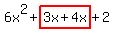
Now let's factor  by grouping: by grouping:
 Group like terms Group like terms
 Factor out the GCF of Factor out the GCF of  out of the first group. Factor out the GCF of out of the second group out of the first group. Factor out the GCF of out of the second group
 Since we have a common term of Since we have a common term of  , we can combine like terms , we can combine like terms
So factors to
So this also means that factors to (since is equivalent to )
-------------------------------
Answer:
So factors to
|
|
|
