Tutors Answer Your Questions about Radicals (FREE)
Question 972558: how do you simplify radical 8x squared
Answer by ikleyn(53937)   (Show Source): (Show Source):
You can put this solution on YOUR website! .
how do you simplify radical 8x squared
~~~~~~~~~~~~~~~~~~~~~~~~
@lwsshak3 gives the answer in his post  . .
This answer is incorrect, and I will explain it below.
In expression  , value of x can be positive or negative (or zero). , value of x can be positive or negative (or zero).
Expression makes sense and is defined for both positive and/or negative values of x.
Also, according to the common agreement, square root of a number is understood in a middle school as a positive value.
THEREFORE, the correct answer to the problem's question is  . .
It works universally for positive and negative values of 'x',
while expression gives a negative value for negative 'x', which contradicts to the common agreement.
This question/problem is a standard  , and almost all , and almost all
unfortunate newcomers, who are not familiar with this explanation, fall into this trap.
The percentage of these unfortunate newcomers is about 99.999%, I think, or even more than that.
Question 163137: Hi, this is the problem I was told to do:
[SQRT(2x + 2)] - [SQRT(x - 3)] = 2
or
√(2x+2) - √(x-3) = 2
I've been told to FOIL this problem, but I don't understand how to FOIL it if its subtracting and not multiplying. What I do know is that the answer is equal to 7.
Thanks in advance.
Answer by MathTherapy(10858)  (Show Source): (Show Source):
Question 720317: Here is my problem.
[SQRT(x + 7)] - 2[SQRT(x)] =-2
OR
√(x + 7) - 2√(x) = -2
-------
Now, the steps I took to solve this problem are to first square both sides:
[√(x + 7) - 2√(x)] * [√(x + 7) - 2√(x)] = 4
so then I FOIL the left side, resulting in:
(x+7) - [√(x + 7) * - 2√(x)] - [ - 2√(x) * √(x + 7)] + 4x
So then I thought to subtract (x+7) and (4x) to both sides
- [√(x + 7) * - 2√(x)] - [ - 2√(x) * √(x + 7)] = 4 - 4x - x - 7 (I think I'm supposed to switch the sign, because I've subtracted it and moved it to the opposite side, right?)
I think I'm correct up to this point, but now I have to square both sides again.
I think this left hand side could be re-written as:
-2[√(x + 7) * - 2√(x)]
Is this right? I'm subtracting it from itself, a negative, which could simply multiplied by -2. Anyway, now I need to square this again, so I assume the -2 becomes a 4 and I FOIL them separately?
FOILING the left side will get:
[√(x + 7) * - 2√(x)] * [√(x + 7) * - 2√(x)]
Which, when FOILed, looks like
(x+7) - [√(x+7) * -2√(x)] - [ - 2√(x) * √(x + 7)] + 4x
It looks exactly the same as before!! I'm just really confused by this problem, and I have a couple more like it, so I want to know if figuring this one out could help me solve the other ones.
I'm confused about FOILing the different sides, whether or not I can combine two square roots, and quite frankly, a lot of other things.
One of the options on the test is 9, and I think this is the answer, because I've inserted it into the original equation and it works, but I'm just confused about how to actually get 9 out of this..
Sorry for the long question. I hope it's not hard to understand. I'm just hoping someone can walk me through all the steps of solving a problem like this so I can do it easily in the future.
Found 2 solutions by greenestamps, MathTherapy:
Answer by greenestamps(13367)  (Show Source): (Show Source):
Answer by MathTherapy(10858) (Show Source):
You can put this solution on YOUR website!
Here is my problem.
[SQRT(x + 7)] - 2[SQRT(x)] =-2 OR √(x + 7) - 2√(x) = -2
-------
Now, the steps I took to solve this problem are to first square both sides:
[√(x + 7) - 2√(x)] * [√(x + 7) - 2√(x)] = 4
so then I FOIL the left side, resulting in:
(x+7) - [√(x + 7) * - 2√(x)] - [ - 2√(x) * √(x + 7)] + 4x
So then I thought to subtract (x+7) and (4x) to both sides
- [√(x + 7) * - 2√(x)] - [ - 2√(x) * √(x + 7)] = 4 - 4x - x - 7 (I think I'm supposed to switch the sign, because I've
subtracted it and moved it to the opposite side, right?)
I think I'm correct up to this point, but now I have to square both sides again.
I think this left hand side could be re-written as:
-2[√(x + 7) * - 2√(x)]
Is this right? I'm subtracting it from itself, a negative, which could simply multiplied by -2. Anyway, now I need to
square this again, so I assume the -2 becomes a 4 and I FOIL them separately?
FOILING the left side will get:
[√(x + 7) * - 2√(x)] * [√(x + 7) * - 2√(x)]
Which, when FOILed, looks like
(x+7) - [√(x+7) * -2√(x)] - [ - 2√(x) * √(x + 7)] + 4x
It looks exactly the same as before!! I'm just really confused by this problem, and I have a couple more like it, so I
want to know if figuring this one out could help me solve the other ones.
I'm confused about FOILing the different sides, whether or not I can combine two square roots, and quite frankly, a lot
of other things.
One of the options on the test is 9, and I think this is the answer, because I've inserted it into the original
equation and it works, but I'm just confused about how to actually get 9 out of this..
Sorry for the long question. I hope it's not hard to understand. I'm just hoping someone can walk me through all
the steps of solving a problem like this so I can do it easily in the future.
*******************************
Here is my problem.
[SQRT(x + 7)] - 2[SQRT(x)] =-2 OR √(x + 7) - 2√(x) = -2
-------
Now, the steps I took to solve this problem are to first square both sides:
[√(x + 7) - 2√(x)] * [√(x + 7) - 2√(x)] = 4
so then I FOIL the left side, resulting in:
(x+7) - [√(x + 7) * - 2√(x)] - [ - 2√(x) * √(x + 7)] + 4x <=== This is where you went WRONG! When FOILed, this's
actually:  , which results in: , which results in:
 . See? . See?

 So then I thought to subtract (x+7) and (4x) to both sides So then I thought to subtract (x+7) and (4x) to both sides
 - [√(x + 7) * - 2√(x)] - [ - 2√(x) * √(x + 7)] = 4 - 4x - x - 7
(I think I'm supposed to switch the sign, because I've
subtracted it and moved it to the opposite side, right?) - [√(x + 7) * - 2√(x)] - [ - 2√(x) * √(x + 7)] = 4 - 4x - x - 7
(I think I'm supposed to switch the sign, because I've
subtracted it and moved it to the opposite side, right?)
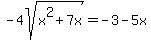 <=== This is exactly how you need to proceed! <=== This is exactly how you need to proceed!
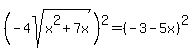 ---- Squaring both sides ---- Squaring both sides



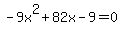 OR OR 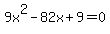
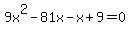 9x(x - 9) - 1(x - 9) = 0
(x - 9)(9x - 1) = 0
x - 9 = 0 OR 9x - 1 = 0
x = 0 + 9 OR 9x = 1
x = 9 OR x =
9x(x - 9) - 1(x - 9) = 0
(x - 9)(9x - 1) = 0
x - 9 = 0 OR 9x - 1 = 0
x = 0 + 9 OR 9x = 1
x = 9 OR x =  (IGNORE)
proves to be EXTRANEOUS, so sole solution is: x = 9
To some though, it's easier to solve, if one of the left-side RADICALS is MOVED to the right, 1st. But then, this's subjective.
It looks exactly the same as before!! I'm just really confused by this problem, and I have a couple more like it, so I want
to know if figuring this one out could help me solve the other ones. Hopefully, the above will clear up SOME/ALL confusion!
I'm confused about FOILing the different sides, whether or not I can combine two square roots, and quite frankly, a lot of
other things. Hopefully, the above will clear up SOME/ALL confusion!
One of the options on the test is 9, and I think this is the answer, because I've inserted it into the original equation
and it works, but I'm just confused about how to actually get 9 out of this. Yes, the solution is indeed 9, as seen above!
Sorry for the long question. I hope it's not hard to understand. I'm just hoping someone can walk me through all the steps
of solving a problem like this so I can do it easily in the future. Hopefully, this author has assisted you in understanding this
problem, so you can understand and obtain SOLUTIONS to similar problems, more easily, more efficiently, and without confusion! (IGNORE)
proves to be EXTRANEOUS, so sole solution is: x = 9
To some though, it's easier to solve, if one of the left-side RADICALS is MOVED to the right, 1st. But then, this's subjective.
It looks exactly the same as before!! I'm just really confused by this problem, and I have a couple more like it, so I want
to know if figuring this one out could help me solve the other ones. Hopefully, the above will clear up SOME/ALL confusion!
I'm confused about FOILing the different sides, whether or not I can combine two square roots, and quite frankly, a lot of
other things. Hopefully, the above will clear up SOME/ALL confusion!
One of the options on the test is 9, and I think this is the answer, because I've inserted it into the original equation
and it works, but I'm just confused about how to actually get 9 out of this. Yes, the solution is indeed 9, as seen above!
Sorry for the long question. I hope it's not hard to understand. I'm just hoping someone can walk me through all the steps
of solving a problem like this so I can do it easily in the future. Hopefully, this author has assisted you in understanding this
problem, so you can understand and obtain SOLUTIONS to similar problems, more easily, more efficiently, and without confusion!
Question 48636: Please help. These problems look so easy but I just can't seem to get the right answer.
First Problem:
1/√3 + 4/√27 - 2/√12
Second Problem:
2 cubed root of 27x + 2 cubed root 64x
I came up with 2 answers:
14 cubed root of x -OR- 2 cubed root of 91x
Which one is correct??
Answer by ikleyn(53937) (Show Source):
You can put this solution on YOUR website! .
Please help. These problems look so easy but I just can't seem to get the right answer.
First Problem:
1/√3 + 4/√27 - 2/√12
Second Problem:
2 cubed root of 27x + 2 cubed root 64x
I came up with 2 answers:
14 cubed root of x -OR- 2 cubed root of 91x
Which one is correct??
~~~~~~~~~~~~~~~~~~~~~~~~~~~~~~~
In the post by @consc198, first solution is irrelevant, while second solution is incorrect.
For right solutions, see what follows.
F i r s t p r o b l e m
It does not say what to do and what is required, but according to common sense,
they want you to simplify and to reduce to simple canonic final form.
 + +  - -  =
= + =
= +  - -  =
= =
=  = = = =  = =  . ANSWER
S e c o n d p r o b l e m . ANSWER
S e c o n d p r o b l e m
 + +  =
Notice that 27 = 3^3, while 64 = 4^3.
So, we continue the chain of equalities
= =
Notice that 27 = 3^3, while 64 = 4^3.
So, we continue the chain of equalities
=  = =  + +  = =  . the correct ANSWER . the correct ANSWER
Solved.
As this person, @consc198, solves simple standard Math problems, he deserves to be excluded
from everywhere of an educational community, because he is not able to teach in a right way.
Question 1095268: how much xsquare -y square ? if x+y=66 xy=9
Found 4 solutions by KMST, ikleyn, greenestamps, MathTherapy:
Answer by KMST(5396)  (Show Source): (Show Source):
You can put this solution on YOUR website! ONE WAY:
Maybe we know about solving quadratic equations.
Sometimes we can solve a quadratic equation such as  by factoring if we find two integers by factoring if we find two integers   such that such that  and and  . .
Then those values for and are the solutions of the equation and the equation is really
 . .
The solutions to a quadratic equation of the form are always two numbers whose sum and product can be found are  and and  respectively. respectively.
Unfortunately, sometimes those numbers are irrational, or even imaginary, and then factoring is not an option.
Then, w must use algebra to "complete the square" and then solve, or apply the dreaded quadratic formula
that says the solutions to an equation of the form  are given by are given by

To avoid confusion, I used  for the variable instead of for the variable instead of  , and I prefer equations where the leading coefficient is , and I prefer equations where the leading coefficient is  , so I wrote my equation as . , so I wrote my equation as .
I will make  and and  to get to get  . .
The solutions will be the numbers and (or and  ) that add up to ) that add up to  and whose product is and whose product is  . .
The quadratic formula tells me that the solution are given by

The solutions to the equation are  and and 
One is and the other is , but there is no way to guess which was intended to be and which was intended to be .
 and and  are are
 and and

The possible answers are
 and and 
ANOTHER APPROACH:
We know that  . If we only knew the value of . If we only knew the value of  we could easily find the value of we could easily find the value of 
We know that  , but to calculate , but to calculate  we would need the value of we would need the value of 
We know that  and we know the values of and we know the values of  and and 
Substituting the known values we get  --> -->  --> --> 
Now we can use that value of to calculate the values of and , and from that find the value of

Then 
Multiplying times 
Answer by ikleyn(53937) (Show Source):
Answer by greenestamps(13367) (Show Source):
Answer by MathTherapy(10858) (Show Source):
Question 316943: simplify: sqrt (121) / (9)
a) sqrt (11) / sqrt (3)
b) 3 sqrt (11)
c) 11/3
d) sqrt (11) / (3)
Answer by MathTherapy(10858) (Show Source):
Question 1030250: I need help simplifying this expression:

I removed the common factor out of the square root to obtain  , but the answer key says it is , but the answer key says it is  . .
How is it possible? Am I missing out on a rule here?
Found 2 solutions by greenestamps, MathTherapy:
Answer by greenestamps(13367) (Show Source):
Answer by MathTherapy(10858) (Show Source):
You can put this solution on YOUR website! I need help simplifying this expression:
I removed the common factor out of the square root to obtain , but the answer key says it is .
How is it possible? Am I missing out on a rule here?
*************************************
This happens to be one of those RARE cases when you can actually factor out a COMMON factor, which happens to be a
PERFECT SQUARE (in 4). This is what you did:
 = = 
 ----- Applying ----- Applying  = = 
 ....At this point, you haven't fully simplified the
expression, and should've continued as follows: ....At this point, you haven't fully simplified the
expression, and should've continued as follows:
 ---- Changing 6 to 5 + 1, and 5 to 5*1 ---- Changing 6 to 5 + 1, and 5 to 5*1
 ---- Applying = ---- Applying =
 --- Converting --- Converting  The above is in the form:
  , with , with  , and so:
then becomes: , and so:
then becomes: 
 ----- Cancelling SQUARE and SQUARE ROOT ----- Cancelling SQUARE and SQUARE ROOT
 = =  This certainly matches the answer key:
=====
On the other hand, this author would've SIMPLIFIED the SURD from the onset, as follows:
This certainly matches the answer key:
=====
On the other hand, this author would've SIMPLIFIED the SURD from the onset, as follows:
 ----- Replacing 8 with factors, 2 & 4 ----- Replacing 8 with factors, 2 & 4
 ----- Converting 4 to ----- Converting 4 to 
 ----- Applying = ----- Applying = 

 ---- Changing 24 to 20 + 4, and applying = ---- Changing 24 to 20 + 4, and applying =
 ---- Converting ---- Converting  The above is in the form: , with
  , and so:
then becomes: , and so:
then becomes: 
 ----- Cancelling SQUARE and SQUARE ROOT
This certainly matches the answer key: ----- Cancelling SQUARE and SQUARE ROOT
This certainly matches the answer key:
Question 973976: what is (4- square root of 8) divided by (2+ square root of 8) simplified
Answer by MathTherapy(10858) (Show Source):
Question 78896: please help me simplify this problem?
sqrt /sqrt /sqrt
Found 3 solutions by ikleyn, timofer, MathTherapy:
Answer by ikleyn(53937) (Show Source):
Answer by timofer(159) (Show Source): (Show Source):
Answer by MathTherapy(10858) (Show Source):
Question 669305: Please help me simplify this: sqrt(x^4y^7)
Answer by MathTherapy(10858) (Show Source):
Question 60849: solve for x by using the quadratic formula: 9x^2-6x+5=0
thanks so much
Answer by ikleyn(53937) (Show Source):
Question 60848: help on this please,,thanks
x+1= sqrt x+7
Answer by ikleyn(53937) (Show Source):
You can put this solution on YOUR website! .
help on this please,, thanks
x+1= sqrt(x+7)
~~~~~~~~~~~~~~~~~~~~~~~~
The solution in the post by @jai_kos is incorrect.
See my correct solution below.
x+1= sqrt(x+7)
Square on both sides, we get
(x+1)^2 = x +7
x^2 + 2x + 1 = x + 7
Reduce it to the standard form quadratic equation
x^2 + x - 6 = 0
Factor left side
(x+3)*(x-2) = 0
The roots of this equation are x = -3 and x = 2.
Direct check shows that x = 2 is the solution to the original equation, while x = -3 is an EXTRANEOUS solution.
ANSWER. The given equation has a unique solution in real numbers x = 2.
Solved correctly.
Question 681800: I'm trying to prove that

Answer by MathTherapy(10858) (Show Source):
Question 1107093: One pair of integers (x.y) solves  , find x*y. , find x*y.
Answer by MathTherapy(10858) (Show Source):
Question 1124474: How would you simplify the equation:
Sqrt(17-12sqrt2) in the form
(a+bsqrt2)
Thank you.
Answer by MathTherapy(10858) (Show Source):
Question 263259: solve: x^5/6 + x^2/3-2x^1/2 =0
thanks!
Answer by ikleyn(53937) (Show Source):
Question 1094302: Solving by substitution with u


creates quadratic = 


u = 2,-1
going back and using those two outputs in 
 and and 
 and and 
Finally, I get  and and 
But -2 can't be in a radical and would 4 turn into 2,-2 or just 2?
Answer by MathTherapy(10858) (Show Source):
You can put this solution on YOUR website!
Solving by substitution with u
creates quadratic =
u = 2,-1
going back and using those two outputs in
and
and
Finally, I get and
But -2 can't be in a radical and would 4 turn into 2,-2 or just 2?
******************************************************************
u = 2,-1 <=== This is okay!
"going back and using those two outputs in and <=== Here's where I guess
you got confused, and substituted 2 and - 1 for x in  But, u = 2, as you mentioned above, NOT x = 2. And, because you'd substituted u for
  earlier, at this juncture, you
need to BACK-SUBSTITUTE the value of u to get: earlier, at this juncture, you
need to BACK-SUBSTITUTE the value of u to get:

 ---- Squaring both sides ---- Squaring both sides

 (x - 4)(x + 1) = 0
x - 4 = 0 OR x + 1 = 0
x = 4 OR x = - 1
Now, you have 2 values for x that you can CHECK to ensure that they're VALID and NOT EXTRANEOUS.
Also, u = - 1, as you mentioned above. And, because you'd substituted u for earlier, at this juncture, you need
to BACK-SUBSTITUTE the value of u to get:
(x - 4)(x + 1) = 0
x - 4 = 0 OR x + 1 = 0
x = 4 OR x = - 1
Now, you have 2 values for x that you can CHECK to ensure that they're VALID and NOT EXTRANEOUS.
Also, u = - 1, as you mentioned above. And, because you'd substituted u for earlier, at this juncture, you need
to BACK-SUBSTITUTE the value of u to get:  Seeing that the square root of ANY expression is positive (> 0), it's obvious that u = - 1 is an EXTRANEOUS value. As such,
x = 4, or x = - 1 (see above).
Seeing that the square root of ANY expression is positive (> 0), it's obvious that u = - 1 is an EXTRANEOUS value. As such,
x = 4, or x = - 1 (see above).
Question 569284: solve the following radical: 
Answer by MathTherapy(10858) (Show Source):
You can put this solution on YOUR website!
solve the following radical:
**********************************************<

Just like "Rational-functions/875226", - 12 is NOT a solution. It's an
EXTRANEOUS root. Only VALID and ACCEPTABLE answer: 
Question 864099: Can you show me how to Rationalize the denominator and simply the equation
6 / the square root of 2 - the square root of 3.
Answer by MathTherapy(10858) (Show Source):
Question 864097: Can you show me how to Rationalize the denominator and simply the equation the square root of 6 / the square root of 5 - the square root of 3.
Answer by MathTherapy(10858) (Show Source):
Question 707329: How would you solve this equation?

Answer by MathTherapy(10858) (Show Source):
Question 144143: Hello. Please help me solve this problem: I need to find the simplest radical form and the approximate answer of  . .


x = 0.8944
Answer by MathTherapy(10858) (Show Source):
You can put this solution on YOUR website!
Hello. Please help me solve this problem:
I need to find the simplest radical form and the approximate answer of .
x = 0.8944
*****************

 ---- Multiplying by LCD, 2x ---- Multiplying by LCD, 2x


 ----- Squaring each side ----- Squaring each side


 However, the negative x-value,
  is EXTRANEOUS, therefore leaving the sole VALID x-value, is EXTRANEOUS, therefore leaving the sole VALID x-value,  .
Great job!! You got up to this point: , but needed to go a little further, by RATIONALIZING the
DENOMINATOR, as demonstrated above. Your decimal approximation, x = 0.8944, is also CORRECT.
I don't know why you sought help. You didn't need it!
Again, great job!! .
Great job!! You got up to this point: , but needed to go a little further, by RATIONALIZING the
DENOMINATOR, as demonstrated above. Your decimal approximation, x = 0.8944, is also CORRECT.
I don't know why you sought help. You didn't need it!
Again, great job!!
Question 798582: Simplify if necessary. Then rationalize the denominator.

Answer by MathTherapy(10858) (Show Source):
Question 459722: Simplify each expression by rationalizing the denominator.
3/sqrt(7)
2sqrt(2)/sqrt(5)
3sqrt(2)/sqrt(6)
2sqrt(5)/sqrt(12)
Answer by MathTherapy(10858) (Show Source):
Question 904562: 
Answer by MathTherapy(10858) (Show Source):
Question 296793: Please help me solve this equation

Answer by MathTherapy(10858) (Show Source):
Question 37745: Hi, I'm having trouble with this problem. Do you think you could help me?

Answer by MathTherapy(10858) (Show Source):
Question 729072: square root of x+7=square root of 2x-3 (+2) not under the square root)
Answer by MathTherapy(10858) (Show Source):
Question 519668: how do you solve the following:
 + +  = = 
Answer by MathTherapy(10858) (Show Source):
Question 701399: simplify 
Answer by MathTherapy(10858) (Show Source):
Question 993742: Hello. I am having an issue solving this problem and I look to you for help. My problem is:
 - - + + . By using prime factorization, I know that 12 = 2^2*3 . By using prime factorization, I know that 12 = 2^2*3
50 = 5^2*2
72 = 3^2*2^3
Now, I plug these terms back in and I get:
 - - + + If I continue, I get: If I continue, I get:
 - - + +
The answer key shows that the answer should be
 - Can you see where I went wrong? I'm not coming up with the right answer. - Can you see where I went wrong? I'm not coming up with the right answer.
Answer by MathTherapy(10858) (Show Source):
Question 1179144: For what values of c will x² +28x + c = 0 have no real solutions? Explain
Answer by ikleyn(53937) (Show Source):
You can put this solution on YOUR website! .
For what values of c will x^2 +28x + c = 0 have no real solutions? Explain
~~~~~~~~~~~~~~~~~~~~~~~~~~~~~~~~
The given quadratic equation has no real solutions if and only if its discriminant is a negative value.


The discriminant is  d = 28^2 - 4c = 784 - 4c.


The condition of negativity the discriminant is

    784 - 4c < 0,   or   4c > 784,   c > 784/4 = 196.


ANSWER.  The given equation has no real solutions at c > 196.
Solved.
Question 787079: Simplify the expression. Assume that all variables are positive
√x/5*√x/20
Answer by MathTherapy(10858) (Show Source):
Question 99475: Perform the indicated division. Rationalize the denominator if necessary. Then simplify each radical expression
-9-sqrt(108) dived by 3
Answer by MathTherapy(10858) (Show Source):
Question 293344: how would you solve this proof?

Answer by MathTherapy(10858) (Show Source):
Question 485164: Write the following expression as a radical and simplify if possible.
(-64)^4/3
Answer by MathTherapy(10858) (Show Source):
Question 732218: how do you do √50x√18?
Found 2 solutions by MathTherapy, ikleyn:
Answer by MathTherapy(10858) (Show Source):
Answer by ikleyn(53937) (Show Source):
|
Older solutions: 1..45, 46..90, 91..135, 136..180, 181..225, 226..270, 271..315, 316..360, 361..405, 406..450, 451..495, 496..540, 541..585, 586..630, 631..675, 676..720, 721..765, 766..810, 811..855, 856..900, 901..945, 946..990, 991..1035, 1036..1080, 1081..1125, 1126..1170, 1171..1215, 1216..1260, 1261..1305, 1306..1350, 1351..1395, 1396..1440, 1441..1485, 1486..1530, 1531..1575, 1576..1620, 1621..1665, 1666..1710, 1711..1755, 1756..1800, 1801..1845, 1846..1890, 1891..1935, 1936..1980, 1981..2025, 2026..2070, 2071..2115, 2116..2160, 2161..2205, 2206..2250, 2251..2295, 2296..2340, 2341..2385, 2386..2430, 2431..2475, 2476..2520, 2521..2565, 2566..2610, 2611..2655, 2656..2700, 2701..2745, 2746..2790, 2791..2835, 2836..2880, 2881..2925, 2926..2970, 2971..3015, 3016..3060, 3061..3105, 3106..3150, 3151..3195, 3196..3240, 3241..3285, 3286..3330, 3331..3375, 3376..3420, 3421..3465, 3466..3510, 3511..3555, 3556..3600, 3601..3645, 3646..3690, 3691..3735, 3736..3780, 3781..3825, 3826..3870, 3871..3915, 3916..3960, 3961..4005, 4006..4050, 4051..4095, 4096..4140, 4141..4185, 4186..4230, 4231..4275, 4276..4320, 4321..4365, 4366..4410, 4411..4455, 4456..4500, 4501..4545, 4546..4590, 4591..4635, 4636..4680, 4681..4725, 4726..4770, 4771..4815, 4816..4860, 4861..4905, 4906..4950, 4951..4995, 4996..5040, 5041..5085, 5086..5130, 5131..5175, 5176..5220, 5221..5265, 5266..5310, 5311..5355, 5356..5400, 5401..5445, 5446..5490, 5491..5535, 5536..5580, 5581..5625, 5626..5670, 5671..5715, 5716..5760, 5761..5805, 5806..5850, 5851..5895, 5896..5940, 5941..5985, 5986..6030, 6031..6075, 6076..6120, 6121..6165, 6166..6210, 6211..6255, 6256..6300, 6301..6345, 6346..6390, 6391..6435, 6436..6480, 6481..6525, 6526..6570, 6571..6615, 6616..6660, 6661..6705, 6706..6750, 6751..6795, 6796..6840, 6841..6885, 6886..6930, 6931..6975, 6976..7020, 7021..7065, 7066..7110, 7111..7155, 7156..7200, 7201..7245, 7246..7290, 7291..7335, 7336..7380, 7381..7425, 7426..7470, 7471..7515, 7516..7560, 7561..7605, 7606..7650, 7651..7695, 7696..7740, 7741..7785, 7786..7830, 7831..7875, 7876..7920, 7921..7965, 7966..8010, 8011..8055, 8056..8100, 8101..8145, 8146..8190, 8191..8235, 8236..8280, 8281..8325, 8326..8370, 8371..8415, 8416..8460, 8461..8505, 8506..8550, 8551..8595, 8596..8640, 8641..8685, 8686..8730, 8731..8775, 8776..8820, 8821..8865, 8866..8910, 8911..8955, 8956..9000, 9001..9045, 9046..9090, 9091..9135, 9136..9180, 9181..9225, 9226..9270, 9271..9315, 9316..9360, 9361..9405, 9406..9450, 9451..9495, 9496..9540, 9541..9585, 9586..9630, 9631..9675, 9676..9720, 9721..9765, 9766..9810, 9811..9855, 9856..9900, 9901..9945, 9946..9990, 9991..10035, 10036..10080, 10081..10125, 10126..10170, 10171..10215, 10216..10260, 10261..10305, 10306..10350, 10351..10395, 10396..10440, 10441..10485, 10486..10530, 10531..10575, 10576..10620, 10621..10665, 10666..10710, 10711..10755, 10756..10800
|
