Tutors Answer Your Questions about Problems-with-consecutive-odd-even-integers (FREE)
Question 945054: the sum of three consecutive numbers is 56. the second is five less than the first and the third is 15 more than the smallest. find the three numbers.
Found 4 solutions by MathTherapy, greenestamps, josgarithmetic, ikleyn:
Answer by MathTherapy(10858)   (Show Source): (Show Source):
You can put this solution on YOUR website!
the sum of three consecutive numbers is 56. the second is five less than the first and the third is 15 more than the
smallest. find the three numbers.
*********************************
In all of the years spent studying mathematics, this author has NEVER heard of 3 consecutive numbers, in which the middle number
is 5 greater than the smallest number, and the largest number, is 15 greater than the middle number. How CRAZY is this!!
This author KNOWS, as most do, that CONSECUTIVE NUMBERS are in a SEQUENCE or PATTERN where each number in the sequence
is SEPARATED by the SAME NUMBER. In other words, the difference between each number in a CONSECUTIVE sequence, is EXACTLY
the SAME, 1. Or, ALL numbers are EQUALLY-SPACED, as in: 1,2,3,4,5, etc. or 16,17,18,19, etc. For consecutive ODD/EVEN numbers,
each number increases by 2, or each number in such SEQUENCE differs by 2. Nonetheless, each is EVENLY-SPACED.
How/Why then, can/does a person state that 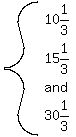 are consecutive? Isn't this a CLEAR indication that something is wrong with
the problem, if these are the numbers, when solved? RIDICULOUS!! are consecutive? Isn't this a CLEAR indication that something is wrong with
the problem, if these are the numbers, when solved? RIDICULOUS!!
Answer by greenestamps(13367)  (Show Source): (Show Source):
You can put this solution on YOUR website!
The description of the relationships between the three numbers clearly indicates that the three numbers are NOT consecutive numbers. So we need to ignore the statement that says the numbers are consecutive.
In the solution by @josgarithmetic, the given information is not reflected correctly in the setup, so the solution is not right.
The second number is 5 less than the first, and the third number is 15 more than the smallest. So the smallest number is the second number:
x = second (smallest) number
x+5 = first number
x+15 = third number
The sum of the three numbers is 56:
(x)+(x+5)+(x+15) = 56
3x+20 = 56
3x = 36
x = 12
The three (not consecutive) numbers are x=12; x+5=17, and x+15=27.
ANSWERS: 12, 17, and 27
Answer by josgarithmetic(39838) (Show Source):
Answer by ikleyn(53937)  (Show Source): (Show Source):
You can put this solution on YOUR website! .
the sum of three consecutive numbers is 56. the second is five less than
the first and the third is 15 more than the smallest. find the three numbers.
~~~~~~~~~~~~~~~~~~~~~~~~~~~~
This problem's formulation is SELF-CONTRADICTORY.
Its first statement contradicts to the next statement.
The person who created this defective problem, is not familiar with the basic Math conceptions and terminology.
Question 969390: find out the three nos such that the product of the first and second is 24 second and the third is 48 and that of the first and and third is 32
Answer by ikleyn(53937) (Show Source):
You can put this solution on YOUR website! .
find out the three nos such that the product of the first and second is 24 second and the third is 48
and that of the first and and third is 32
~~~~~~~~~~~~~~~~~~~~~~~~~~~
I am looking at the solution by @lwsshar3, and I see that the other possible solution
(x,y,z) = (-4,-6,-8) is missed.
So, his solution is not as accurate as a Math solution should be.
It is also long, boring and non-interesting: there is a lot of unnecessary calculations.
There is more short, more effective, more impressive and more instructive solution.
Let x be the 1st number, let y be the 2nd number, and let z be the 3rd number..
From the problem's formulation, we have these equations
xy = 24, (1)
yz = 48, (2)
xz = 32. (3)
Multiply these equations. You will get
 = 24*48*32 = = 24*48*32 =  ,
or ,
or
 = =  .
Hence, x*y*z = .
Hence, x*y*z =  = +/- = +/-  = +/- 64*3,
or x*y*z = +/- 192.
Now consider two cases.
(a) xyz = 192. (4)
To get x, divide equation (4) by equation (2). You will get x = 192/48 = 4.
To get y, divide equation (4) by equation (3). You will get y = 192/32 = 6.
To get z, divide equation (4) by equation (1). You will get z = 192/24 = 8.
So, in case (a), the solution is (x,y,z) = (4,6,8).
(b) xyz = -192. (5)
To get x, divide equation (5) by equation (2). You will get x = -192/48 = -4.
To get y, divide equation (5) by equation (3). You will get y = -192/32 = -6.
To get z, divide equation (5) by equation (1). You will get z = -192/24 = -8.
So, in case (b), the solution is (x,y,z) = (-4,-6,-8).
Thus, the problem has two solutions.
One solution is (x,y,z) = (4,6,8). Another solution is (x,y,z,) = (-4,-6, -8). = +/- 64*3,
or x*y*z = +/- 192.
Now consider two cases.
(a) xyz = 192. (4)
To get x, divide equation (4) by equation (2). You will get x = 192/48 = 4.
To get y, divide equation (4) by equation (3). You will get y = 192/32 = 6.
To get z, divide equation (4) by equation (1). You will get z = 192/24 = 8.
So, in case (a), the solution is (x,y,z) = (4,6,8).
(b) xyz = -192. (5)
To get x, divide equation (5) by equation (2). You will get x = -192/48 = -4.
To get y, divide equation (5) by equation (3). You will get y = -192/32 = -6.
To get z, divide equation (5) by equation (1). You will get z = -192/24 = -8.
So, in case (b), the solution is (x,y,z) = (-4,-6,-8).
Thus, the problem has two solutions.
One solution is (x,y,z) = (4,6,8). Another solution is (x,y,z,) = (-4,-6, -8).
Solved correctly and completely.
This method of solution is a standard and is the expected to this given problem.
Question 288985: A uniform-width boardwalk is built around the inside edge of a rectangular parkland that is 10m by 15m. If the boardwalk takes 20% of the lot, how wide is the boardwalk to the nearest centimetre?
Found 2 solutions by n2, ikleyn:
Answer by n2(91) (Show Source): (Show Source):
Answer by ikleyn(53937) (Show Source):
You can put this solution on YOUR website! .
A uniform-width boardwalk is built around the inside edge of a rectangular parkland that is 10m by 15m.
If the boardwalk takes 20% of the lot, how wide is the boardwalk to the nearest centimetre?
~~~~~~~~~~~~~~~~~~~~~~~
In his post, @mananth produces the answer for the wide of the boardwalk: 13.07, or 13 meters.
To me, it means only one thing: he even did not read his solution and did not compare
his answer with the problem. To me, there is nothing unexpected in it: by observing his numerous solutions,
I just learned it long time ago and firmly: this person never reads his own solutions.
It is simply non-interesting to him.
Below is my correct solution to this problem.
Let x be the uniform wide of the boardwalk, in meters.
The area inside the boardwalk is 0.8*10*15 = 120 square meters.
Therefore, our equation for this area is
(10-2x)*(15-2x) = 120.
Simplify and reduce it to the standard form quadratic equation
150 - 50x + 4x^2 = 120,
4x^2 - 50x + 30 = 0,
2x^2 - 25x + 15 = 0.
 = =  .
One root .
One root  is about 11.86 meters, and it is too big to be a solution
to the problem, so we reject it.
The other root is about 11.86 meters, and it is too big to be a solution
to the problem, so we reject it.
The other root  is about 0.63 meters, and it makes sense as a solution
to the problem, so we accept it.
ANSWER. The width of the boardwalk is about 63 centimeters. is about 0.63 meters, and it makes sense as a solution
to the problem, so we accept it.
ANSWER. The width of the boardwalk is about 63 centimeters.
Solved correctly to teach you in a right way.
Question 275504: if you take a certain two-digit number and reverse its digits to get another two-digit number, then add these two numbers together, their sum is 132. what is the original number?
Found 4 solutions by greenestamps, josgarithmetic, n2, ikleyn:
Answer by greenestamps(13367) (Show Source):
You can put this solution on YOUR website!
While a formal algebraic solution was probably wanted, note that you can also work this problem using logical reasoning and the basic process of adding two 2-digit numbers. In "coded" form, you have this addition, where A and B are the two digits of the original number and S is the sum of those two digits (S is not a digit, because the sum of the two 2-digit numbers is 3 digits):
   A B
 + B A
 ------
   S S
Now that sum has the sum "S" in the 10s column and also in the units column, so the value of that sum is 10S + 1S = 11S.
But the sum is 132, so 11S = 132, so S = 132/11 = 12.
So we know that the sum of the two digits A and B is 12.
However, we have no other information to use to find a unique solution to the problem. So the original number can be any 2-digit number in which the sum of the two digits is 12: 39, 48, 57, 66, 75, 84, or 93. Notice that the statement of the problem did not require the two digits of the original number to be different, so 66 is one of the possible answers.
ANSWERS: any of the numbers 39, 48, 57, 66, 75, 84, or 93
Answer by josgarithmetic(39838) (Show Source):
Answer by n2(91) (Show Source):
You can put this solution on YOUR website! .
if you take a certain two-digit number and reverse its digits to get another two-digit number,
then add these two numbers together, their sum is 132. what is the original number?
~~~~~~~~~~~~~~~~~~~~~~~~~~~~~~
Let the digit in the units place be y
& in the tens place be x
So the number will be 10x+y
On reversing the digits
the number becomes 10y+x
The sum of the two = 132
10x+y + 10y+x= 132
11x+11y=132
x+y=12
From this equation, SEVEN different two-digit integer numbers are possible
93, 84, 75, 66, 57, 48, 39.
All the SEVEN numbers when reversed and added give you 132.
Answer by ikleyn(53937) (Show Source):
You can put this solution on YOUR website! .
if you take a certain two-digit number and reverse its digits to get another two-digit number,
then add these two numbers together, their sum is 132. what is the original number?
~~~~~~~~~~~~~~~~~~~~~~~~~~~~~~
The solution in the post by @mananth is incomplete: some other possible answers are missed.
I came to provide a complete accurate solution.
Let the digit in the units place be y
& in the tens place be x
So the number will be 10x+y
On reversing the digits
the number becomes 10y+x
The sum of the two = 132
10x+y + 10y+x= 132
11x+11y=132
x+y=12
From this equation, SEVEN different two-digit integer numbers are possible
93, 84, 75, 66, 57, 48, 39.
All the SEVEN numbers when reversed and added give you 132.
Solved completely and correctly.
Question 265347: The square of the first of three consecutive odd integers is 9 more than 6 times the sum of the second and the first. Find the numbers.
Found 3 solutions by timofer, josgarithmetic, ikleyn:
Answer by timofer(159) (Show Source): (Show Source):
Answer by josgarithmetic(39838) (Show Source):
Answer by ikleyn(53937) (Show Source):
You can put this solution on YOUR website! .
The square of the first of three consecutive odd integers is 9 more than 6 times the sum of the second and the first.
Find the numbers.
~~~~~~~~~~~~~~~~~~~~~~~~~~~
The solution in the post by @mananth is incorrect. His answer is incorrect, as well.
See below my correct solution.
Let the three consecutive odd integer numbers be x, (x+2) and (x+4).


The equation is

    x^2 = 6(x + (x+2)) + 9,


Write it in standard form quadratic equation

    x^2 - 12x - 21 = 0.    (1)


Its discriminant is

    d = b^2 - 4ac = (-12)^2 -4*1*(-21) = 144 + 84 = 228.


The number 228 is not a perfect square.

It tells that equation (1) has no solutions in integer numbers.
The conclusion is that the given problem has no solutions and describes a situation which NEVER may happen.
In other words, the problem as it is given in the post is a FAKE.
Question 534852: The square of the first of three consecutive odd integers is 9 more than 6 times the sum of the second and third. Find the integers.
Answer by timofer(159) (Show Source):
Question 264377: The tens digits of a number is 2 less than the units digit. The sum of the digits is 12. Identify what the number is.
Found 2 solutions by josgarithmetic, ikleyn:
Answer by josgarithmetic(39838) (Show Source):
Answer by ikleyn(53937) (Show Source):
You can put this solution on YOUR website! .
The tens digits of a number is 2 less than the units digit. The sum of the digits is 12.
Identify what the number is.
~~~~~~~~~~~~~~~~~~~~~~~~~~~
The solution in the post by @mananth is incorrect due to an arithmetic error in his calculations.
I came to bring a correct solution.
let the unit digit be x
ten's digit will be x-2
x + (x-2) = 12
2x = 14
x = 7 (the units digit)
the tens digit = 7 - 2 = 5
The number is 57. ANSWER
Solved correctly.
Question 730038: Hello Tutor can you please help me with this question the product of 2 consecutive odd integers is equal to 30 more than the first.Find the integors
Answer by ikleyn(53937) (Show Source):
You can put this solution on YOUR website! .
the product of 2 consecutive odd integers is equal to 30 more than the first. Find the integers
~~~~~~~~~~~~~~~~~~~~~~~~~~~~
Let your lesser odd number be 'n'.
Then the other odd number is (n+2).


Your equation is

    n*(n+2) = n + 30.


Simplify

    n^2 + 2n = n + 30,

    n^2 + n - 30 = 0,

    (n+6)*(n-5) = 0.


The roots are -6 and 5.


You want the odd number - so, you select 5 and reject -6.


ANSWER.  The numbers are 5 and 7.
Solved.
--------------------
Ignore the answer by @lynnlo, since it is incorrect.
Question 1208747: Find two consecutive positive integers such that the square of the first
increased by 2 times the second is equal to 37.
Found 2 solutions by Edwin McCravy, ikleyn:
Answer by Edwin McCravy(20086)  (Show Source): (Show Source):
You can put this solution on YOUR website!
There are multiple ways to interpret the wording of this problem.  Ikleyn
picked a way that did have a solution in positive integers, the first way
below.  However, the others are also valid ways to interpret the problem,
although some of the others likely do not have positive integer solutions.
Algebra problem-creators should be more careful to avoid ambiguous sentences.

1. Find two consecutive positive integers such that
(the square of the first) increased by (2 times the second) is equal to 37.

2. Find two consecutive positive integers such that
[(the square of the first) increased by 2] times the second is equal to 37.

3. Find two consecutive positive integers such that
[the square of (the first increased by 2)] times the second is equal to 37.

4. Find two consecutive positive integers such that
the square of [(the first increased by 2) times the second] is equal to 37.

5. Find two consecutive positive integers such that
the square of [the first increased by (2 times the second)] is equal to 37.

6. Find two consecutive positive integers such that
[the square of (the first increased by 2) times the second] is equal to 37.

Edwin
Answer by ikleyn(53937) (Show Source):
You can put this solution on YOUR website! .
Find two consecutive positive integers such that the square of the first
increased by 2 times the second is equal to 37.
~~~~~~~~~~~~~~~~~~~~~
Let first (smaller) positive integer be n; then the next consecutive integer number is (n+1).


Write an equation according to the problem

    n^2 + 2*(n+1) = 37.


Simplify

    n^2 + 2n + 2 = 37,

    n^2 + 2n - 35 = 0


Factorize

    (n+7)*(n-5) = 0.


The roots are n= -7  and  n= 5.   We want the positive value.


ANSWER.  The numbers are 5 and 6.


CHECK.  5^2 + 2*6 = 25 + 12 = 37.    ! correct !
Solved.
/////////////////////////
Based on Edwin's note, someone can write a Master thesis or even a PhD dissertation in Math education :).
As an epigraph to such a Master thesis or PhD dissertation the person may write
that word problems in English often require a small auxiliary volume of explanations
of used terms and of what exactly means by the author, and what does not mean.
Question 1207267: 4. Two numbers differ by 9 and the sum of their reciprocals is 5/12. Find the numbers.
Answer by math_tutor2020(3838) (Show Source):
Question 634306: Given three consecutive odd numbers such that the square of the second number is 192 less than the square of the third. Find those numbers.
Answer by josgarithmetic(39838) (Show Source):
Question 1206045: A number is such that thrice the number is 14 what is then 5 times number find the number
Found 2 solutions by Edwin McCravy, ikleyn:
Answer by Edwin McCravy(20086) (Show Source):
You can put this solution on YOUR website!
If 3n = 14, what is 5n?

Do you want to know 5n or n or both?

Solve the equation and if you want n, you'll have it.

If you want 5n, multiply by 5.

Edwin
Answer by ikleyn(53937) (Show Source):
You can put this solution on YOUR website! .
A number is such that thrice the number is 14 what is then 5 times number find the number
~~~~~~~~~~~~~~~~~~~~~
Isn't it obvious ?
Question 1205039: A popular band wants to sell $9,099 worth of tickets on its upcoming tour. If each ticket costs $2, how many tickets will the band have to sell to meet its goal?
Answer by ikleyn(53937) (Show Source):
You can put this solution on YOUR website! .
Divide 9,099 dollars by 2;  then take the closest integer from the top for the number of tickets.


ANSWER.  ---> 4549.5 ---> 4550 tickets. ---> 4549.5 ---> 4550 tickets.
Solved.
The level of difficulty is as 5 divide by 2.
------------------------
Posting such tasks to the forum can only be done out of idleness.
Question 1205024: In a right angle triangle ABC side AC is 4cm shorter than the hypotenuse and side BC is also 4cm shorter than the hypotenuse. Find the dimensions of the triangle
Found 2 solutions by mananth, ikleyn:
Answer by mananth(16949)  (Show Source): (Show Source):
You can put this solution on YOUR website!
In a right angle triangle ABC side AC is 4cm shorter than the hypotenuse and side BC is also 4cm shorter than the hypotenuse. Find the dimensions of the triangle
Since it is a right angled triangle we apply pythagoras theorem
let hypotenuse be x
AC= x-4
BC = x-4
(x-4)^2+(x-4)^2= x^2
2(x-4)^2=x^2
2(x^2-8x+16)=x^2
2x^2-16x+32=x^2
subtract x^2 from both sides
x^2-16x+32=0
add 64 to both sides to solve by comp;eting the square metod
(x^2-16x+64)+32=64
(x-8)^2= 64-32
(x-8)^2= 32
take square root
x-8= +/- sqrt(32)
x= 8+/-sqrt(32) The hypotenuse
sides are 4 less than the hypotenuse
Answer by ikleyn(53937) (Show Source):
Question 1205018: There are three consecutive odd integers. The sum of quadruple the largest and twice the smallest is 46. What is the middle integer?
Answer by MathLover1(20855)  (Show Source): (Show Source):
Question 1204967: Tony found four consecutive even integers such that 5 times the sum of the first and third was 9604 greater than twice the sum of the second and the fourth. Find the numbers and express each in standard form.
Found 2 solutions by mananth, math_tutor2020:
Answer by mananth(16949) (Show Source):
You can put this solution on YOUR website! Tony found four consecutive even integers such that 5 times the sum of the first and third was 9604 greater than twice the sum of the second and the fourth. Find the numbers and express each in standard form.
n-3, n-1,n+1,n+3
5 times the sum of the first and third was 9604 greater than twice the sum of the second and the fourth.
5(n-3+n+1)= 2(n-1+n+3)+9604
5(2n-2)=2(2n+2)+9604
10n-10 = 4n+4+9604
6n = 9618
n= 1603
n-3= 1603-3= 1600
n-1= 1603-1= 1602
n+11603+1=1604
n+3= 1603+3- 1606
CHECK
5*(1600+1604)= 2(1602+1606)+9604 =16020
Answer by math_tutor2020(3838) (Show Source):
You can put this solution on YOUR website!
1st number = x = some even integer
2nd number = x+2 = the even integer just after x
3rd number = x+4 = the even integer just after x+2
4th number = x+6 = the even integer just after x+4
One possible equation to form is
5(x + x+4) = 2(x+2 + x+6) + 9604
Pay attention to the color coding to see where all the expressions fit in.
The left side is of the form 5*(1st + 3rd)
The right side is of the form 2*(2nd + 4th) + 9604
I'll let the student solve that equation for x.
Question 1204922: A positive integer is 5 less than another. If the reciprocal of the smaller
integer is subtracted from 3 times the reciprocal of the larger,
, then the
result is 1/12. Find the two integers
Found 2 solutions by Theo, josgarithmetic:
Answer by Theo(13342)  (Show Source): (Show Source):
You can put this solution on YOUR website! let x equal the larger number
let y equal the smaller number
your equation is 3/x - 1/y = 1/12
that equation states that 3 times the reciprocal of the larger number minus the reciprocal of the smaller number is equal to 1/12.
another way of saying that is that the reciprocal of the smaller number is subtracted from 3 time the reciprocal of the larger number.
you start with 3/x - 1/y = 1/12
multiply both sides of the equation by xy to get:
3y - x = xy/12
multiply both sides of the equation by 12 to get:
12 * (3y - x) = xy
simplify to get:
36y - 12x = xy
you are given that y = x-5, so replace y with x-5 in the equation to get:
36 * (x-5) - 12x = x * (x-5)
simplify to get:
36x - 180 - 12x = x^2 - 5x
combine like terms to get:
24x - 180 = x^2 - 5x
subtract 24x from both sides of the equation and add 180 to both sides of the equation to get:
0 = x^2 - 29x + 180
factor this quadratic equation to get:
(x - 20) * (x - 9) = 0
solve for x to get:
x = 20 or x = 9
when x = 20, y = 15
when x = 9, y = 4
your initial equation was 3/x - 1/y = 1/12
when x = 20 and y = 15, the equation becomes 3/20 - 1/15 = 1/12
multiply both sides of this equation by 300 to get 45 - 20 = 25
this results in 25 = 25, confirming the equation is true.
when x = 9 and y = 4, the equation becomes 3/9 - 1/4 = 1/12
multiply both sides of this equation by 36 to get 12 - 9 = 36/12
this results in 3 = 3, confirming the equation is true.
your value pairs of x = 20 and y = 15 or x = 9 and y = 4 both satisfy the requirements of the problem.
you actually have two answers.
the first answer is your integers are 20 and 15.
the second answer is your integers are 9 and 4.
Answer by josgarithmetic(39838) (Show Source):
Question 1204912: find five consecutive integers such that triple the third is equal to 44 more than half the fifth
Answer by josgarithmetic(39838) (Show Source):
You can put this solution on YOUR website! using n for the the number-three positioned integer,

If that makes sense then the rest is simple arithmetic.
16, 17, 18, 19, 20
Question 1204829: The sum of three consecutive integers is 48. Find the integers
Answer by mananth(16949) (Show Source):
You can put this solution on YOUR website!
The sum of three consecutive integers is 48. Find the integers
n, n+1, n+2 be the integers
n+n+1+n+2=48
3n+3=48
3n = 48-3
3n=45
n= 15
n+1=16
n+2=17
15,16,17 are the integers
Question 1204742: What is the equation for the following word problem?
The sum of 3 consecutive even integers is no more that 39. What are the two integers?
Found 4 solutions by josgarithmetic, ikleyn, Alan3354, ankor@dixie-net.com:
Answer by josgarithmetic(39838) (Show Source):
Answer by ikleyn(53937) (Show Source):
You can put this solution on YOUR website! .
There are at least TWO fatal errors in your post.
One error is when you are asking about "the two integers".
Article "the" is used when an item after "the" is just defined previously as a subject of discussion.
But in your post, the two numbers are not defined as a subject of discussion - only THREE numbers are defined, but not two of them.
Second error is that you ask about an equation.
Where is NO such equation, at all.
There is only an inequality relevant to this context.
So, it is not surprising that tutors can not answer your question as it is posed.
It is because everything is incorrect there.
The inequality you are asking about is
(n-2) + n + (n+2) <= 39,
or
3n <= 39,
where n is the middle of the three consecutive even integers.
After reading your post, it becomes clear, that this "problem" is created/composed/worded/printed
by a person, who does not know neither English nor Math.
///////////////////
There is third fatal error, too.
The number of solutions of this inequality is infinite.
In other words, the number of such triples of integer numbers is infinite.
Therefore, when you ask "what are the two numbers", the question becomes totally undefined.
.............................
Do not even try to create your own Math problems.
To do it properly, 15 year of intensive studying Math is required,
in the school and in the University, PLUS 5-10 years practicing after that.
Tens of textbooks on the subject should be read and thousands problems should be
solved before you become a Math problems composer and writer (if you are lucky).
Answer by Alan3354(69443)  (Show Source): (Show Source):
Answer by ankor@dixie-net.com(22740)  (Show Source): (Show Source):
Question 1204660: There are a total of 20 lions, tigers, and bears at the local zoo. The number of tigers is 2 more than the number of lions. The number of bears is 3 more than the number of lions. How many lions are at the zoo?
Found 4 solutions by math_tutor2020, josgarithmetic, ikleyn, mananth:
Answer by math_tutor2020(3838) (Show Source):
You can put this solution on YOUR website!
Let's make a guess that there are 6 lions because 20/3 = 6.67 approximately. I rounded down to the nearest whole number.
6 lions --> 6+2 = 8 tigers and 6+3 = 9 bears
6 lions + 8 tigers + 9 bears = 23 total animals
We have 3 too many animals. Let's take away 1 of each
6-1 = 5 lions
8-1 = 7 tigers
9-1 = 8 bears
Then,
5 lions + 7 tigers + 8 bears = 20 total animals
We have found the answer.
This method is probably not as efficient as the standard algebraic approach, but it's good to have multiple pathways to any math problem.
Answer by josgarithmetic(39838) (Show Source):
Answer by ikleyn(53937) (Show Source):
You can put this solution on YOUR website! .
Even if you are 2-nd grade student and do not know equations yet,
you can easy solve this problem using only your common sense and skills calculating whole numbers.
From 20 animals, take out 2 tigers and 3 bears, for a minute (mentally in your mind).
You will get 15 animals, lions, tigers and bears in equal amount.
What you will do next ? - But of course, you will distribute 15 animal in 3 equal groups.
In other words, you will divide 15 by 3 and will get 5 animals in each group.
After that, you will return back 2 tigers and 3 bears and will get the final answer this way.
----------------
Nice problem for 2-nd grade 7-years old/(young) students.
Answer by mananth(16949) (Show Source):
You can put this solution on YOUR website! There are a total of 20 lions, tigers, and bears at the local zoo.
The number of tigers is 2 more than the number of lions.
Let number of lions be x
Number of tigers will be x+2
The number of bears is 3 more than the number of lions.
The number of bears= x+3
Add them up. They equal 20
x+x+2+x+3=20
3x+5 =20
subtract 5 from both sides
3x+5-5= 20-5
3x=15
divide by 3
x=5
There are 5 lions at the zoo.
Question 1204547: The sum of the reciprocals of two consecutive even integers is 23/264
. Find the two integers.
Found 3 solutions by ikleyn, Alan3354, math_tutor2020:
Answer by ikleyn(53937) (Show Source):
Answer by Alan3354(69443) (Show Source):
You can put this solution on YOUR website! The sum of the reciprocals of two consecutive even integers is 23/264
. Find the two integers.
-------------
23/264 = 46/528
 --- close to 23 --- close to 23
---> 22 & 24
Answer by math_tutor2020(3838) (Show Source):
|
Older solutions: 1..45, 46..90, 91..135, 136..180, 181..225, 226..270, 271..315, 316..360, 361..405, 406..450, 451..495, 496..540, 541..585, 586..630, 631..675, 676..720, 721..765, 766..810, 811..855, 856..900, 901..945, 946..990, 991..1035, 1036..1080, 1081..1125, 1126..1170, 1171..1215, 1216..1260, 1261..1305, 1306..1350, 1351..1395, 1396..1440, 1441..1485, 1486..1530, 1531..1575, 1576..1620, 1621..1665, 1666..1710, 1711..1755, 1756..1800, 1801..1845, 1846..1890, 1891..1935, 1936..1980, 1981..2025, 2026..2070, 2071..2115, 2116..2160, 2161..2205, 2206..2250, 2251..2295, 2296..2340, 2341..2385, 2386..2430, 2431..2475, 2476..2520, 2521..2565, 2566..2610, 2611..2655, 2656..2700, 2701..2745, 2746..2790, 2791..2835, 2836..2880, 2881..2925, 2926..2970, 2971..3015, 3016..3060, 3061..3105, 3106..3150, 3151..3195, 3196..3240, 3241..3285, 3286..3330, 3331..3375, 3376..3420, 3421..3465, 3466..3510, 3511..3555, 3556..3600, 3601..3645, 3646..3690, 3691..3735, 3736..3780, 3781..3825, 3826..3870, 3871..3915, 3916..3960, 3961..4005, 4006..4050, 4051..4095, 4096..4140, 4141..4185, 4186..4230, 4231..4275, 4276..4320, 4321..4365, 4366..4410, 4411..4455, 4456..4500, 4501..4545, 4546..4590, 4591..4635, 4636..4680, 4681..4725, 4726..4770, 4771..4815, 4816..4860, 4861..4905, 4906..4950, 4951..4995, 4996..5040, 5041..5085, 5086..5130, 5131..5175, 5176..5220, 5221..5265, 5266..5310, 5311..5355, 5356..5400, 5401..5445, 5446..5490, 5491..5535, 5536..5580, 5581..5625, 5626..5670, 5671..5715, 5716..5760, 5761..5805, 5806..5850, 5851..5895, 5896..5940, 5941..5985, 5986..6030, 6031..6075, 6076..6120, 6121..6165, 6166..6210, 6211..6255, 6256..6300, 6301..6345, 6346..6390, 6391..6435, 6436..6480, 6481..6525, 6526..6570, 6571..6615, 6616..6660, 6661..6705, 6706..6750
|
