Question 153491: A random sample of 10 miniature Tootsie Rolls was taken from a bag. Each piece was weighed on a very accurate scale. The results in grams were
3.087 3.131 3.241 3.241 3.270 3.353 3.400 3.411 3.437 3.477
a). Construct a 90 percent confidence interval for the true mean weight. (b) What sample size would be necessary to estimate the true weight with an error of ± 0.03 grams with 90 percent confidence? (c) Discuss the factors which might cause variation in the weight of Tootsie Rolls during manufacture.
Answer by Fombitz(32388)   (Show Source): (Show Source):
You can put this solution on YOUR website! a)Since you don't know  and your sample size is <30, assume your samples are normally distributed. and your sample size is <30, assume your samples are normally distributed.
Use the t-distribution as the best estimate. Degrees of freedom are n-1 or 9.
.
.
.
The calculated mean, , is 3.3048. , is 3.3048.
The calculated standard deviation,  , is 0.132 , is 0.132
For  and and  , ,  . .
.
.
.
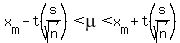
The confidence interval is


.
.
.
b) Working backwards,

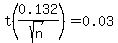

t is a function of n so you have to iterate to find n.
I set up an iteration cell in EXCEL using TINV and varying n.
n=54 gives 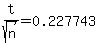
54 samples required to give 
For this large a value for n, we can use the normal distribution as a check of the value since as n gets large the t distribution approaches the normal distribution.
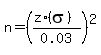
z=1.65 for 90%
Use the calculated 0.132 as an estimate for
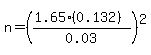

 or or 
Good, that's close.
.
.
.
c) Factors include length errors from cutting machine, air in the mixture, humidity in the plant, density changes in the mixture, etc.
|
|
|
