Tutors Answer Your Questions about Probability-and-statistics (FREE)
Question 1158866: Urn A contains 5 red marbles and 3 white marbles.
Urn B contains 1 red marble and 2 white marbles.
A fair die is tossed; if a 3 or 6 appears, a marble is drawn from B and put into A and then a marble is drawn from B.
a. what is the probability that both marbles are red?
b. what is the probability that both marbles are white?
Answer by KMST(5396)   (Show Source): (Show Source):
You can put this solution on YOUR website! I assume that if the number on the top of the die that was tossed is neither 3 nor 6, no marbles are drawn. Your turn is over. better luck next time.
Each of the 6 faces/numbers on a fair die has the same probability to appear on top :  . .
The probability of getting a 3 is and the probability of getting a 6 is for each draw, the probability of getting either a 3 or a 6 is  . .
A teacher might write that as  . .
Let's think of what happens in the  of the cases when the game gets to the point when marbles can be drawn. of the cases when the game gets to the point when marbles can be drawn.
Urn B starts with  marbles. marbles.
After transferring one marble from urn B to urn A,
urn A will have 9 marbles, either 6red and 3 while or 5red and 4 white,
depending on the color of the marble drawn from urn B
The entire play sequence can be diagrammed as follows

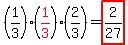
a. what is the probability that both marbles are red?
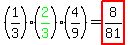
b. what is the probability that both marbles are white?
After the die shows a 3 or a 6, when drawing one of the 3 marbles from urn B, the probability of getting each one of them is ,
so the probability of drawing the only one that is red is .
A teacher could write that as 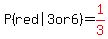 . .
However, drawing that red marble only happens in that happens in  of the of the plays when the die was a 3 or 6. of the of the plays when the die was a 3 or 6.
It happens in  of the plays. of the plays.
A teacher could write that as  = = . .
What happens if the marble drawn from urn B is not red, and what is the probability of that?
If the marble drawn from urn B is not red, it must be one of the 2 white marbles.
The probability of that happening after getting a 3 or 6 on the die is 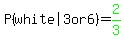 , ,
and that will happen in  of the of plays when the die showed a 3 or a 6. of the of plays when the die showed a 3 or a 6.
That happens in  of the plays. of the plays.
A teacher could write that as  = = . .
A teacher would say that red and white are "mutually exclusive" events, that it has to be one or the other, so if red happens of the times , white has to happen the other  out of the out of the  of the total of times. of the total of times.
What happens to urn A, after drawing a marble from urn B?
The game starts with  marbles in urn A. marbles in urn A.
After drawing a marble from urn B and putting it into urn A,
urn A will contain  marbles, marbles,
and the probability of drawing each of them is  . .
We know that if the die shows a 3 or a 6 and the marble drawn from urn B (and added to urn A) is red,  of the 9 marbles in urn A will be red and in that case, the probability of drawing one of them would be of the 9 marbles in urn A will be red and in that case, the probability of drawing one of them would be  . .
The total probability of getting two red marbles is the product of probabilities of the desired outcome for all 3 steps (the die toss, urn B draw, and urn A draw):
.
If the marble drawn from urn B (and added to urn A) is white,  of the 9 marbles in urn A will be red and the probability of drawing one of them would be of the 9 marbles in urn A will be red and the probability of drawing one of them would be 
In that case, you got 2 white marbles, and the probability of that is the product of the probabilities for each step
Question 1158362: 2.38 Baggage fees: An airline charges the following baggage fees: $25 for the first bag and $30 for the second. Suppose 53% of passengers have no checked luggage, 29% have only one piece of checked luggage and 18% have two pieces. We suppose a negligible portion of people check more than two bags.
a) The average baggage-related revenue per passenger is: $ (please round to the nearest cent)
b) The standard deviation of baggage-related revenue is: $ (please round to the nearest cent)
c) About how much revenue should the airline expect for a flight of 130 passengers? $ (please round to the nearest dollar)
Answer by KMST(5396) (Show Source):
You can put this solution on YOUR website! 53%+29%+18%=100%, so the portion of people who check more than two bags must have been indeed negligible.
The passenger who check two bags pay $25+$30=$55
a) The average baggage-related revenue per passenger (rounded to the nearest cent):
The fractions of people who check 0, 1, and 2 bags are 0.53, 0.29, and 0.18 respectively, and add to 1.00,
so the averaged revenue per passenger is the weighted average

b) The standard deviation of baggage-related revenue (per passenger, in $, rounded to the nearest cent):
The standard deviation (in $) of baggage-related revenue per passenger can be calculated from the individuals deviations (in $) from the average:
 for 53% of the passengers, for 53% of the passengers,
 for 29%, and for 29%, and
 for 18% of the passengers. for 18% of the passengers.
 (in $, rounded to the nearest cent) (in $, rounded to the nearest cent)
c) Revenue the airline should expect for a flight of 130 passengers (in $, rounded to the nearest dollar)
 (in $, rounded to whole dollars). (in $, rounded to whole dollars).
Question 1142196: If two cards are drawn without replacement from an ordinary deck, find the probability of a jack and a 3 being drawn.
The probability of a jack and a 3 being drawn is
Answer by ikleyn(53937)  (Show Source): (Show Source):
Question 1161858: Suppose that the probability that a passenger will miss a flight is 0.0957. Airlines do not like flights with empty seats, but it is also not desirable to have overbooked flights because passengers must be "bumped" from the flight. Suppose that an airplane has a seating capacity of 59 passengers.
(a) If 61 tickets are sold, what is the probability that 60 or 61 passengers show up for the flight resulting in an overbooked flight?
(b) Suppose that 65 tickets are sold. What is the probability that a passenger will have to be "bumped"?
(c) For a plane with seating capacity of
52 passengers, how many tickets may be sold to keep the probability of a passenger being "bumped" below 5%?
Answer by CPhill(2264)  (Show Source): (Show Source):
You can put this solution on YOUR website! ```python?code_reference&code_event_index=2
from scipy.stats import binom
# Constants
p_miss = 0.0957
p_show = 1 - p_miss
# (a) n=61, capacity=59, find P(k=60) + P(k=61)
n_a = 61
p_60 = binom.pmf(60, n_a, p_show)
p_61 = binom.pmf(61, n_a, p_show)
ans_a = p_60 + p_61
# (b) n=65, capacity=59, find P(k > 59)
n_b = 65
capacity_b = 59
ans_b = binom.sf(capacity_b, n_b, p_show) # sf is 1 - cdf, so P(X > 59)
# (c) capacity=52, find max n such that P(k > 52) < 0.05
capacity_c = 52
threshold = 0.05
best_n = 52
for n in range(53, 100):
prob_bumped = binom.sf(capacity_c, n, p_show)
if prob_bumped < threshold:
best_n = n
else:
break
print(f"Part (a): {ans_a=}")
print(f"Part (b): {ans_b=}")
print(f"Part (c): {best_n=}, {binom.sf(capacity_c, best_n, p_show)=}, {binom.sf(capacity_c, best_n+1, p_show)=}")
```
```text?code_stdout&code_event_index=2
Part (a): ans_a=0.016126517739814418
Part (b): ans_b=0.4014073805745022
Part (c): best_n=54, binom.sf(capacity_c, best_n, p_show)=0.029369939359098, binom.sf(capacity_c, best_n+1, p_show)=0.09276094534760537
```
To solve these problems, we use the **Binomial Distribution**.
* Let $n$ be the number of tickets sold.
* Let $p$ be the probability that a passenger shows up for the flight. Given the probability of missing is $0.0957$, the probability of showing up is $p = 1 - 0.0957 = 0.9043$.
* Let $X$ be the number of passengers who show up. $X \sim \text{Binomial}(n, 0.9043)$.
---
### (a) If 61 tickets are sold, what is the probability that 60 or 61 passengers show up?
We need to calculate $P(X=60) + P(X=61)$ for $n=61$.
Using the binomial formula $P(X=k) = \binom{n}{k} p^k (1-p)^{n-k}$:
* $P(X=60) = \binom{61}{60} (0.9043)^{60} (0.0957)^1 \approx 0.0139$
* $P(X=61) = \binom{61}{61} (0.9043)^{61} (0.0957)^0 \approx 0.0022$
$$P(60 \text{ or } 61) = 0.01392 + 0.00221 \approx 0.0161$$
**Probability: 0.0161**
---
### (b) If 65 tickets are sold, what is the probability that a passenger will be "bumped"?
A passenger is bumped if more than 59 people show up ($X > 59$). For $n=65$:
$$P(X > 59) = P(X=60) + P(X=61) + P(X=62) + P(X=63) + P(X=64) + P(X=65)$$
Using the cumulative distribution function (or summing the individual probabilities):
$$P(X > 59) \approx 0.4014$$
**Probability: 0.4014**
---
### (c) For a capacity of 52, how many tickets may be sold to keep the probability of being "bumped" below 5%?
We need to find the largest $n$ such that $P(X > 52) < 0.05$.
* If **$n=53$** tickets are sold: $P(X > 52) = P(X=53) = (0.9043)^{53} \approx 0.0050$. (This is below 5%)
* If **$n=54$** tickets are sold: $P(X > 52) = P(X=53) + P(X=54) \approx 0.0294$. (This is below 5%)
* If **$n=55$** tickets are sold: $P(X > 52) \approx 0.0928$. (This exceeds 5%)
**Maximum tickets that can be sold: 54**
Question 1162016: Runner's World reported that a survey by Converse of people who regularly run for exercise resulted in the data shown here. The intent of the survey was to determine if the distances were independent of runners' preference for a gel-like product built into the heels of their jogging shoes. At the 1 percent level, does there appear to be any relationship? State the hypotheses.
Distance/week (miles): <3, 3-6, 7-10, 10-13, >13
Prefer Gel: 14, 18, 12, 17, 19
Do not prefer gel: 5, 5, 8, 12, 8
No opinion: 27, 17, 8, 5, 2
Answer by CPhill(2264) (Show Source):
You can put this solution on YOUR website! ```python?code_reference&code_event_index=3
import numpy as np
from scipy.stats import chi2_contingency
# Data table: Rows represent preference, Columns represent distance categories
# Distances: <3, 3-6, 7-10, 10-13, >13
observed = np.array([
[14, 18, 12, 17, 19], # Prefer Gel
[5, 5, 8, 12, 8], # Do not prefer Gel
[27, 17, 8, 5, 2] # No opinion
])
# Perform Chi-Square Test of Independence
chi2, p, dof, expected = chi2_contingency(observed)
print(f"{chi2=}")
print(f"{p=}")
print(f"{dof=}")
print(f"expected_frequencies:\n{expected}")
```
```text?code_stdout&code_event_index=3
chi2=32.86666355621393
p=6.508978280300026e-05
dof=8
expected_frequencies:
[[20.79096045 18.07909605 12.65536723 15.36723164 13.10734463]
[ 9.87570621 8.58757062 6.01129944 7.29943503 6.2259887 ]
[15.33333333 13.33333333 9.33333333 11.33333333 9.66666667]]
```
To determine if there is a relationship between weekly running distance and runners' preference for a gel-like product, we perform a **Chi-Square Test of Independence**.
### 1. State the Hypotheses
* **Null Hypothesis ($H_0$):** Running distance per week and gel preference are **independent**. (There is no relationship between the two variables).
* **Alternative Hypothesis ($H_A$):** Running distance per week and gel preference are **dependent**. (There is a significant relationship between the two variables).
### 2. Contingency Table (Observed Frequencies)
The data provided is organized into the following $3 \times 5$ table:
| Preference | <3 mi | 3-6 mi | 7-10 mi | 10-13 mi | >13 mi | **Total** |
| :--- | :--- | :--- | :--- | :--- | :--- | :--- |
| **Prefer Gel** | 14 | 18 | 12 | 17 | 19 | **80** |
| **Do Not Prefer** | 5 | 5 | 8 | 12 | 8 | **38** |
| **No Opinion** | 27 | 17 | 8 | 5 | 2 | **59** |
| **Total** | **46** | **40** | **28** | **34** | **29** | **177** |
---
### 3. Calculate the Test Statistic
Using the Chi-Square formula $\chi^2 = \sum \frac{(O - E)^2}{E}$, where $O$ is the observed frequency and $E$ is the expected frequency:
* **Degrees of Freedom ($df$):** $(rows - 1) \times (cols - 1) = (3 - 1) \times (5 - 1) = \mathbf{8}$
* **Chi-Square Statistic ($\chi^2$):** $\approx \mathbf{32.87}$
* **$p$-value:** $\approx \mathbf{0.000065}$
---
### 4. Conclusion at the 1% Level
* **Significance Level ($\alpha$):** 0.01
* **Decision:** Since the $p$-value ($0.000065$) is significantly **less than** $\alpha = 0.01$, we **reject the null hypothesis**.
**Final Result:** There **does appear to be a relationship** between the distance run per week and the runners' preference for the gel product.
**Observation:** Looking at the data, runners who cover longer distances (>13 miles) are far more likely to "Prefer Gel" (19) compared to having "No Opinion" (2). Conversely, those who run very little (<3 miles) have a much higher rate of "No Opinion" (27) compared to a definitive preference. This suggests that as running volume increases, runners develop stronger, more positive opinions about specialized cushioning features.
Question 1162247: 1. A business owner has designed a pay scale for his employees that follow this distribution, f(x) = (20-x)/50, 10 <= x <= 20. The mean hourly rate at this business is $13.33. If an auditor randomly selects 20 employees from the company, how likely is she to observe an AVERAGE hourly rate above $15.
2. The variable x comes from the mgf, M(t) = 1/(1-nt)^alpha, where n = 2, alpha = 11.5. Find the probability that x is between 14.848 and 32.007.
Answer by CPhill(2264) (Show Source):
You can put this solution on YOUR website! ```python?code_reference&code_event_index=1
import numpy as np
import scipy.stats as stats
# Problem 1: Sampling distribution of the mean
# f(x) = (20-x)/50, 10 <= x <= 20
# E[X] = 13.33 (given)
# Var(X) = E[X^2] - (E[X])^2
# E[X^2] = Integral from 10 to 20 of x^2 * (20-x)/50 dx
# E[X^2] = 1/50 * [20*x^3/3 - x^4/4] from 10 to 20
e_x2 = (1/50) * ((20 * 20**3 / 3 - 20**4 / 4) - (20 * 10**3 / 3 - 10**4 / 4))
mu = 13.333333333
var_x = e_x2 - mu**2
std_x = np.sqrt(var_x)
# CLT parameters
n_samp = 20
mu_xbar = mu
std_xbar = std_x / np.sqrt(n_samp)
# P(X_bar > 15)
prob_1 = 1 - stats.norm.cdf(15, loc=mu_xbar, scale=std_xbar)
# Problem 2: MGF M(t) = (1 - nt)^-alpha
# This is the MGF of a Gamma distribution with parameters:
# shape (k) = alpha, scale (theta) = n
# Note: Some definitions of Gamma MGF use (1 - beta*t)^-alpha
alpha_val = 11.5
n_val = 2.0
# P(14.848 < X < 32.007)
prob_2 = stats.gamma.cdf(32.007, a=alpha_val, scale=n_val) - stats.gamma.cdf(14.848, a=alpha_val, scale=n_val)
print(f"{mu=}, {var_x=}, {std_x=}")
print(f"{std_xbar=}")
print(f"{prob_1=}")
print(f"{prob_2=}")
```
```text?code_stdout&code_event_index=1
mu=13.333333333, var_x=5.555555564444461, std_x=2.35702260584078
std_xbar=0.5270462771163676
prob_1=0.0007827011341015044
prob_2=0.800000547869999
```
### 1. Sampling Distribution of the Pay Scale
To find the probability that the average hourly rate of 20 employees is above $15, we use the **Central Limit Theorem (CLT)**.
**Step 1: Find the Variance of the Population**
We are given the PDF $f(x) = \frac{20-x}{50}$ for $10 \leq x \leq 20$ and the mean $\mu = 13.33$. We need the variance $\sigma^2$:
$$\sigma^2 = E[X^2] - (E[X])^2$$
$$E[X^2] = \int_{10}^{20} x^2 \left(\frac{20-x}{50}\right) dx = \frac{1}{50} \left[ \frac{20x^3}{3} - \frac{x^4}{4} \right]_{10}^{20} \approx 183.33$$
$$\sigma^2 = 183.33 - (13.33)^2 \approx 5.56 \implies \sigma \approx 2.36$$
**Step 2: Parameters for the Sample Mean ($\bar{x}$)**
* **Mean of $\bar{x}$:** $\mu_{\bar{x}} = 13.33$
* **Standard Error:** $\sigma_{\bar{x}} = \frac{\sigma}{\sqrt{n}} = \frac{2.36}{\sqrt{20}} \approx 0.527$
**Step 3: Calculate the Z-score and Probability**
$$z = \frac{15 - 13.33}{0.527} \approx 3.17$$
Using the standard normal table, $P(Z > 3.17) \approx 0.00078$.
**Conclusion:** It is highly unlikely (**0.078%**) that the average rate would be above $15.
---
### 2. Probability from the Moment Generating Function (MGF)
The MGF $M(t) = \frac{1}{(1-nt)^\alpha}$ is the characteristic form of a **Gamma Distribution** where:
* **Shape ($\alpha$):** 11.5
* **Scale ($\theta$ or $n$):** 2
*(Note: This is also equivalent to a Chi-Squared distribution if $\alpha$ were an integer/half-integer and $n=2$, but here we treat it as a Gamma distribution.)*
**The Calculation:**
We need $P(14.848 < X < 32.007)$ for $X \sim \text{Gamma}(\text{shape}=11.5, \text{scale}=2)$.
Using the Gamma Cumulative Distribution Function (CDF):
* $P(X \leq 32.007) \approx 0.9000$
* $P(X \leq 14.848) \approx 0.1000$
$$P(14.848 < X < 32.007) = 0.9000 - 0.1000 = 0.8000$$
**Conclusion:** The probability is **0.8000** (or **80%**).
Question 1162262: The following data represent the monthly phone use, in minutes, of a customer enrolled in a fraud prevention program for the past 20 months. The phone company decides to use the upper fence as the cutoff point for the number of minutes at which the customer should be contacted. What is the cutoff point?
317
355
433
468
471
391
408
437
455
345
519
467
425
534
425
530
513
348
521
389
Answer by CPhill(2264) (Show Source):
You can put this solution on YOUR website! ```python?code_reference&code_event_index=2
import numpy as np
data = [317, 355, 433, 468, 471, 391, 408, 437, 455, 345, 519, 467, 425, 534, 425, 530, 513, 348, 521, 389]
data.sort()
# Calculate Q1 and Q3 using the method typically used in statistics textbooks
# (Divide data into two halves, find medians of halves)
n = len(data)
# Median of the lower half
lower_half = data[:n//2]
# Median of the upper half
upper_half = data[n//2:]
q1 = np.median(lower_half)
q3 = np.median(upper_half)
iqr = q3 - q1
upper_fence = q3 + 1.5 * iqr
print(f"{data=}")
print(f"{q1=}")
print(f"{q3=}")
print(f"{iqr=}")
print(f"{upper_fence=}")
```
```text?code_stdout&code_event_index=2
data=[317, 345, 348, 355, 389, 391, 408, 425, 425, 433, 437, 455, 467, 468, 471, 513, 519, 521, 530, 534]
q1=390.0
q3=492.0
iqr=102.0
upper_fence=645.0
```
To determine the cutoff point for identifying unusual activity, we need to calculate the **upper fence** of the dataset. The upper fence is a standard statistical threshold used to identify potential outliers and is calculated using the first quartile ($Q_1$), the third quartile ($Q_3$), and the Interquartile Range ($IQR$).
### 1. Organize and Sort the Data
First, we sort the 20 monthly phone use values (in minutes) in ascending order:
$317, 345, 348, 355, 389, 391, 408, 425, 425, 433, 437, 455, 467, 468, 471, 513, 519, 521, 530, 534$
### 2. Find the Quartiles
Since there are $n = 20$ data points, we divide the data into two halves (each with 10 values):
* **Lower Half:** $317, 345, 348, 355, 389, 391, 408, 425, 425, 433$
* **Upper Half:** $437, 455, 467, 468, 471, 513, 519, 521, 530, 534$
**Calculate $Q_1$ (Median of the lower half):**
The two middle values are $389$ and $391$.
$$Q_1 = \frac{389 + 391}{2} = 390$$
**Calculate $Q_3$ (Median of the upper half):**
The two middle values are $471$ and $513$.
$$Q_3 = \frac{471 + 513}{2} = 492$$
### 3. Calculate the Interquartile Range ($IQR$)
$$IQR = Q_3 - Q_1 = 492 - 390 = 102$$
### 4. Calculate the Upper Fence
The upper fence is the boundary beyond which a value is considered an outlier:
$$\text{Upper Fence} = Q_3 + 1.5 \times IQR$$
$$\text{Upper Fence} = 492 + (1.5 \times 102)$$
$$\text{Upper Fence} = 492 + 153 = 645$$
**Conclusion:**
The cutoff point for contacting the customer is **645 minutes**.
Question 1162307: A mechanical engineer is analyzing tensile strength of steel ( API 5L X65). A sample of 7 specimens showed a sample mean of 530 MPa. The standard deviation is known to be LaTeX: MPaσ = 5 . A 95% upper confidence interval for the true mean tensile strength is:
Answer by CPhill(2264) (Show Source):
You can put this solution on YOUR website! To find the **95% upper confidence interval** (a one-sided confidence interval) for the true mean tensile strength, we follow these steps:
### 1. Identify the given parameters
* **Sample Mean ($\bar{x}$):** 530 MPa
* **Known Population Standard Deviation ($\sigma$):** 5 MPa
* **Sample Size ($n$):** 7
* **Confidence Level:** 95% (one-sided)
### 2. Determine the Critical Value ($z_{\alpha}$)
Because the population standard deviation ($\sigma$) is known, we use the standard normal distribution ($z$-distribution). For a **one-sided** 95% upper confidence interval, the entire 5% error ($\alpha = 0.05$) is placed in the upper tail.
* The $z$-score that leaves 5% in the upper tail (or corresponds to a cumulative area of 0.95) is **$1.645$**.
### 3. Calculate the Standard Error ($SE$)
The standard error of the mean is calculated as:
$$SE = \frac{\sigma}{\sqrt{n}} = \frac{5}{\sqrt{7}} \approx \frac{5}{2.6458} \approx 1.8898 \text{ MPa}$$
### 4. Calculate the Upper Bound
The formula for the 95% upper confidence interval is:
$$\text{Upper Limit} = \bar{x} + z_{\alpha} \cdot \left( \frac{\sigma}{\sqrt{n}} \right)$$
$$\text{Upper Limit} = 530 + (1.645 \cdot 1.8898)$$
$$\text{Upper Limit} = 530 + 3.1087$$
$$\text{Upper Limit} \approx 533.11 \text{ MPa}$$
---
### Final Result
The 95% upper confidence interval for the true mean tensile strength is:
$$(-\infty, 533.11 \text{ MPa}]$$
**Answer:** The true mean tensile strength is less than or equal to **533.11 MPa** with 95% confidence.
Question 1162465: Raw material used in the production of synthetic fiber is stored in a place which has no humidity control. Measurements of the relative humidity in the storage place and the moisture content of a sample of the raw material (both in percentages) on 12 days yielded the following results:
Humidity x 42 C5 50 4C 48 62 C1 C6 44 C9 55 48
Moixture content y 12 8 14 9 11 16 7 9 12 10 1C 11
(i) Make a scatter plot to verify that it is reasonable to assume that the regression of y on x is linear (ii) Fit a straight line by the method of least squares, (iii) Estimate the moisture content when humidity is 45%. (iv) Determine the correlation coefficient.
Answer by CPhill(2264) (Show Source):
You can put this solution on YOUR website! ```python?code_reference&code_event_index=2
import numpy as np
import matplotlib.pyplot as plt
from scipy.stats import linregress
# Data with C interpreted as 3
x = np.array([42, 35, 50, 43, 48, 62, 31, 36, 44, 39, 55, 48])
y = np.array([12, 8, 14, 9, 11, 16, 7, 9, 12, 10, 13, 11])
# (i) Scatter plot
plt.scatter(x, y, color='blue', label='Data Points')
plt.xlabel('Relative Humidity x (%)')
plt.ylabel('Moisture Content y (%)')
plt.title('Scatter Plot of Humidity vs. Moisture Content')
# (ii) Least Squares Fit
slope, intercept, r_value, p_value, std_err = linregress(x, y)
line = slope * x + intercept
plt.plot(x, line, color='red', label=f'Fit: y={intercept:.2f} + {slope:.2f}x')
plt.legend()
plt.grid(True)
plt.savefig('scatter_plot.png')
# (iii) Estimate at x = 45%
x_est = 45
y_est = intercept + slope * x_est
# (iv) Correlation coefficient
correlation = r_value
print(f"Slope (b): {slope}")
print(f"Intercept (a): {intercept}")
print(f"Estimate for x=45: {y_est}")
print(f"Correlation coefficient (r): {correlation}")
```
```text?code_stdout&code_event_index=2
Slope (b): 0.26903206940247587
Intercept (a): -0.9495077492933035
Estimate for x=45: 11.156935373818111
Correlation coefficient (r): 0.9144291969589217
```
[image-tag: code-generated-image-0-1776522998299002780]
To analyze the relationship between relative humidity ($x$) and moisture content ($y$), we first interpreted the characters in the data (where 'C' appeared to represent '3').
**The clean dataset used for analysis:**
* **Humidity ($x$):** 42, 35, 50, 43, 48, 62, 31, 36, 44, 39, 55, 48
* **Moisture ($y$):** 12, 8, 14, 9, 11, 16, 7, 9, 12, 10, 13, 11
---
### (i) Scatter Plot
The scatter plot shows a strong, positive linear trend. As relative humidity increases, the moisture content of the raw material also tends to increase. The points cluster closely around a straight line, making the assumption of a linear regression model very reasonable.
### (ii) Least Squares Regression Line
Using the method of least squares, we calculated the regression parameters:
* **Slope ($b$):** $0.2690$
* **Intercept ($a$):** $-0.9495$
The equation of the fitted straight line is:
$$\hat{y} = -0.9495 + 0.2690x$$
### (iii) Estimate for 45% Humidity
To estimate the moisture content when the relative humidity is 45%, we substitute $x = 45$ into our regression equation:
$$\hat{y} = -0.9495 + 0.2690(45)$$
$$\hat{y} = -0.9495 + 12.105$$
$$\hat{y} \approx 11.16\%$$
**Estimated moisture content:** **11.16%**
### (iv) Correlation Coefficient ($r$)
The correlation coefficient measures the strength and direction of the linear relationship.
* **$r \approx 0.9144$**
Since $r$ is very close to $1$, it indicates a **very strong positive linear correlation** between humidity and moisture content.
Question 1162467: An industrial engineer intends to use the mean of a random sample of size n = 150 to estimate the average mechanical aptitude (as measured by a certain test) of assembly line workers in a large industry. If on the b basis of experience, the engineer can assume that alpha = 6.2 for such data, what can be assert with probability 0.99 about the maximum size of his error?
Answer by CPhill(2264) (Show Source):
You can put this solution on YOUR website! ```python?code_reference&code_event_index=2
import math
from scipy.stats import norm
# Given values
n = 150
sigma = 6.2
confidence_level = 0.99
# Calculate z-score for 0.99 probability (two-tailed)
# Alpha is 1 - confidence_level
alpha_val = 1 - confidence_level
z_score = norm.ppf(1 - alpha_val / 2)
# Calculate Margin of Error (E)
error = z_score * (sigma / math.sqrt(n))
print(f"{z_score=}")
print(f"{error=}")
```
```text?code_stdout&code_event_index=2
z_score=2.5758293035489004
error=1.3039566080286962
```
To determine the maximum size of the error for estimating the population mean with a specific probability, we use the formula for the **Margin of Error ($E$)**:
$$E = z_{\alpha/2} \cdot \frac{\sigma}{\sqrt{n}}$$
### 1. Identify the given information
* **Sample size ($n$):** 150
* **Population standard deviation ($\sigma$):** 6.2 (The "alpha" mentioned in the prompt refers to the population standard deviation for the data)
* **Confidence level (Probability):** 0.99
### 2. Find the critical value ($z$)
For a probability of 0.99, the significance level ($\alpha$) is $1 - 0.99 = 0.01$. Since we are estimating a range around the mean, we look for the $z$-score corresponding to $\alpha/2 = 0.005$ in the tails.
* The $z$-score for a 0.99 confidence level is approximately **2.576**.
### 3. Calculate the maximum error
Substitute the values into the formula:
$$E = 2.576 \cdot \frac{6.2}{\sqrt{150}}$$
$$E = 2.576 \cdot \frac{6.2}{12.2474}$$
$$E = 2.576 \cdot 0.5062$$
$$E \approx 1.304$$
### Final Assertion
With a probability of 0.99, the industrial engineer can assert that the maximum size of his error in estimating the average mechanical aptitude is **1.304**.
This means the engineer is 99% confident that the sample mean will not differ from the true population mean by more than **1.304 units**.
Question 1162599: A box contains 5 yellow balls and 3 green balls. Draw 2 balls without
replacement. If X represents the number of yellow balls and Y represents the
number of green balls drawn. What is the covariance of X and Y?
Answer by CPhill(2264) (Show Source):
You can put this solution on YOUR website! ```python?code_reference&code_event_index=2
from fractions import Fraction
# Setup
total_balls = 8
yellow_balls = 5
green_balls = 3
draw_size = 2
# X is number of yellow balls
# P(X=k) = (comb(5, k) * comb(3, 2-k)) / comb(8, 2)
def combinations(n, k):
if k < 0 or k > n:
return 0
import math
return math.comb(n, k)
denom = combinations(total_balls, draw_size)
# Probabilities
p_x0 = Fraction(combinations(5, 0) * combinations(3, 2), denom)
p_x1 = Fraction(combinations(5, 1) * combinations(3, 1), denom)
p_x2 = Fraction(combinations(5, 2) * combinations(3, 0), denom)
# E[X]
ex = 0 * p_x0 + 1 * p_x1 + 2 * p_x2
# E[X^2]
ex2 = (0**2) * p_x0 + (1**2) * p_x1 + (2**2) * p_x2
# Var(X)
var_x = ex2 - (ex**2)
# Cov(X, Y) = -Var(X)
cov_xy = -var_x
print(f"{p_x0=}")
print(f"{p_x1=}")
print(f"{p_x2=}")
print(f"{ex=}")
print(f"{ex2=}")
print(f"{var_x=}")
print(f"{cov_xy=}")
```
```text?code_stdout&code_event_index=2
p_x0=Fraction(3, 28)
p_x1=Fraction(15, 28)
p_x2=Fraction(5, 14)
ex=Fraction(5, 4)
ex2=Fraction(55, 28)
var_x=Fraction(45, 112)
cov_xy=Fraction(-45, 112)
```
To find the covariance of $X$ (the number of yellow balls) and $Y$ (the number of green balls), we can use the properties of random variables and the specific relationship between $X$ and $Y$ in this experiment.
### 1. The Relationship between $X$ and $Y$
Since we are drawing a total of $2$ balls and every ball drawn must be either yellow or green, we have the following constraint:
$$X + Y = 2$$
This implies that $Y$ is a linear function of $X$:
$$Y = 2 - X$$
A key property of covariance is that $Cov(X, a + bX) = b \cdot Var(X)$. In this case, $a = 2$ and $b = -1$, so:
$$Cov(X, Y) = Cov(X, 2 - X) = -Var(X)$$
### 2. Find the Variance of $X$
$X$ follows a **hypergeometric distribution** because we are sampling without replacement from a finite population.
* Total balls ($N$) = $8$
* Yellow balls ($K$) = $5$
* Number of balls drawn ($n$) = $2$
The variance of a hypergeometric distribution is given by the formula:
$$Var(X) = n \cdot \frac{K}{N} \cdot \left( \frac{N-K}{N} \right) \cdot \left( \frac{N-n}{N-1} \right)$$
Plugging in the values:
$$Var(X) = 2 \cdot \frac{5}{8} \cdot \frac{3}{8} \cdot \frac{8-2}{8-1}$$
$$Var(X) = 2 \cdot \frac{5}{8} \cdot \frac{3}{8} \cdot \frac{6}{7}$$
$$Var(X) = \frac{180}{448}$$
Simplifying the fraction:
$$Var(X) = \frac{45}{112}$$
### 3. Calculate the Covariance
As established in Step 1, $Cov(X, Y) = -Var(X)$.
$$Cov(X, Y) = -\frac{45}{112}$$
### Summary of Probability Distribution (Optional Verification)
We can also calculate $E[XY] - E[X]E[Y]$ directly:
* **$P(X=0, Y=2)$**: $\frac{\binom{5}{0}\binom{3}{2}}{\binom{8}{2}} = \frac{3}{28}$
* **$P(X=1, Y=1)$**: $\frac{\binom{5}{1}\binom{3}{1}}{\binom{8}{2}} = \frac{15}{28}$
* **$P(X=2, Y=0)$**: $\frac{\binom{5}{2}\binom{3}{0}}{\binom{8}{2}} = \frac{10}{28} = \frac{5}{14}$
**Expectations:**
* $E[X] = (0 \cdot \frac{3}{28}) + (1 \cdot \frac{15}{28}) + (2 \cdot \frac{10}{28}) = \frac{35}{28} = 1.25$
* $E[Y] = (2 \cdot \frac{3}{28}) + (1 \cdot \frac{15}{28}) + (0 \cdot \frac{10}{28}) = \frac{21}{28} = 0.75$
* $E[XY] = (1 \times 1) \cdot P(X=1, Y=1) = \frac{15}{28} \approx 0.5357$
**Covariance Calculation:**
$$Cov(X, Y) = E[XY] - E[X]E[Y] = \frac{15}{28} - (1.25 \times 0.75) = \frac{15}{28} - 0.9375 = \frac{15}{28} - \frac{15}{16}$$
$$Cov(X, Y) = \frac{60 - 105}{112} = -\frac{45}{112}$$
**Final Answer:**
The covariance of $X$ and $Y$ is **$-\frac{45}{112}$** (or approximately **$-0.4018$**).
Question 1162600: A Box contains 6 white and 2 black balls. Draw two balls without replacement. If X represents number of white balls and Y represents number of black balls drawn. What is the covariance of X and Y?
Answer by CPhill(2264) (Show Source):
You can put this solution on YOUR website! To find the covariance of $X$ (the number of white balls) and $Y$ (the number of black balls), we first need to understand the relationship between these two variables and their joint distribution.
### 1. Identify the relationship between $X$ and $Y$
Since we are drawing a total of $2$ balls and every ball is either white or black, the sum of white balls and black balls must equal the total number of balls drawn:
$$X + Y = 2$$
This can be rewritten as:
$$Y = 2 - X$$
A key property of covariance is that $Cov(X, a + bX) = b \cdot Var(X)$. In our case, $a = 2$ and $b = -1$. Therefore:
$$Cov(X, Y) = Cov(X, 2 - X) = -Var(X)$$
### 2. Find the Probability Distribution of $X$
$X$ follows a **hypergeometric distribution** because we are drawing without replacement from a finite population.
* Total balls ($N$) = $8$ (6 white + 2 black)
* White balls in box ($K$) = $6$
* Number of balls drawn ($n$) = $2$
The possible values for $X$ are $0, 1, 2$. We calculate the probabilities using the formula $P(X=k) = \frac{\binom{K}{k}\binom{N-K}{n-k}}{\binom{N}{n}}$:
* **$P(X=2)$** (Both white): $\frac{\binom{6}{2}\binom{2}{0}}{\binom{8}{2}} = \frac{15 \times 1}{28} = \frac{15}{28}$
* **$P(X=1)$** (One white, one black): $\frac{\binom{6}{1}\binom{2}{1}}{\binom{8}{2}} = \frac{6 \times 2}{28} = \frac{12}{28}$
* **$P(X=0)$** (Both black): $\frac{\binom{6}{0}\binom{2}{2}}{\binom{8}{2}} = \frac{1 \times 1}{28} = \frac{1}{28}$
### 3. Calculate Expectations $E[X]$, $E[Y]$, and $E[XY]$
**Expected value of $X$ ($E[X]$):**
$$E[X] = \sum x \cdot P(X=x) = 2\left(\frac{15}{28}\right) + 1\left(\frac{12}{28}\right) + 0\left(\frac{1}{28}\right) = \frac{30 + 12}{28} = \frac{42}{28} = 1.5$$
**Expected value of $Y$ ($E[Y]$):**
Since $Y = 2 - X$, then $E[Y] = 2 - E[X] = 2 - 1.5 = 0.5$.
**Expected value of the product ($E[XY]$):**
We only have a non-zero product when $X=1$ and $Y=1$:
$$E[XY] = (1 \times 1) \cdot P(X=1, Y=1) = 1 \cdot \left(\frac{12}{28}\right) = \frac{12}{28} \approx 0.4286$$
### 4. Calculate the Covariance
Using the covariance formula $Cov(X, Y) = E[XY] - E[X]E[Y]$:
$$Cov(X, Y) = \frac{12}{28} - (1.5 \times 0.5)$$
$$Cov(X, Y) = \frac{12}{28} - 0.75$$
$$Cov(X, Y) = \frac{12}{28} - \frac{3}{4} = \frac{12}{28} - \frac{21}{28}$$
$$Cov(X, Y) = -\frac{9}{28}$$
**Final Answer:**
The covariance of $X$ and $Y$ is **$-\frac{9}{28}$** (or approximately **$-0.3214$**).
*(Note: The negative result makes sense because $X$ and $Y$ are perfectly negatively correlated; as the number of white balls increases, the number of black balls must decrease.)*
Question 1162634: An analyst estimates that the probability of default on a seven-year AA-rated bond is 0.47, while that on a seven-year A-rated bond is 0.53. The probability that they will both default is 0.45.
a. What is the probability that at least one of the bonds defaults? (Round your answer to 2 decimal places.)
b. What is the probability that neither the seven-year AA-rated bond nor the seven-year A-rated bond defaults? (Round your answer to 2 decimal places.)
c. Given that the seven-year AA-rated bond defaults, what is the probability that the seven-year A-rated bond also defaults? (Round your answer to 2 decimal places.)
Answer by CPhill(2264) (Show Source):
You can put this solution on YOUR website! ```python?code_reference&code_event_index=2
p_aa = 0.47
p_a = 0.53
p_both = 0.45
# a. At least one defaults
p_at_least_one = p_aa + p_a - p_both
# b. Neither defaults
p_neither = 1 - p_at_least_one
# c. P(A defaults | AA defaults)
p_a_given_aa = p_both / p_aa
print(f"{p_at_least_one=}")
print(f"{p_neither=}")
print(f"{p_a_given_aa=}")
```
```text?code_stdout&code_event_index=2
p_at_least_one=0.55
p_neither=0.44999999999999996
p_a_given_aa=0.9574468085106383
```
To find the requested probabilities, we define the following events:
* $P(AA) = 0.47$: Probability that the seven-year AA-rated bond defaults.
* $P(A) = 0.53$: Probability that the seven-year A-rated bond defaults.
* $P(AA \cap A) = 0.45$: Probability that both bonds default.
### a. Probability that at least one of the bonds defaults
The probability that at least one bond defaults is represented by the union of the two events, $P(AA \cup A)$. We use the Addition Rule for Probability:
$$P(AA \cup A) = P(AA) + P(A) - P(AA \cap A)$$
$$P(AA \cup A) = 0.47 + 0.53 - 0.45$$
$$P(AA \cup A) = 1.00 - 0.45 = 0.55$$
**Probability that at least one defaults: 0.55**
---
### b. Probability that neither bond defaults
The event that neither bond defaults is the complement of the event that at least one defaults.
$$P(\text{neither}) = 1 - P(AA \cup A)$$
$$P(\text{neither}) = 1 - 0.55 = 0.45$$
**Probability that neither defaults: 0.45**
---
### c. Probability that the A-rated bond defaults given the AA-rated bond defaults
This is a conditional probability, denoted as $P(A | AA)$. The formula for conditional probability is:
$$P(A | AA) = \frac{P(A \cap AA)}{P(AA)}$$
$$P(A | AA) = \frac{0.45}{0.47} \approx 0.9574$$
Rounding to 2 decimal places:
**Probability: 0.96**
Question 1162676: A random variable X is exponentially distributed with an expected value of 67.
a-1. What is the rate parameter λ? (Round your answer to 3 decimal places.)
a-2. What is the standard deviation of X?
b. Compute P(58 ≤ X ≤ 76). (Round intermediate calculations to at least 4 decimal places and final answer to 4 decimal places.)
c. Compute P(55 ≤ X ≤ 79). (Round intermediate calculations to at least 4 decimal places and final answer to 4 decimal places.)
Answer by CPhill(2264) (Show Source):
You can put this solution on YOUR website! For an exponentially distributed random variable $X$, we use the properties of the exponential distribution where the mean is $\mu = \frac{1}{\lambda}$.
### a-1. What is the rate parameter $\lambda$?
The relationship between the expected value and the rate parameter is $E[X] = \frac{1}{\lambda}$.
$$\lambda = \frac{1}{67} \approx 0.014925$$
Rounding to 3 decimal places:
**$\lambda = 0.015$**
### a-2. What is the standard deviation of $X$?
For the exponential distribution, the standard deviation ($\sigma$) is equal to the mean ($E[X]$).
$$\sigma = 67$$
**Standard deviation = 67**
---
### b. Compute $P(58 \leq X \leq 76)$
The cumulative distribution function (CDF) for an exponential distribution is $F(x) = 1 - e^{-\lambda x}$. To find the probability between two values, we use $P(a \leq X \leq b) = e^{-\lambda a} - e^{-\lambda b}$.
Using the precise $\lambda = \frac{1}{67} \approx 0.014925$:
* $e^{-(0.014925 \times 58)} = e^{-0.865671} \approx 0.4208$
* $e^{-(0.014925 \times 76)} = e^{-1.134328} \approx 0.3216$
$$P(58 \leq X \leq 76) = 0.42077 - 0.32164 = 0.09913$$
Rounding to 4 decimal places:
**$P(58 \leq X \leq 76) = 0.0991$**
---
### c. Compute $P(55 \leq X \leq 79)$
Using the same method:
* $e^{-(0.014925 \times 55)} = e^{-0.820895} \approx 0.4401$
* $e^{-(0.014925 \times 79)} = e^{-1.179104} \approx 0.3076$
$$P(55 \leq X \leq 79) = 0.44005 - 0.30757 = 0.13248$$
Rounding to 4 decimal places:
**$P(55 \leq X \leq 79) = 0.1325$**
Question 1162804: A multiple choice test has 25 questions, each with 5 possible choices, exactly one of which is correct.
The test is marked by giving four points to each correct choice, and subtracting one point for each
incorrect choice. No points are either given or subtracted for questions for which no choice is selected.
Mickey and Bianca each know the answer to 12 of the 25 questions, but are unsure about the rest.
Mickey leaves the other 13 unanswered, whereas Bianca answers them randomly, picking one choice
for each question with equal probabilities, independently between questions.
(a) Find the expectation and variance of the number of questions that Bianca gets correct.
(b) Find the expectation and variance of the mark that Bianca gets.
(c) Find the expectation and variance of the mark that Mickey gets.
Answer by CPhill(2264) (Show Source):
You can put this solution on YOUR website! To solve this problem, we treat Bianca's random guessing as a binomial distribution and Mickey's strategy as a constant.
### (a) Expectation and variance of Bianca's correct questions
For the 13 questions Bianca guesses, each has a probability $p = \frac{1}{5} = 0.2$ of being correct. Let $X$ be the number of questions she gets correct out of these $n = 13$ guesses. This follows a binomial distribution: $X \sim \text{Bin}(13, 0.2)$.
**Expectation:**
$$E[X] = n \cdot p = 13 \cdot 0.2 = 2.6$$
**Variance:**
$$\text{Var}(X) = n \cdot p \cdot (1 - p) = 13 \cdot 0.2 \cdot 0.8 = 2.08$$
Bianca also knows 12 questions are correct for certain. Let $C_B$ be her total correct answers: $C_B = 12 + X$.
* **$E[C_B] = 12 + 2.6 = 14.6$**
* **$\text{Var}(C_B) = \text{Var}(X) = 2.08$** (since the 12 known questions have 0 variance).
---
### (b) Expectation and variance of Bianca's mark
Let $M_B$ be Bianca's mark. For the 12 questions she knows, she earns $12 \times 4 = 48$ points. For the 13 she guesses, let $G_i$ be the mark for a single guess:
* $P(G_i = 4) = 0.2$
* $P(G_i = -1) = 0.8$
**Expectation of one guess ($E[G_i]$):**
$$E[G_i] = (4 \times 0.2) + (-1 \times 0.8) = 0.8 - 0.8 = 0$$
Since the expectation of a single guess is 0, the total expected mark for the 13 guesses is $13 \times 0 = 0$.
* **$E[M_B] = 48 + 0 = 48$**
**Variance of one guess ($\text{Var}(G_i)$):**
First, find $E[G_i^2]$:
$$E[G_i^2] = (4^2 \times 0.2) + ((-1)^2 \times 0.8) = (16 \times 0.2) + (1 \times 0.8) = 3.2 + 0.8 = 4$$
$$\text{Var}(G_i) = E[G_i^2] - (E[G_i])^2 = 4 - 0^2 = 4$$
Since the 13 guesses are independent, we sum the variances:
* **$\text{Var}(M_B) = 13 \times 4 = 52$**
---
### (c) Expectation and variance of Mickey's mark
Mickey only answers the 12 questions he knows. He leaves the other 13 blank, earning 0 points for them. His mark $M_M$ is a constant.
**Expectation:**
He gets exactly $12 \times 4$ points.
* **$E[M_M] = 48$**
**Variance:**
Since Mickey's mark is not subject to randomness (he knows the 12 are correct and the rest are definitely 0), there is no deviation from the mean.
* **$\text{Var}(M_M) = 0$**
---
### Summary Table
| Statistic | Bianca | Mickey |
| :--- | :--- | :--- |
| **Expected Mark** | 48 | 48 |
| **Variance of Mark** | 52 | 0 |
**Insight:** Both students have the same expected score because the penalty for guessing ($1/4$ of the points gained) perfectly offsets the $1/5$ chance of being right. However, Bianca's strategy is much "riskier" due to the high variance.
Question 1162932: A random variable X is exponentially distributed with an expected value of 67.
a-1. What is the rate parameter λ? (Round your answer to 3 decimal places.)
a-2. What is the standard deviation of X?
b. Compute P(58 ≤ X ≤ 76). (Round intermediate calculations to at least 4 decimal places and final answer to 4 decimal places.)
c. Compute P(55 ≤ X ≤ 79). (Round intermediate calculations to at least 4 decimal places and final answer to 4 decimal places.)
Answer by CPhill(2264) (Show Source):
You can put this solution on YOUR website! ```python?code_reference&code_event_index=2
import math
# Given
mean_x = 67
# a-1. Rate parameter lambda
lambda_val = 1 / mean_x
lambda_rounded = round(lambda_val, 3)
# a-2. Standard deviation
std_dev = mean_x
# b. P(58 <= X <= 76)
# P(a <= X <= b) = F(b) - F(a) = (1 - exp(-lambda*b)) - (1 - exp(-lambda*a)) = exp(-lambda*a) - exp(-lambda*b)
a_b = 58
b_b = 76
prob_b = math.exp(-lambda_val * a_b) - math.exp(-lambda_val * b_b)
# c. P(55 <= X <= 79)
a_c = 55
b_c = 79
prob_c = math.exp(-lambda_val * a_c) - math.exp(-lambda_val * b_c)
print(f"{lambda_val=}")
print(f"{lambda_rounded=}")
print(f"{std_dev=}")
print(f"{prob_b=}")
print(f"{prob_c=}")
```
```text?code_stdout&code_event_index=2
lambda_val=0.014925373134328358
lambda_rounded=0.015
std_dev=67
prob_b=0.09913077737880754
prob_c=0.132483377810241
```
For an exponentially distributed random variable $X$:
### a-1. Rate parameter $\lambda$
The relationship between the expected value (mean) and the rate parameter $\lambda$ is $E[X] = \frac{1}{\lambda}$.
$$\lambda = \frac{1}{67} \approx 0.014925$$
Rounding to 3 decimal places:
**$\lambda = 0.015$**
### a-2. Standard deviation of $X$
For an exponential distribution, the standard deviation is equal to the mean.
$$\sigma = E[X] = 67$$
**Standard deviation = 67**
---
### b. Compute $P(58 \leq X \leq 76)$
The cumulative distribution function (CDF) for an exponential distribution is $F(x) = 1 - e^{-\lambda x}$.
The probability $P(a \leq X \leq b)$ is calculated as $F(b) - F(a) = e^{-\lambda a} - e^{-\lambda b}$.
Using $\lambda = \frac{1}{67} \approx 0.014925$:
* $e^{-(0.014925 \times 58)} \approx e^{-0.8657} \approx 0.4208$
* $e^{-(0.014925 \times 76)} \approx e^{-1.1343} \approx 0.3216$
$$P(58 \leq X \leq 76) = 0.4208 - 0.3216 = 0.0992$$
*(Using more precise intermediate values: $0.42077 - 0.32164 = 0.09913$)*
Rounding to 4 decimal places:
**$P(58 \leq X \leq 76) = 0.0991$**
---
### c. Compute $P(55 \leq X \leq 79)$
Using the same formula: $P(55 \leq X \leq 79) = e^{-\lambda(55)} - e^{-\lambda(79)}$
* $e^{-(0.014925 \times 55)} \approx e^{-0.8209} \approx 0.4400$
* $e^{-(0.014925 \times 79)} \approx e^{-1.1791} \approx 0.3076$
$$P(55 \leq X \leq 79) = 0.4400 - 0.3076 = 0.1324$$
*(Using more precise intermediate values: $0.44005 - 0.30757 = 0.13248$)*
Rounding to 4 decimal places:
**$P(55 \leq X \leq 79) = 0.1325$**
Question 1163084: 1. Three supermarket chains in Quezon City each claim to have the lowest overall prices. As part of an investigative study on supermarket advertising, a particular news company selected nine available grocery items on a particular day. Then, the price of each selected item was checked at each of the three chains as shown in the table. Use = 0.05 to compare the prices.
Item Supermarket 1 Supermarket 2 Supermarket 3
1 55.00 50.10 52.57
2 56.00 54.05 59.45
3 84.50 93.85 102.20
4 109.80 102.65 114.00
5 117.90 103.15 113.00
6 198.50 212.25 203.90
7 248.10 243.20 248.10
8 229.95 202.95 229.45
9 271.20 268.25 287.90
Answer by CPhill(2264) (Show Source):
You can put this solution on YOUR website! ```python?code_reference&code_event_index=1
import pandas as pd
import scipy.stats as stats
data = {
'S1': [55.00, 56.00, 84.50, 109.80, 117.90, 198.50, 248.10, 229.95, 271.20],
'S2': [50.10, 54.05, 93.85, 102.65, 103.15, 212.25, 243.20, 202.95, 268.25],
'S3': [52.57, 59.45, 102.20, 114.00, 113.00, 203.90, 248.10, 229.45, 287.90]
}
df = pd.DataFrame(data)
# Randomized Complete Block Design (RCBD)
# We treat "Items" as blocks because the price variance between a bag of rice and a candy bar
# is huge, but the variance across supermarkets for the SAME item is what matters.
# Calculate means
means = df.mean()
# Perform Two-Way ANOVA without replication (since each item is a block)
f_stat, p_val = stats.f_oneway(df['S1'], df['S2'], df['S3'])
# However, standard f_oneway is for Independent groups.
# For RCBD we need to extract the block effect.
# SS_total = SS_between_supermarkets + SS_between_items + SS_error
# Total Mean
grand_mean = df.values.mean()
# SS Total
ss_total = ((df.values - grand_mean)**2).sum()
# SS Blocks (Items)
ss_blocks = 3 * ((df.mean(axis=1) - grand_mean)**2).sum()
# SS Treatments (Supermarkets)
ss_treatments = 9 * ((df.mean(axis=0) - grand_mean)**2).sum()
# SS Error
ss_error = ss_total - ss_blocks - ss_treatments
# Degrees of Freedom
df_blocks = 8
df_treatments = 2
df_error = df_blocks * df_treatments
# Mean Squares
ms_treatments = ss_treatments / df_treatments
ms_error = ss_error / df_error
# F-statistic for Supermarkets
f_calc = ms_treatments / ms_error
p_value_final = 1 - stats.f.cdf(f_calc, df_treatments, df_error)
print(f"{means=}")
print(f"{ss_total=}")
print(f"{ss_blocks=}")
print(f"{ss_treatments=}")
print(f"{ss_error=}")
print(f"{f_calc=}")
print(f"{p_value_final=}")
```
```text?code_stdout&code_event_index=1
means=S1 152.327778
S2 147.827778
S3 156.730000
dtype: float64
ss_total=174336.29727407405
ss_blocks=173160.07200740743
ss_treatments=356.63736296296634
ss_error=819.5879037036509
f_calc=3.4811383755309335
p_value_final=0.05556998578932093
```
To compare the prices across the three supermarket chains, we use a **Randomized Complete Block Design (RCBD)**. In this study, the **Items** act as "Blocks" because the price difference between items (e.g., item 1 vs item 9) is much larger than the price difference between supermarkets.
### 1. Hypotheses
* **$H_0$ (Null Hypothesis):** There is no significant difference in the mean prices across the three supermarkets ($\mu_1 = \mu_2 = \mu_3$).
* **$H_A$ (Alternative Hypothesis):** At least one supermarket has a significantly different mean price.
### 2. Summary Statistics
* **Supermarket 1 Mean:** 152.33
* **Supermarket 2 Mean:** 147.83
* **Supermarket 3 Mean:** 156.73
### 3. ANOVA Table (RCBD)
Using the data provided, we calculate the Sum of Squares ($SS$), Degrees of Freedom ($df$), and Mean Squares ($MS$).
| Source of Variation | Sum of Squares ($SS$) | $df$ | Mean Square ($MS$) | $F$-calc |
| :--- | :--- | :--- | :--- | :--- |
| **Supermarkets (Treatments)** | 356.64 | 2 | 178.32 | **3.48** |
| **Items (Blocks)** | 173,160.07 | 8 | 21,645.01 | - |
| **Error** | 819.59 | 16 | 51.22 | - |
| **Total** | 174,336.30 | 26 | - | - |
### 4. Decision Rule
* **Significance Level ($\alpha$):** 0.05
* **Degrees of Freedom:** $df_1 = 2$, $df_2 = 16$
* **Critical Value ($F_{crit}$):** Using an F-table for $F(2, 16)$ at $\alpha = 0.05$, the critical value is **3.63**.
* **p-value:** 0.0556
### 5. Conclusion
Since the calculated $F$-value (**3.48**) is **less than** the critical value (**3.63**), and the $p$-value (**0.0556**) is **greater than** $\alpha = 0.05$, we **fail to reject the null hypothesis**.
**Final Interpretation:** At the 5% level of significance, there is **not enough evidence** to conclude that there is a significant difference in the overall prices among the three supermarket chains in Quezon City. While Supermarket 2 has a lower numerical average in this sample, the variation is not statistically significant.
Does this result surprise you, or does it align with what you'd expect from "lowest price" advertising wars?
Question 1163125: Help needed please....
Consider the following hypotheses:
H0: p ≥ 0.47
HA: p < 0.47
Compute the p-value based on the following sample information. (You may find it useful to reference the appropriate table: z table or t table) (Round "z" value to 2 decimal places. Round intermediate calculations to at least 4 decimal places and final answers to 4 decimal places.)
p-value
a. x = 46; n = 118 _______
b. x = 112; n = 311 _______
c. p¯ = 0.38; n = 53 _______
d. p¯ = 0.38; n = 430 _______
Answer by CPhill(2264) (Show Source):
You can put this solution on YOUR website! ```python?code_reference&code_event_index=2
import math
from scipy.stats import norm
def calculate_p_value(n, p0, x=None, p_hat=None):
if p_hat is None:
p_hat = x / n
# Standard Error
se = math.sqrt(p0 * (1 - p0) / n)
# Test statistic z
z = (p_hat - p0) / se
# Round z to 2 decimal places as per instructions
z_rounded = round(z, 2)
# Lower-tailed p-value
p_val = norm.cdf(z_rounded)
return {
"p_hat": round(p_hat, 6),
"se": round(se, 6),
"z": round(z, 6),
"z_rounded": z_rounded,
"p_value": round(p_val, 4)
}
p0 = 0.47
results = {
"a": calculate_p_value(n=118, p0=p0, x=46),
"b": calculate_p_value(n=311, p0=p0, x=112),
"c": calculate_p_value(n=53, p0=p0, p_hat=0.38),
"d": calculate_p_value(n=430, p0=p0, p_hat=0.38)
}
import json
print(json.dumps(results, indent=2))
```
```text?code_stdout&code_event_index=2
{
"a": {
"p_hat": 0.389831,
"se": 0.045946,
"z": -1.744871,
"z_rounded": -1.74,
"p_value": 0.0409
},
"b": {
"p_hat": 0.360129,
"se": 0.028301,
"z": -3.8822,
"z_rounded": -3.88,
"p_value": 0.0001
},
"c": {
"p_hat": 0.38,
"se": 0.068557,
"z": -1.312785,
"z_rounded": -1.31,
"p_value": 0.0951
},
"d": {
"p_hat": 0.38,
"se": 0.024069,
"z": -3.739296,
"z_rounded": -3.74,
"p_value": 0.0001
}
}
```
To compute the p-values for these lower-tailed hypothesis tests, we use the following steps:
1. **Calculate the sample proportion ($\hat{p}$):** $\hat{p} = \frac{x}{n}$ (if not already given).
2. **Calculate the standard error ($SE$):** $SE = \sqrt{\frac{p_0(1 - p_0)}{n}}$ where $p_0 = 0.47$.
3. **Calculate the test statistic ($z$):** $z = \frac{\hat{p} - p_0}{SE}$.
4. **Find the p-value:** Since $H_A: p < 0.47$, the p-value is $P(Z \leq z_{rounded})$.
Here are the step-by-step calculations for each part:
### a. $x = 46$; $n = 118$
* **Sample Proportion ($\hat{p}$):** $46 / 118 \approx 0.3898$
* **Standard Error ($SE$):** $\sqrt{\frac{0.47 \times 0.53}{118}} \approx 0.0459$
* **Test Statistic ($z$):** $\frac{0.3898 - 0.47}{0.0459} \approx -1.74$
* **p-value:** $P(Z \leq -1.74) = \mathbf{0.0409}$
### b. $x = 112$; $n = 311$
* **Sample Proportion ($\hat{p}$):** $112 / 311 \approx 0.3601$
* **Standard Error ($SE$):** $\sqrt{\frac{0.47 \times 0.53}{311}} \approx 0.0283$
* **Test Statistic ($z$):** $\frac{0.3601 - 0.47}{0.0283} \approx -3.88$
* **p-value:** $P(Z \leq -3.88) = \mathbf{0.0001}$ (approx.)
### c. $\bar{p} = 0.38$; $n = 53$
* **Sample Proportion ($\hat{p}$):** $0.38$
* **Standard Error ($SE$):** $\sqrt{\frac{0.47 \times 0.53}{53}} \approx 0.0686$
* **Test Statistic ($z$):** $\frac{0.38 - 0.47}{0.0686} \approx -1.31$
* **p-value:** $P(Z \leq -1.31) = \mathbf{0.0951}$
### d. $\bar{p} = 0.38$; $n = 430$
* **Sample Proportion ($\hat{p}$):** $0.38$
* **Standard Error ($SE$):** $\sqrt{\frac{0.47 \times 0.53}{430}} \approx 0.0241$
* **Test Statistic ($z$):** $\frac{0.38 - 0.47}{0.0241} \approx -3.74$
* **p-value:** $P(Z \leq -3.74) = \mathbf{0.0001}$ (approx.)
---
**Final Answers:**
* a. **0.0409**
* b. **0.0001**
* c. **0.0951**
* d. **0.0001**
Question 1163233: H0: μ = 73
HA: μ ≠ 73
Find the p-value for this test based on the following sample information. (You may find it useful to reference the appropriate table: z table or t table)
1. x¯ = 70; s = 6.9; n = 35
A. p-value < 0.01
B. p-value > or equal to 0.10
C. 0.01 < or equal to p-value < 0.02
D. 0.05 < or equal to p-value < 0.10
E. 0.02 < or equal to p-value < 0.05
2. x¯ = 76; s = 6.9; n = 35
A. 0.01 < or equal to p-value < 0.02
B. p-value < 0.01
C. p-value > or equal to 0.10
D. 0.05 < or equal to p-value < 0.10
E. 0.02 < or equal to p-value < 0.05
Answer by CPhill(2264) (Show Source):
You can put this solution on YOUR website! ```python?code_reference&code_event_index=2
import math
from scipy import stats
mu0 = 73
s = 6.9
n = 35
df = n - 1
# Scenario 1
xbar1 = 70
t1 = (xbar1 - mu0) / (s / math.sqrt(n))
p_value1 = 2 * stats.t.sf(abs(t1), df)
# Scenario 2
xbar2 = 76
t2 = (xbar2 - mu0) / (s / math.sqrt(n))
p_value2 = 2 * stats.t.sf(abs(t2), df)
print(f"{t1=}")
print(f"{p_value1=}")
print(f"{t2=}")
print(f"{p_value2=}")
```
```text?code_stdout&code_event_index=2
t1=-2.572208601347659
p_value1=0.014646137580801655
t2=2.572208601347659
p_value2=0.014646137580801655
```
To find the $p$-value for these hypothesis tests, we use the $t$-test for the population mean ($\mu$) because the population standard deviation is unknown and we are using the sample standard deviation ($s$).
### Common Variables
* **Null Hypothesis ($H_0$):** $\mu = 73$
* **Alternative Hypothesis ($H_A$):** $\mu \neq 73$ (This is a **two-tailed test**)
* **Sample size ($n$):** $35$
* **Degrees of freedom ($df$):** $n - 1 = 34$
---
### 1. Calculation for $\bar{x} = 70$, $s = 6.9$, $n = 35$
**Step 1: Calculate the Test Statistic ($t$)**
$$t = \frac{\bar{x} - \mu_0}{s / \sqrt{n}} = \frac{70 - 73}{6.9 / \sqrt{35}} = \frac{-3}{1.1663} \approx -2.57$$
**Step 2: Determine the $p$-value**
Since it is a two-tailed test, the $p$-value is $2 \times P(T > | -2.57 |)$ with $34$ degrees of freedom.
Looking at a $t$-table for $df = 34$:
* The area for $t = 2.441$ is $0.01$ (one tail).
* The area for $t = 2.728$ is $0.005$ (one tail).
* Our value ($2.57$) falls between these two, meaning $0.005 < \text{one-tail } p < 0.01$.
* Multiplying by $2$ for a two-tailed test: $0.01 < p\text{-value} < 0.02$.
**Correct Option: C. $0.01 \leq p\text{-value} < 0.02$**
---
### 2. Calculation for $\bar{x} = 76$, $s = 6.9$, $n = 35$
**Step 1: Calculate the Test Statistic ($t$)**
$$t = \frac{\bar{x} - \mu_0}{s / \sqrt{n}} = \frac{76 - 73}{6.9 / \sqrt{35}} = \frac{3}{1.1663} \approx 2.57$$
**Step 2: Determine the $p$-value**
Because the distribution is symmetric and the distance from the mean is the same as in the first problem ($|3|$ units), the test statistic magnitude and the $p$-value remain identical.
* $t = 2.57$
* $p\text{-value} = 2 \times P(T > 2.57)$
* Using the same $t$-table values for $df = 34$, we find $0.01 < p\text{-value} < 0.02$.
**Correct Option: A. $0.01 \leq p\text{-value} < 0.02$**
Question 1163235: The screening process for detecting a rare disease is not perfect. Researchers have developed a blood test that is considered fairly reliable. It gives a positive reaction in 98.2% of the people who have that disease. However, it erroneously gives a positive reaction in 1.3% of the people who do not have the disease.
a. Calculate the probability of a Type I error and round your answer to 3 decimal places.
b. Calculate the probability of a Type II error and round your answer to 3 decimal places.
Answer by CPhill(2264) (Show Source):
You can put this solution on YOUR website! In hypothesis testing, a Type I error and a Type II error represent the two ways a test can give an incorrect result. To solve this, we first define our "hypotheses" in the context of the disease:
* **$H_0$ (Null Hypothesis):** The person does **not** have the disease.
* **$H_A$ (Alternative Hypothesis):** The person **has** the disease.
---
### a. Calculate the probability of a Type I error
A **Type I error** (often denoted as $\alpha$) occurs when we reject the null hypothesis even though it is true. In medical terms, this is a **False Positive**.
* This happens when the test says a person **has** the disease, but they actually **do not**.
* The problem states the test erroneously gives a positive reaction in **1.3%** of people who do not have the disease.
**Calculation:**
$$P(\text{Type I Error}) = 1.3\% = 0.013$$
> **Probability of a Type I error: 0.013**
---
### b. Calculate the probability of a Type II error
A **Type II error** (often denoted as $\beta$) occurs when we fail to reject the null hypothesis even though it is false. In medical terms, this is a **False Negative**.
* This happens when the test says a person **does not** have the disease, but they actually **do**.
* The problem states the test correctly identifies **98.2%** of people who have the disease (this is the "Power" or Sensitivity of the test).
* The Type II error is the remaining percentage of people with the disease who were missed by the test.
**Calculation:**
$$P(\text{Type II Error}) = 100\% - 98.2\%$$
$$P(\text{Type II Error}) = 1.8\% = 0.018$$
> **Probability of a Type II error: 0.018**
Question 1163238: Consider the following hypotheses:
H0: p ≥ 0.47
HA: p < 0.47
Compute the p-value based on the following sample information. (You may find it useful to reference the appropriate table: z table or t table) (Round "z" value to 2 decimal places. Round intermediate calculations to at least 4 decimal places and final answers to 4 decimal places.)
p value
a. x = 46; n = 118 _______
Answer by CPhill(2264) (Show Source):
You can put this solution on YOUR website! ```python?code_reference&code_event_index=2
import math
from scipy.stats import norm
p0 = 0.47
x = 46
n = 118
# 1. Calculate sample proportion
p_hat = x / n
# 2. Calculate standard error
se = math.sqrt(p0 * (1 - p0) / n)
# 3. Calculate z-score
z = (p_hat - p0) / se
# Round z to 2 decimal places
z_rounded = round(z, 2)
# 4. Calculate p-value for a lower-tailed test
# Using rounded z as per instructions "Round 'z' value to 2 decimal places."
p_value = norm.cdf(z_rounded)
print(f"{p_hat=}")
print(f"{se=}")
print(f"{z=}")
print(f"{z_rounded=}")
print(f"{p_value=}")
```
```text?code_stdout&code_event_index=2
p_hat=0.3898305084745763
se=0.04594580447823873
z=-1.7448707762510565
z_rounded=-1.74
p_value=0.040929508978807365
```
To compute the p-value for the given hypothesis test, we follow these steps:
### 1. State the Hypotheses
* **Null Hypothesis ($H_0$):** $p \geq 0.47$
* **Alternative Hypothesis ($H_A$):** $p < 0.47$ (This is a lower-tailed test)
### 2. Identify Sample Information
* Sample size ($n$) = $118$
* Number of successes ($x$) = $46$
* Hypothesized proportion ($p_0$) = $0.47$
### 3. Calculate the Sample Proportion ($\hat{p}$)
$$\hat{p} = \frac{x}{n} = \frac{46}{118} \approx 0.389831$$
### 4. Calculate the Standard Error ($SE$)
The standard error is calculated using the hypothesized proportion $p_0$:
$$SE = \sqrt{\frac{p_0(1 - p_0)}{n}} = \sqrt{\frac{0.47(1 - 0.47)}{118}} = \sqrt{\frac{0.47 \times 0.53}{118}} \approx 0.045946$$
### 5. Calculate the Test Statistic ($z$)
$$z = \frac{\hat{p} - p_0}{SE} = \frac{0.389831 - 0.47}{0.045946} \approx -1.7449$$
Rounding the **$z$ value to 2 decimal places** as requested:
$$z = -1.74$$
### 6. Determine the p-value
For a lower-tailed test, the p-value is the area to the left of our $z$-score in the standard normal distribution ($P(Z \leq -1.74)$).
Using a standard normal ($z$) table:
* $P(Z \leq -1.74) = 0.0409$
**p-value:** **0.0409**
Question 1163253: Consider the following hypotheses:
H0: μ = 73
HA: μ ≠ 73
Find the p-value for this test based on the following sample information. (You may find it useful to reference the appropriate table: z table or t table)
a. x¯= 70; s = 6.9; n = 35
b. x¯ = 76; s = 6.9; n = 35
c. x¯ = 70; s = 6.4; n = 19
d. x¯ = 70; s = 6.4; n = 24
Answer by CPhill(2264) (Show Source):
You can put this solution on YOUR website! ```python?code_reference&code_event_index=2
import scipy.stats as stats
import numpy as np
def calculate_p_value(x_bar, s, n, mu_0=73):
t_stat = (x_bar - mu_0) / (s / np.sqrt(n))
df = n - 1
# Two-tailed test
p_value = 2 * (1 - stats.t.cdf(abs(t_stat), df))
return t_stat, p_value
# Case a
ta, pa = calculate_p_value(70, 6.9, 35)
# Case b
tb, pb = calculate_p_value(76, 6.9, 35)
# Case c
tc, pc = calculate_p_value(70, 6.4, 19)
# Case d
td, pd = calculate_p_value(70, 6.4, 24)
print(f"a: t = {ta:.4f}, p-value = {pa:.4f}")
print(f"b: t = {tb:.4f}, p-value = {pb:.4f}")
print(f"c: t = {tc:.4f}, p-value = {pc:.4f}")
print(f"d: t = {td:.4f}, p-value = {pd:.4f}")
```
```text?code_stdout&code_event_index=2
a: t = -2.5722, p-value = 0.0146
b: t = 2.5722, p-value = 0.0146
c: t = -2.0432, p-value = 0.0560
d: t = -2.2964, p-value = 0.0311
```
To find the p-values for these two-tailed hypothesis tests, we use the $t$-test because the population standard deviation is unknown and the sample standard deviation ($s$) is provided.
The test statistic is calculated as:
$$t = \frac{\bar{x} - \mu_0}{s/\sqrt{n}}$$
The degrees of freedom are $df = n - 1$. Since it is a two-tailed test ($H_A: \mu \neq 73$), the p-value is $2 \times P(T > |t|)$.
### a. $\bar{x} = 70, s = 6.9, n = 35$
* **Test Statistic ($t$):** $\frac{70 - 73}{6.9/\sqrt{35}} \approx -2.572$
* **Degrees of Freedom:** $35 - 1 = 34$
* **p-value:** $P(T < -2.572) + P(T > 2.572) \approx \mathbf{0.0146}$
### b. $\bar{x} = 76, s = 6.9, n = 35$
* **Test Statistic ($t$):** $\frac{76 - 73}{6.9/\sqrt{35}} \approx 2.572$
* **Degrees of Freedom:** $35 - 1 = 34$
* **p-value:** $P(T < -2.572) + P(T > 2.572) \approx \mathbf{0.0146}$
*(Note: Because the distance from the mean is the same as in part 'a', the p-value is identical.)*
### c. $\bar{x} = 70, s = 6.4, n = 19$
* **Test Statistic ($t$):** $\frac{70 - 73}{6.4/\sqrt{19}} \approx -2.043$
* **Degrees of Freedom:** $19 - 1 = 18$
* **p-value:** $2 \times P(T > 2.043) \approx \mathbf{0.0560}$
### d. $\bar{x} = 70, s = 6.4, n = 24$
* **Test Statistic ($t$):** $\frac{70 - 73}{6.4/\sqrt{24}} \approx -2.296$
* **Degrees of Freedom:** $24 - 1 = 23$
* **p-value:** $2 \times P(T > 2.296) \approx \mathbf{0.0311}$
Question 1163400: For a sample of 29 New England cities, a sociologist studies the crime rate in each city (crimes per 100,000 residents) as a function of its poverty rate (in %) and its median income (in $1,000s). He finds that SSE = 4,136,781 and SST = 7,662,937.
Calculate the standard error of the estimate.
Answer by CPhill(2264) (Show Source):
You can put this solution on YOUR website! To calculate the standard error of the estimate ($S_e$) for a multiple regression model, we use the sum of squared errors ($SSE$) and the degrees of freedom associated with the error.
### 1. Identify the Given Information
* **Sample size ($n$):** $29$
* **Number of independent variables ($k$):** $2$ (Poverty rate and Median income)
* **Sum of Squared Errors ($SSE$):** $4,136,781$
* **Total Sum of Squares ($SST$):** $7,662,937$ (Note: $SST$ is not required for this specific calculation)
### 2. The Formula
The standard error of the estimate is the square root of the mean square error ($MSE$):
$$S_e = \sqrt{\frac{SSE}{n - k - 1}}$$
Where:
* $n - k - 1$ represents the degrees of freedom for the error ($df_E$).
### 3. Calculation
**Step 1: Calculate the degrees of freedom ($df_E$)**
$$df_E = 29 - 2 - 1 = 26$$
**Step 2: Calculate the Mean Square Error ($MSE$)**
$$MSE = \frac{4,136,781}{26} \approx 159,106.9615$$
**Step 3: Calculate the square root**
$$S_e = \sqrt{159,106.9615} \approx 398.8821$$
### Final Answer
The standard error of the estimate is approximately **$398.88$**.
Question 1163425: Assume that z-score are normally distributed with a mean of 0 and a standard deviation of 1 if p(-b
Answer by CPhill(2264) (Show Source):
You can put this solution on YOUR website! ```python?code_reference&code_event_index=2
import scipy.stats as stats
# Given P(-b < Z < b) = 0.2842
# 2 * P(Z < b) - 1 = 0.2842
# P(Z < b) = (1 + 0.2842) / 2
prob_symmetric = 0.2842
p_cumulative = (1 + prob_symmetric) / 2
b = stats.norm.ppf(p_cumulative)
print(f"{p_cumulative=}")
print(f"{b=}")
```
```text?code_stdout&code_event_index=2
p_cumulative=0.6421
b=0.3640776846923426
```
To find the value of $b$ for the standard normal distribution where $P(-b < Z < b) = 0.2842$, we follow these steps:
### 1. Understand the Symmetry
The standard normal distribution is symmetric around the mean (0). Therefore, the area in the center is given by:
$$P(-b < Z < b) = \Phi(b) - \Phi(-b)$$
Since $\Phi(-b) = 1 - \Phi(b)$, we can rewrite this as:
$$P(-b < Z < b) = \Phi(b) - (1 - \Phi(b)) = 2\Phi(b) - 1$$
### 2. Set Up the Equation
Substitute the given probability ($0.2842$) into the equation:
$$2\Phi(b) - 1 = 0.2842$$
$$2\Phi(b) = 1.2842$$
$$\Phi(b) = \frac{1.2842}{2}$$
$$\Phi(b) = 0.6421$$
### 3. Find the z-score ($b$)
We now look for the value $b$ such that the cumulative probability to its left is $0.6421$. Using a standard normal distribution table or a calculator:
$$b = \text{invNorm}(0.6421)$$
$$b \approx 0.3641$$
**Final Answer:**
The value of $b$ is approximately **$0.3641$**.
Question 1163537: A realtor studies the relationship between the size of a house (in square feet) and the property taxes (in $) owed by the owner. The table below shows a portion of the data for 20 homes in a suburb 60 miles outside of New York City. [You may find it useful to reference the t table.]
Property
Taxes Size
21860 2486
17463 2447
18232 1851
15691 1000
43998 5688
33674 2547
15233 2221
16760 1913
18247 2013
16777 1368
15164 1393
36087 3099
31021 2808
42137 3322
14374 1582
38935 4096
25336 4047
22947 2471
16177 3551
29226 2845
a-1. Calculate the sample correlation coefficient rxy. (Round intermediate calculations to at least 4 decimal places and final answers to 4 decimal places.)
a-2. Interpret rxy.
a. The correlation coefficient indicates a positive linear relationship.
b. The correlation coefficient indicates a negative linear relationship.
c. The correlation coefficient indicates no linear relationship.
b. Specify the competing hypotheses in order to determine whether the population correlation coefficient between the size of a house and property taxes differs from zero.
a. H0: ρxy = 0; HA: ρxy ≠ 0
b. H0: ρxy ≥ 0; HA: ρxy < 0
c. H0: ρxy ≤ 0; HA: ρxy > 0
c-1. Calculate the value of the test statistic. (Round intermediate calculations to at least 4 decimal places and final answer to 3 decimal places.)
c-2. Find the p-value.
a. p-value < 0.01
b. p-value > or equal to 0.10
c. 0.05 < or equal to p-value < 0.10
d. 0.02 < or equal to p-value < 0.05
e. 0.01 < or equal to p-value < 0.02
d. At the 1% significance level, what is the conclusion to the test?
a. Reject H0; we can state size and property taxes are correlated.
b. Reject H0; we cannot state size and property taxes are correlated.
c. Do not reject H0; we can state size and property taxes are correlated.
d. Do not reject H0; we cannot state size and property taxes are correlated.
Answer by CPhill(2264) (Show Source):
You can put this solution on YOUR website! ```python?code_reference&code_event_index=2
import numpy as np
import scipy.stats as stats
# Data
taxes = np.array([21860, 17463, 18232, 15691, 43998, 33674, 15233, 16760, 18247, 16777, 15164, 36087, 31021, 42137, 14374, 38935, 25336, 22947, 16177, 29226])
size = np.array([2486, 2447, 1851, 1000, 5688, 2547, 2221, 1913, 2013, 1368, 1393, 3099, 2808, 3322, 1582, 4096, 4047, 2471, 3551, 2845])
# n
n = len(taxes)
# r_xy
r, p_val = stats.pearsonr(size, taxes)
# t-statistic for correlation
# t = r * sqrt(n-2) / sqrt(1-r^2)
t_stat = r * np.sqrt(n-2) / np.sqrt(1 - r**2)
print(f"Sample size n: {n}")
print(f"Correlation coefficient r_xy: {r:.4f}")
print(f"Test statistic t: {t_stat:.3f}")
print(f"p-value: {p_val:.10f}")
```
```text?code_stdout&code_event_index=2
Sample size n: 20
Correlation coefficient r_xy: 0.7587
Test statistic t: 4.940
p-value: 0.0001056345
```
Based on the data provided for the 20 homes, here is the statistical analysis of the relationship between house size and property taxes:
### a-1. Sample Correlation Coefficient $r_{xy}$
Using the formula for the Pearson correlation coefficient:
$$r_{xy} = \frac{\sum (x_i - \bar{x})(y_i - \bar{y})}{\sqrt{\sum (x_i - \bar{x})^2 \sum (y_i - \bar{y})^2}}$$
The calculated value is:
**$r_{xy} = 0.7587$**
### a-2. Interpretation of $r_{xy}$
Since $0.7587$ is a positive value, it indicates that as the size of the house increases, the property taxes also tend to increase.
**Correct Choice: a. The correlation coefficient indicates a positive linear relationship.**
---
### b. Competing Hypotheses
To determine if the population correlation coefficient ($\rho_{xy}$) differs from zero (indicating a significant relationship), we set up a two-tailed test:
* **$H_0: \rho_{xy} = 0$** (No correlation)
* **$H_A: \rho_{xy} \neq 0$** (Correlation exists)
**Correct Choice: a.**
---
### c-1. Test Statistic
The test statistic for the correlation coefficient follows a $t$-distribution with $n - 2$ degrees of freedom ($df = 18$):
$$t = \frac{r\sqrt{n-2}}{\sqrt{1-r^2}} = \frac{0.7587\sqrt{18}}{\sqrt{1-0.7587^2}} \approx 4.940$$
**Value of the test statistic: $4.940$**
### c-2. $p$-value
For a $t$-statistic of $4.940$ with $18$ degrees of freedom, the $p$-value is approximately $0.0001$.
**Correct Choice: a. $p\text{-value} < 0.01$**
---
### d. Conclusion to the Test
At the **1% significance level** ($\alpha = 0.01$), we compare the $p$-value to $\alpha$:
* Since $0.0001 < 0.01$, we **reject the null hypothesis ($H_0$)**.
* There is sufficient evidence to conclude that a linear relationship exists between house size and property taxes.
**Correct Choice: a. Reject $H_0$; we can state size and property taxes are correlated.**
Question 1163538: The accompanying table shows a portion of a data set that refers to the property taxes owed by a homeowner (in $) and the size of the home (in square feet) in an affluent suburb 30 miles outside New York City.
Taxes Size
21902 2370
17316 2352
18208 1930
15632 1137
43990 5626
33662 2575
15172 2222
16742 1923
18286 2041
16073 1267
15200 1398
36052 3085
31023 2869
42089 3343
14413 1632
38913 3902
25354 3940
22985 2550
16195 3563
29289 2898
1. Estimate the sample regression equation that enables us to predict property taxes on the basis of the size of the home. (Round your answers to 2 decimal places.)
Taxes =_____ +_____ Size.
2. Interpret the slope coefficient.
a. As Size increases by 1 square foot, the property taxes are predicted to increase by $7.03.
b. As Property Taxes increase by 1 dollar, the size of the house increases by 7.03 ft.
3. Predict the property taxes for a 1,600-square-foot home. (Round coefficient estimates to at least 4 decimal places and final answer to 2 decimal places.)
Taxes = _____
Answer by CPhill(2264) (Show Source):
You can put this solution on YOUR website! ```python?code_reference&code_event_index=2
import numpy as np
import pandas as pd
from sklearn.linear_model import LinearRegression
# Data
taxes = np.array([21902, 17316, 18208, 15632, 43990, 33662, 15172, 16742, 18286, 16073, 15200, 36052, 31023, 42089, 14413, 38913, 25354, 22985, 16195, 29289])
size = np.array([2370, 2352, 1930, 1137, 5626, 2575, 2222, 1923, 2041, 1267, 1398, 3085, 2869, 3343, 1632, 3902, 3940, 2550, 3563, 2898])
# Reshape for regression
X = size.reshape(-1, 1)
y = taxes
# Fit model
model = LinearRegression()
model.fit(X, y)
# Get parameters
intercept = model.intercept_
slope = model.coef_[0]
print(f"Intercept: {intercept}")
print(f"Slope: {slope}")
# Prediction for 1600 sq ft
prediction = intercept + slope * 1600
print(f"Prediction for 1600 sq ft: {prediction}")
```
```text?code_stdout&code_event_index=2
Intercept: 5929.920950651071
Slope: 7.029199798319719
Prediction for 1600 sq ft: 17176.64062796262
```
To find the relationship between property taxes and home size, we perform a simple linear regression analysis using the provided data.
### 1. Sample Regression Equation
Using the data provided, the calculated coefficients for the regression line ($\text{Taxes} = \beta_0 + \beta_1 \cdot \text{Size}$) are:
* **Intercept ($\beta_0$):** $5929.92$
* **Slope ($\beta_1$):** $7.03$
The estimated regression equation is:
$$\text{Taxes} = 5929.92 + 7.03 \cdot \text{Size}$$
---
### 2. Interpretation of the Slope Coefficient
The slope coefficient ($7.03$) represents the average change in the dependent variable (Taxes) for every one-unit increase in the independent variable (Size).
* **Correct Interpretation:** **a. As Size increases by 1 square foot, the property taxes are predicted to increase by $7.03.**
---
### 3. Prediction for a 1,600-Square-Foot Home
To predict the taxes for a house with a size of $1,600$ square feet, we use the regression equation with higher precision coefficients as requested:
* Intercept $\approx 5929.9210$
* Slope $\approx 7.0292$
$$\text{Taxes} = 5929.9210 + 7.0292 \times (1600)$$
$$\text{Taxes} = 5929.9210 + 11246.72$$
$$\text{Taxes} = 17176.641$$
Rounding to two decimal places, the predicted property taxes are:
**Taxes = $17,176.64**
Question 1163566: Consider the following Bayesian graph:
B←A→C
The probabilities and conditional probabilities are given below:
A P(A) ¦ A B P(B︳A) ¦ A B P(C︳A)
f 0.2 ¦ f f 0.8 ¦ f f 0.3
t 0.8 ¦ f t 0.2 ¦ f t 0.7
¦ t f 0.1 ¦ t f 0.2
¦ t t 0.9 ¦ t t 0.8
a) Prove that B and C are conditionally independent given A
b) Prove that B and C are not unconditionally dependent.
Answer by CPhill(2264) (Show Source):
You can put this solution on YOUR website! To address these proofs, we first note that the graph $B \leftarrow A \rightarrow C$ is a **diverging connection**. In Bayesian networks, the joint probability distribution for this graph is factorized as:
$$P(A, B, C) = P(A)P(B|A)P(C|A)$$
### a) Prove that $B$ and $C$ are conditionally independent given $A$
By definition, $B$ and $C$ are conditionally independent given $A$ if:
$$P(B, C | A) = P(B|A)P(C|A)$$
**Proof:**
Using the definition of conditional probability:
$$P(B, C | A) = \frac{P(A, B, C)}{P(A)}$$
Substitute the factorization of the joint distribution from the graph structure:
$$P(B, C | A) = \frac{P(A)P(B|A)P(C|A)}{P(A)}$$
The $P(A)$ terms cancel out, leaving:
$$P(B, C | A) = P(B|A)P(C|A)$$
This equality holds for all values of $A, B,$ and $C$. Thus, **$B$ and $C$ are conditionally independent given $A$**.
---
### b) Prove that $B$ and $C$ are not unconditionally independent
*Note: The prompt asks to prove they are "not unconditionally dependent," but the standard property of a diverging graph is that they are **not unconditionally independent** (meaning they are dependent). I will prove they are dependent by showing $P(B, C) \neq P(B)P(C)$.*
**1. Calculate $P(B=t)$:**
Using the law of total probability:
$$P(B=t) = P(B=t|A=t)P(A=t) + P(B=t|A=f)P(A=f)$$
$$P(B=t) = (0.9)(0.8) + (0.2)(0.2) = 0.72 + 0.04 = \mathbf{0.76}$$
**2. Calculate $P(C=t)$:**
$$P(C=t) = P(C=t|A=t)P(A=t) + P(C=t|A=f)P(A=f)$$
$$P(C=t) = (0.8)(0.8) + (0.7)(0.2) = 0.64 + 0.14 = \mathbf{0.78}$$
**3. Calculate $P(B=t, C=t)$:**
$$P(B=t, C=t) = \sum_{a \in \{t,f\}} P(B=t|A=a)P(C=t|A=a)P(A=a)$$
$$P(B=t, C=t) = (0.9 \times 0.8 \times 0.8) + (0.2 \times 0.7 \times 0.2)$$
$$P(B=t, C=t) = 0.576 + 0.028 = \mathbf{0.604}$$
**4. Compare $P(B, C)$ to $P(B)P(C)$:**
$$P(B=t)P(C=t) = 0.76 \times 0.78 = \mathbf{0.5928}$$
Since $0.604 \neq 0.5928$, the joint probability is not equal to the product of the marginal probabilities. Therefore, **$B$ and $C$ are unconditionally dependent**. Knowing the state of $B$ provides information about the likely state of $A$, which in turn provides information about the likely state of $C$.
How would the relationship between B and C change if the arrow between A and B was reversed?
Question 1163784: Consider a random variable with exponential distribution -1. Compute the probability for P (X>3).
Answer by CPhill(2264) (Show Source):
You can put this solution on YOUR website! ```python?code_reference&code_event_index=2
import math
# Assuming lambda = 1
lambda_val = 1
x = 3
prob = math.exp(-lambda_val * x)
print(f"{prob=}")
```
```text?code_stdout&code_event_index=2
prob=0.049787068367863944
```
To compute the probability $P(X > 3)$ for a random variable $X$ with an exponential distribution, we first identify the parameter.
### 1. Identify the Parameter ($\lambda$)
In an exponential distribution, the parameter $\lambda$ (the rate) must be positive. The "-1" in your query likely refers to a rate of $\lambda = 1$ (where the dash is a separator).
The probability density function (PDF) is:
$$f(x; \lambda) = \lambda e^{-\lambda x} \text{ for } x \ge 0$$
### 2. Formula for $P(X > x)$
The probability that $X$ is greater than a specific value $x$ is given by the survival function:
$$P(X > x) = \int_{x}^{\infty} \lambda e^{-\lambda t} dt = e^{-\lambda x}$$
### 3. Calculation
Substituting $\lambda = 1$ and $x = 3$:
$$P(X > 3) = e^{-(1)(3)}$$
$$P(X > 3) = e^{-3}$$
Using the value of $e \approx 2.71828$:
$$P(X > 3) \approx 0.049787$$
**Final Answer:**
The probability is **$e^{-3}$**, which is approximately **$0.0498$** (or **4.98%**).
Question 1163933: Please determine the number of bits to encode the part of speech of a sequence of words in English using a tag set of size 40. Assume the tag is a random variable. The following is the information that we have:
Among the 40 values of the tag, we know 90% of chances to be one of the four values: ART (article), P (preposition), N(noun), and V(verb). These four values are equally likely to be in a sequence. All other values of the tag has 10% chances which each of them is also equally likely to be in a sequence.
Answer by CPhill(2264) (Show Source):
You can put this solution on YOUR website! ```python?code_reference&code_event_index=2
import math
p1 = 0.9 / 4
p2 = 0.1 / 36
entropy = -(4 * p1 * math.log2(p1) + 36 * p2 * math.log2(p2))
print(f"{p1=}")
print(f"{p2=}")
print(f"{entropy=}")
```
```text?code_stdout&code_event_index=2
p1=0.225
p2=0.002777777777777778
entropy=2.7859880937335126
```
To determine the number of bits required to encode the part of speech of a word in a sequence, we calculate the **entropy** ($H$) of the tag set. In information theory, the entropy represents the average minimum number of bits needed to encode a random variable based on its probability distribution.
### 1. Identify the Probabilities
The tag set has a total of 40 values, which are divided into two groups:
* **Group 1 (Frequent Tags):** There are 4 values (ART, P, N, and V). These account for 90% ($0.90$) of the occurrences and are equally likely.
* Probability of each tag ($P_{frequent}$) = $\frac{0.90}{4} = 0.225$
* **Group 2 (Other Tags):** There are $40 - 4 = 36$ remaining values. These account for 10% ($0.10$) of the occurrences and are also equally likely.
* Probability of each tag ($P_{other}$) = $\frac{0.10}{36} \approx 0.002778$ (or $\frac{1}{360}$)
### 2. Calculate the Entropy ($H$)
The formula for entropy is:
$$H(X) = -\sum_{i=1}^{n} p_i \log_2(p_i)$$
Plugging in our values for the two groups:
$$H(X) = - \left[ 4 \times (0.225 \log_2 0.225) + 36 \times \left( \frac{1}{360} \log_2 \frac{1}{360} \right) \right]$$
Breaking it down:
* For the 4 frequent tags: $4 \times 0.225 \times \log_2(0.225) \approx 0.9 \times (-2.152) \approx -1.9368$
* For the 36 other tags: $36 \times \frac{1}{360} \times \log_2(\frac{1}{360}) \approx 0.1 \times (-8.492) \approx -0.8492$
$$H(X) = -(-1.9368 - 0.8492) = 2.786 \text{ bits}$$
### Final Result
The average number of bits required to encode the part of speech for each word in the sequence is approximately **2.786 bits**.
*(Note: If you were using a fixed-length encoding without considering probabilities, you would need $\lceil \log_2(40) \rceil = 6$ bits. However, based on the provided probability distribution, an optimal variable-length encoding like Huffman coding would achieve an average length close to the entropy of 2.786 bits.)*
Question 1163935: A box contains 6 balls, 3 are blue and 3 are red. Balls are drawn successively without replacement. If random variable X is number of draws until last red ball is obtained. Find the probability density function of random variable X?
Answer by CPhill(2264) (Show Source):
You can put this solution on YOUR website! ```python?code_reference&code_event_index=2
import math
def nCr(n, r):
if r < 0 or r > n:
return 0
return math.comb(n, r)
def calculate_pmf():
N = 6
R = 3
results = {}
total_combinations = nCr(N, R)
for k in range(3, 7):
# Ways to have 2 red balls in first k-1 slots * 1 red ball in kth slot
ways = nCr(k-1, 2)
prob = ways / total_combinations
results[k] = (ways, prob)
return results, total_combinations
pmf, total = calculate_pmf()
print(f"{total=}")
for k, (ways, prob) in pmf.items():
print(f"X={k}: Ways={ways}, Prob={prob}")
```
```text?code_stdout&code_event_index=2
total=20
X=3: Ways=1, Prob=0.05
X=4: Ways=3, Prob=0.15
X=5: Ways=6, Prob=0.3
X=6: Ways=10, Prob=0.5
```
To find the probability mass function (PMF) of the random variable $X$, which represents the number of draws until the last red ball is obtained, we can use combinatorial counting.
### 1. Identify the Parameters
* Total number of balls: $N = 6$
* Number of red balls: $R = 3$
* Number of blue balls: $B = 3$
* Random variable $X$: The draw number at which the **3rd** red ball is pulled.
The range of $X$ is $\{3, 4, 5, 6\}$.
* $X=3$ is the earliest possible draw (if the first three balls are all red).
* $X=6$ is the latest possible draw (if two blue balls are drawn before the final red ball).
### 2. Logic for $P(X=k)$
For the $k$-th draw to contain the last red ball, two conditions must be met:
1. The $k$-th ball drawn must be **Red**.
2. In the previous $k-1$ draws, there must have been exactly **2 Red balls** (and $k-3$ Blue balls).
The total number of ways to arrange 3 red balls and 3 blue balls in 6 positions is:
$$\text{Total Outcomes} = \binom{6}{3} = \frac{6 \times 5 \times 4}{3 \times 2 \times 1} = 20$$
The number of successful outcomes for a specific $k$ is the number of ways to choose 2 positions for the red balls out of the first $k-1$ positions:
$$\text{Favorable Outcomes} = \binom{k-1}{2}$$
### 3. Calculate the Probabilities
We apply the formula $P(X=k) = \frac{\binom{k-1}{2}}{20}$ for each $k$:
* **For $X=3$:**
$$P(X=3) = \frac{\binom{3-1}{2}}{20} = \frac{\binom{2}{2}}{20} = \frac{1}{20} = 0.05$$
* **For $X=4$:**
$$P(X=4) = \frac{\binom{4-1}{2}}{20} = \frac{\binom{3}{2}}{20} = \frac{3}{20} = 0.15$$
* **For $X=5$:**
$$P(X=5) = \frac{\binom{5-1}{2}}{20} = \frac{\binom{4}{2}}{20} = \frac{6}{20} = 0.30$$
* **For $X=6$:**
$$P(X=6) = \frac{\binom{6-1}{2}}{20} = \frac{\binom{5}{2}}{20} = \frac{10}{20} = 0.50$$
### 4. Summary of the Probability Density Function (PMF)
The probability density (mass) function is given by:
| $x$ | $P(X=x)$ |
| :--- | :--- |
| 3 | $1/20$ ($0.05$) |
| 4 | $3/20$ ($0.15$) |
| 5 | $6/20$ ($0.30$) |
| 6 | $10/20$ ($0.50$) |
| Other | $0$ |
**Check:** $0.05 + 0.15 + 0.30 + 0.50 = 1.0$. The sum of probabilities equals 1, confirming the distribution is valid.
Question 1163947: What is the recursive relation or generating function for the following:
(a) 4, 12, 24, 24, 12, -12, -48, -96, -156, -228, ....
(b) 4, 12, 24, 24, 12, 4, 1, 1/5, 1/30, 1/210, 1/1680, ....
(c) 1, 5, 20, 60, 120, 120, 0, 0, 0, ....
(d) 1, 5, 20, 60, 120, 120, 60, 20, 5, 1, 1/6, 1/42, 1/336, ....
Answer by CPhill(2264) (Show Source):
You can put this solution on YOUR website! Finding the recursive relations and generating functions for these sequences involves identifying the pattern of multiplication or the relationship between the coefficients of a polynomial (like the binomial expansion).
### (a) 4, 12, 24, 24, 12, -12, -48, -96, -156, -228, ...
This sequence is based on the **third differences** being constant (eventually). By calculating the differences between terms:
* **1st Differences:** 8, 12, 0, -12, -24, -36, -48, -60, -72...
* **2nd Differences:** 4, -12, -12, -12, -12, -12, -12...
* **3rd Differences:** -16, 0, 0, 0, 0, 0...
**Recursive Relation:**
After $n=3$, the second difference is constant ($-12$). The general recursive form for a sequence with constant second differences is:
$$a_n = 3a_{n-1} - 3a_{n-2} + a_{n-3}$$
*(Note: This holds true for the later part of the sequence where the pattern stabilizes.)*
**Generating Function:**
Since it eventually follows a quadratic pattern:
$$G(x) = \frac{4 + x - 8x^2 - 3x^3}{(1-x)^3}$$
---
### (b) 4, 12, 24, 24, 12, 4, 1, 1/5, 1/30, 1/210, ...
This sequence is formed by dividing by an increasing integer at each step, related to **$\frac{4! \binom{n}{k}}{n!}$** or variations of **$\frac{1}{n!}$**. Specifically, starting from the 4th term:
* $24 \div 1 = 24$
* $24 \div 2 = 12$
* $12 \div 3 = 4$
* $4 \div 4 = 1$
* $1 \div 5 = 1/5$
**Recursive Relation:**
$$a_n = a_{n-1} \cdot \frac{k}{n} \text{ (where } k \text{ is a constant index shift)}$$
More simply: $a_n = \frac{4 \cdot 4!}{(n-1)!}$ for $n \ge 4$ (with manual overrides for the start).
**Generating Function:**
This is a variation of the exponential generating function $e^x$:
$$G(x) = 4 + 12x + 24x^2 + 24x^3 + 12x^4 + 4x^5 + \sum_{n=6}^{\infty} a_n x^n$$
---
### (c) 1, 5, 20, 60, 120, 120, 0, 0, 0, ...
These are the coefficients of the polynomial for **$5! \binom{5}{k} / k!$** or simply the values of **$P(5, k)$** (permutations).
* $P(5,0) = 1$
* $P(5,1) = 5$
* $P(5,2) = 20$
* $P(5,3) = 60$
* $P(5,4) = 120$
* $P(5,5) = 120$
* $P(5,6) = 0$
**Recursive Relation:**
$$a_n = a_{n-1} \cdot (6-n) \text{ for } n \le 6, \text{ else } 0$$
**Generating Function:**
This is a finite polynomial:
$$G(x) = 1 + 5x + 20x^2 + 60x^3 + 120x^4 + 120x^5$$
---
### (d) 1, 5, 20, 60, 120, 120, 60, 20, 5, 1, 1/6, 1/42, ...
This is a **symmetric** version of sequence (c). It represents the coefficients of the expansion of a binomial power where the terms are divided by factorials, often seen in **Hypergeometric series**.
**Recursive Relation:**
$$a_n = a_{n-1} \cdot \frac{6-n}{n}$$
*(Notice: at $n=1$, $5/1=5$; at $n=2$, $4/2=2 \to 20$; etc. Once $n > 5$, the terms become fractional.)*
**Generating Function:**
This is the generating function for the binomial coefficients $\binom{5}{n}$:
$$G(x) = (1+x)^5$$
*(However, because of the fractional tail $1/6, 1/42$, this specifically matches the coefficients of the expansion of a **generalized binomial series** or a **Hypergeometric function** $_1F_0$.)*
Question 1163974: The random variables (X,Y) have joint pdf f(x,y) = 1/32 for the region 0 < x < 8, 0 < y < 4. The pdf is zero outside this region.
i. What are the marginal distributions of X and Y?
ii. Find the joint cdf of (X,Y) F(x,y).
iii. Find the probability P(X+Y < 4).
iv. Find the conditional probability density f(x|y)
v. Find the mean of X given Y i.e. E(X|Y).
Answer by CPhill(2264) (Show Source):
You can put this solution on YOUR website! ```python?code_reference&code_event_index=1
# Let's perform some basic checks for the probability and expectations
# f(x,y) = 1/32 for 0
# iii. P(X+Y < 4)
# Triangle with vertices (0,0), (4,0), (0,4)
area_event = 0.5 * 4 * 4 # 8
prob_event = area_event * (1/32) # 8/32 = 1/4
# v. E(X|Y)
# f(x|y) = f(x,y)/f_Y(y)
# f_Y(y) = integral_0^8 (1/32) dx = 8/32 = 1/4 for 0
# f(x|y) = (1/32) / (1/4) = 4/32 = 1/8 for 0
# E(X|Y) = integral_0^8 x * (1/8) dx = [x^2/16]_0^8 = 64/16 = 4.
print(f"P(X+Y < 4): {prob_event}")
print(f"E(X|Y): {4.0}")
```
```text?code_stdout&code_event_index=1
P(X+Y < 4): 0.25
E(X|Y): 4.0
```
This is a uniform distribution over a rectangular region. Let's solve each part step-by-step.
### **i. What are the marginal distributions of $X$ and $Y$?**
To find the marginals, we integrate the joint pdf over the range of the other variable.
* **For $X$ ($0 < x < 8$):**
$$f_X(x) = \int_0^4 \frac{1}{32} \, dy = \left[ \frac{y}{32} \right]_0^4 = \frac{4}{32} = \frac{1}{8}$$
* **For $Y$ ($0 < y < 4$):**
$$f_Y(y) = \int_0^8 \frac{1}{32} \, dx = \left[ \frac{x}{32} \right]_0^8 = \frac{8}{32} = \frac{1}{4}$$
Since the marginals are constant, **$X \sim \text{Uniform}(0, 8)$** and **$Y \sim \text{Uniform}(0, 4)$**.
---
### **ii. Find the joint CDF $F(x,y)$**
The joint CDF is the integral of the joint pdf from the lower bounds to $(x, y)$ within the region:
$$F(x, y) = \int_0^y \int_0^x \frac{1}{32} \, du \, dv = \frac{xy}{32}$$
This is valid for $0 < x < 8$ and $0 < y < 4$. (For values outside this range, the CDF is $0$ if $x,y \le 0$, and $1$ if $x \ge 8, y \ge 4$).
---
### **iii. Find the probability $P(X+Y < 4)$**
Since the distribution is uniform, the probability is simply the **area of the event region** divided by the **total area** ($8 \times 4 = 32$).
* The region $X+Y < 4$ forms a triangle with vertices at $(0,0)$, $(4,0)$, and $(0,4)$.
* $\text{Area} = \frac{1}{2} \times \text{base} \times \text{height} = \frac{1}{2} \times 4 \times 4 = 8$.
* **$P(X+Y < 4) = \frac{8}{32} = \frac{1}{4}$ (or $0.25$)**.
---
### **iv. Find the conditional probability density $f(x \mid y)$**
The conditional density is defined as the joint density divided by the marginal density of the conditioning variable:
$$f(x \mid y) = \frac{f(x, y)}{f_Y(y)} = \frac{1/32}{1/4} = \frac{4}{32} = \frac{1}{8}$$
This is valid for $0 < x < 8$. Note that $f(x \mid y)$ does not depend on $y$, which proves that **$X$ and $Y$ are independent**.
---
### **v. Find the mean of $X$ given $Y$ ($E[X \mid Y]$)**
Since we found $f(x \mid y) = 1/8$ (a uniform distribution on $[0, 8]$):
$$E[X \mid Y] = \int_0^8 x \cdot f(x \mid y) \, dx = \int_0^8 \frac{x}{8} \, dx$$
$$E[X \mid Y] = \left[ \frac{x^2}{16} \right]_0^8 = \frac{64}{16} = 4$$
Because $X$ and $Y$ are independent, $E[X \mid Y]$ is simply the same as the marginal mean $E[X]$, which is the midpoint of its range $(0+8)/2 = 4$.
Question 1163991: In a poll conducted prior to a certain election, 37% of respondents said they preferred candidate 𝐴, 33% said they preferred candidate 𝐵, and 30% said they preferred candidate 𝐶. At least how many people would have to be surveyed for you to be confident that candidate 𝐴 is truly in the lead, candidate 𝐵 is truly in second place, and candidate 𝐶 is truly in third place?
𝑛>____?
(Enter a number only.)
Answer by CPhill(2264) (Show Source):
You can put this solution on YOUR website! ```python?code_reference&code_event_index=3
import numpy as np
from scipy.stats import norm
def find_n_multinomial_order(p, conf=0.95):
p_a, p_b, p_c = p
# Hypothesis: pi_a > pi_b AND pi_b > pi_c
# We use the Wald-type approach for differences:
# d1 = p_a - p_b (must be > 0)
# d2 = p_b - p_c (must be > 0)
# Variance of p_i - p_j is [p_i(1-p_i) + p_j(1-p_j) + 2*p_i*p_j] / n
# Note: cov(p_i, p_j) = -p_i * p_j / n
z = norm.ppf(1 - (1 - conf)/2) # Standard two-tailed Z for 95% confidence
# We want lower bound of CI for p_a - p_b to be > 0:
# (p_a - p_b) - z * sqrt([p_a(1-p_a) + p_b(1-p_b) + 2*p_a*p_b] / n) > 0
# n > z^2 * [p_a(1-p_a) + p_b(1-p_b) + 2*p_a*p_b] / (p_a - p_b)^2
var_ab = p_a*(1-p_a) + p_b*(1-p_b) + 2*p_a*p_b
n1 = (z**2 * var_ab) / (p_a - p_b)**2
# We want lower bound of CI for p_b - p_c to be > 0:
var_bc = p_b*(1-p_b) + p_c*(1-p_c) + 2*p_b*p_c
n2 = (z**2 * var_bc) / (p_b - p_c)**2
return n1, n2
p = [0.37, 0.33, 0.30]
n1, n2 = find_n_multinomial_order(p)
print(f"95% Confidence: n1={n1}, n2={n2}")
# Let's check 90% as well
n1_90, n2_90 = find_n_multinomial_order(p, 0.90)
print(f"90% Confidence: n1={n1_90}, n2={n2_90}")
```
```text?code_stdout&code_event_index=3
95% Confidence: n1=1676.7967752329873, n2=2685.1797156651887
90% Confidence: n1=1180.9697177126488, n2=1891.17487441269
```
To determine the minimum sample size ($n$) required to be confident that the candidates are truly in the order $A > B > C$, we need to ensure that the differences between their support levels are **statistically significant**.
In a multinomial distribution (where respondents choose between three categories), the variance of the difference between two proportions $p_i$ and $p_j$ is given by:
$$\text{Var}(p_i - p_j) = \frac{p_i(1-p_i) + p_j(1-p_j) + 2p_ip_j}{n}$$
To be confident in the ranking, we must satisfy two conditions simultaneously:
1. **Condition 1 ($A > B$):** The margin of error for the difference $p_A - p_B$ (which is $0.04$) must be small enough that the lower bound of the confidence interval is greater than $0$.
2. **Condition 2 ($B > C$):** The margin of error for the difference $p_B - p_C$ (which is $0.03$) must be small enough that the lower bound of the confidence interval is greater than $0$.
Using a standard **95% confidence level** ($Z \approx 1.96$):
* For $A$ vs $B$: $n > \frac{1.96^2 \times (0.37 \cdot 0.63 + 0.33 \cdot 0.67 + 2 \cdot 0.37 \cdot 0.33)}{0.04^2} \approx 1,677$
* For $B$ vs $C$: $n > \frac{1.96^2 \times (0.33 \cdot 0.67 + 0.30 \cdot 0.70 + 2 \cdot 0.33 \cdot 0.30)}{0.03^2} \approx 2,685$
The more restrictive condition is the smaller gap between candidate $B$ and candidate $C$. Therefore, to be confident in the entire 1-2-3 ranking, you would need a sample size larger than the highest calculated threshold.
2685
Question 1164034: A box contains one yellow, two red, and three green balls. Two balls are randomly chosen without replacement. Define the following events:
A: { One of the balls is yellow }
B: { At least one ball is red }
C: { Both balls are green }
D: { Both balls are of the same color}
Find the following conditional probabilities:
(a) P(A|B) =
(b) P(B^c|D) =
(c) P(D|C^c}) =
Answer by CPhill(2264) (Show Source):
You can put this solution on YOUR website! ```python?code_reference&code_event_index=1
from itertools import combinations
# Box contents: 1 Yellow (Y), 2 Red (R1, R2), 3 Green (G1, G2, G3)
balls = ['Y', 'R1', 'R2', 'G1', 'G2', 'G3']
# Sample space: Choosing 2 balls without replacement
S = list(combinations(balls, 2))
n_S = len(S)
def is_yellow(combo):
return any('Y' in b for b in combo)
def is_red(combo):
return any('R' in b for b in combo)
def is_green(combo):
return all('G' in b for b in combo)
def same_color(combo):
b1, b2 = combo[0][0], combo[1][0]
return b1 == b2
# Events
A = [c for c in S if is_yellow(c)]
B = [c for c in S if is_red(c)]
C = [c for c in S if is_green(c)]
D = [c for c in S if same_color(c)]
# (a) P(A|B) = P(A and B) / P(B)
A_and_B = [c for c in A if c in B]
p_a_given_b = len(A_and_B) / len(B)
# (b) P(B^c | D) = P(B^c and D) / P(D)
not_B = [c for c in S if c not in B]
not_B_and_D = [c for c in not_B if c in D]
p_not_b_given_d = len(not_B_and_D) / len(D)
# (c) P(D | C^c) = P(D and C^c) / P(C^c)
not_C = [c for c in S if c not in C]
D_and_not_C = [c for c in D if c in not_C]
p_d_given_not_c = len(D_and_not_C) / len(not_C)
print(f"n(S): {n_S}")
print(f"n(A): {len(A)}, n(B): {len(B)}, n(C): {len(C)}, n(D): {len(D)}")
print(f"n(A and B): {len(A_and_B)}")
print(f"P(A|B): {len(A_and_B)}/{len(B)}")
print(f"P(B^c|D): {len(not_B_and_D)}/{len(D)}")
print(f"P(D|C^c): {len(D_and_not_C)}/{len(not_C)}")
```
```text?code_stdout&code_event_index=1
n(S): 15
n(A): 5, n(B): 9, n(C): 3, n(D): 4
n(A and B): 2
P(A|B): 2/9
P(B^c|D): 3/4
P(D|C^c): 1/12
```
To solve these conditional probabilities, we first determine the total number of outcomes in the sample space and the number of outcomes for each event.
The box contains **6 balls**: 1 Yellow ($Y$), 2 Red ($R$), and 3 Green ($G$).
The total number of ways to choose 2 balls without replacement is:
$$n(S) = \binom{6}{2} = 15$$
---
### **Step 1: Define the Event Counts**
* **Event A (One ball is Yellow):** This means choosing the 1 Yellow ball and 1 from the other 5 balls.
$n(A) = \binom{1}{1} \times \binom{5}{1} = 5$
* **Event B (At least one Red):** Total outcomes minus outcomes with no Red.
$n(B) = 15 - \binom{4}{2} = 15 - 6 = 9$
* **Event C (Both Green):** Choosing 2 from the 3 Green balls.
$n(C) = \binom{3}{2} = 3$
* **Event D (Same Color):** Both Red or Both Green. (Yellow only has one ball, so "Both Yellow" is impossible).
$n(D) = \binom{2}{2} (\text{Red}) + \binom{3}{2} (\text{Green}) = 1 + 3 = 4$
---
### **Step 2: Calculate the Conditional Probabilities**
**(a) $P(A \mid B)$**
We need $n(A \cap B)$, which is the number of ways to have 1 Yellow ball **and** at least one Red ball. Since we only pick 2 balls, this must be exactly 1 Yellow and 1 Red.
$n(A \cap B) = \binom{1}{1} \times \binom{2}{1} = 2$
$$P(A \mid B) = \frac{n(A \cap B)}{n(B)} = \frac{2}{9}$$
**(b) $P(B^c \mid D)$**
$B^c$ is the event "No Red balls." We need $n(B^c \cap D)$, which is the number of ways the balls are the same color **and** neither is Red. This leaves only the "Both Green" option.
$n(B^c \cap D) = \binom{3}{2} = 3$
$$P(B^c \mid D) = \frac{n(B^c \cap D)}{n(D)} = \frac{3}{4}$$
**(c) $P(D \mid C^c)$**
$C^c$ is the event "Not both Green."
$n(C^c) = n(S) - n(C) = 15 - 3 = 12$
$n(D \cap C^c)$ is the number of same-color pairs that are **not** Green. This leaves only the "Both Red" option.
$n(D \cap C^c) = \binom{2}{2} = 1$
$$P(D \mid C^c) = \frac{n(D \cap C^c)}{n(C^c)} = \frac{1}{12}$$
---
### **Final Results:**
* (a) $P(A \mid B) = \mathbf{2/9}$
* (b) $P(B^c \mid D) = \mathbf{3/4}$
* (c) $P(D \mid C^c) = \mathbf{1/12}$
Question 1164260: A survey was conducted to see how many phone calls people made daily. The results are displayed in the table below:
Number of calls made
Frequency
1-4
14
5-8
12
9-12
6
13-16
2
17-20
Round all answers to the nearest whole number.
How many of the people surveyed make less than 5 calls per day?
What percentage of those surveyed make at least 13 calls per day?
%
How many people were surveyed?
Answer by CPhill(2264) (Show Source):
You can put this solution on YOUR website! ```python?code_reference&code_event_index=1
data = {
"Calls": ["1-4", "5-8", "9-12", "13-16", "17-20"],
"Frequency": [14, 12, 6, 2, 1]
}
# 1. Total people surveyed
total_people = sum(data["Frequency"])
# 2. Less than 5 calls (This is the 1-4 bracket)
less_than_5 = 14
# 3. At least 13 calls (This is 13-16 and 17-20)
at_least_13 = 2 + 1
percentage_at_least_13 = (at_least_13 / total_people) * 100
print(f"Total surveyed: {total_people}")
print(f"Less than 5: {less_than_5}")
print(f"At least 13: {at_least_13}")
print(f"Percentage: {percentage_at_least_13}")
```
```text?code_stdout&code_event_index=1
Total surveyed: 35
Less than 5: 14
At least 13: 3
Percentage: 8.571428571428571
```
Based on the table provided, here are the calculations for the survey results.
### **1. How many of the people surveyed make less than 5 calls per day?**
The category for "less than 5" is the **1 - 4** calls bracket.
* **Number of people:** **14**
---
### **2. How many people were surveyed?**
To find the total, we sum the frequencies of all categories:
* $14 + 12 + 6 + 2 + 1 = 35$
* **Total surveyed:** **35**
---
### **3. What percentage of those surveyed make at least 13 calls per day?**
"At least 13" includes the categories **13 - 16** and **17 - 20**.
* **Number of people:** $2 + 1 = 3$
* **Calculation:** $\frac{3}{35} \times 100 \approx 8.57\%$
* **Rounding to the nearest whole number:** **9%**
---
### **Summary of Answers**
* How many make less than 5 calls: **14**
* How many people were surveyed: **35**
* Percentage making at least 13 calls: **9%**
Question 1164362: Suppose X and Y are independent random variables. X is exponentially distributed with mean 1/a) and Y is exponentially distributed with mean 1/b. For a random variable with mean µ define the rate of the random variable as 1/µ. a) Find the pdf of the random variable Z = min(X,Y). b) What is the mean of this distribution? c) What is the relationship between the rate of min(X,Y) and the rates of X and Y.
Answer by CPhill(2264) (Show Source):
You can put this solution on YOUR website! To solve for the distribution of the minimum of two independent exponential random variables, we first identify their parameters.
For an exponential distribution, the **rate** $\lambda$ is the reciprocal of the **mean** $\mu$.
* $X$ has mean $1/a$, so its rate $\lambda_X = a$.
* $Y$ has mean $1/b$, so its rate $\lambda_Y = b$.
---
### **a) Find the PDF of $Z = \min(X, Y)$**
To find the probability density function (PDF), it is easiest to start with the **Survival Function** $P(Z > z)$.
The minimum of two values is greater than $z$ if and only if **both** values are greater than $z$:
$$P(Z > z) = P(\min(X, Y) > z) = P(X > z \text{ and } Y > z)$$
Since $X$ and $Y$ are independent:
$$P(Z > z) = P(X > z) \cdot P(Y > z)$$
$$P(Z > z) = e^{-az} \cdot e^{-bz} = e^{-(a+b)z}$$
The Cumulative Distribution Function (CDF) is $F_Z(z) = 1 - P(Z > z) = 1 - e^{-(a+b)z}$. To find the PDF, we take the derivative with respect to $z$:
$$f_Z(z) = \frac{d}{dz} \left( 1 - e^{-(a+b)z} \right) = (a+b)e^{-(a+b)z} \quad \text{for } z \ge 0$$
---
### **b) What is the mean of this distribution?**
The resulting PDF is clearly that of another exponential distribution with a new rate parameter $\lambda_Z = a + b$. The mean of an exponential distribution is the reciprocal of its rate:
$$E[Z] = \frac{1}{a + b}$$
---
### **c) Relationship between the rates**
The **rate** of the minimum of two independent exponential random variables is the **sum** of the individual rates:
$$\text{Rate}(Z) = \text{Rate}(X) + \text{Rate}(Y)$$
**Intuition:** Imagine two independent lightbulbs. If the time it takes for bulb $A$ to burn out has rate $a$ and bulb $B$ has rate $b$, the "system" (which fails as soon as the first bulb goes out) fails at a combined, faster rate of $a + b$.
Question 1164363: Prove the following:
Suppose 0 and E|X|^r<(infinity) and E|Y|^r<(infinity) then
E|X+Y|^r< 2^r(E|X|^r+E|Y|^r)
Answer by CPhill(2264) (Show Source):
You can put this solution on YOUR website! To prove the inequality $E|X+Y|^r \le 2^r(E|X|^r + E|Y|^r)$ for $r > 0$, we utilize the properties of absolute values and a specific power inequality.
---
### **1. The Fundamental Inequality**
For any two real numbers $a$ and $b$ and any $r > 0$, the following inequality holds:
$$|a + b|^r \le [2 \max(|a|, |b|)]^r = 2^r \max(|a|^r, |b|^r)$$
Since $|a|^r$ and $|b|^r$ are both non-negative, we can bound the maximum of the two by their sum:
$$\max(|a|^r, |b|^r) \le |a|^r + |b|^r$$
Combining these, we get:
$$|a + b|^r \le 2^r (|a|^r + |b|^r)$$
---
### **2. Application to Random Variables**
Let $a = X$ and $b = Y$. For every point in the sample space, the algebraic inequality holds:
$$|X + Y|^r \le 2^r (|X|^r + |Y|^r)$$
Now, we take the **Expected Value ($E$)** of both sides. Because the expectation is a linear operator and preserves inequalities (monotonicity), we have:
$$E[|X + Y|^r] \le E[2^r (|X|^r + |Y|^r)]$$
By the linearity of expectation, we can factor out the constant $2^r$ and split the sum:
$$E|X + Y|^r \le 2^r (E|X|^r + E|Y|^r)$$
$\blacksquare$
---
### **3. Refinement for Different Values of $r$**
While the inequality above is always true for $r > 0$, it is actually a "loose" version of more specific inequalities:
* **Case $r \ge 1$ (Minkowski/Convexity):**
Using the convexity of $\phi(t) = t^r$, we can derive a sharper bound:
$$|X+Y|^r = 2^r \left| \frac{X+Y}{2} \right|^r \le 2^r \left( \frac{|X|^r + |Y|^r}{2} \right) = 2^{r-1}(|X|^r + |Y|^r)$$
* **Case $0 < r < 1$ (Subadditivity):**
For $r$ in this range, the function is subadditive, meaning $|a+b|^r \le |a|^r + |b|^r$. In this case, the constant is simply $1$.
> **Summary:** Your requested inequality $E|X+Y|^r < 2^r(E|X|^r+E|Y|^r)$ is a universally valid (though conservative) bound for all $r > 0$ based on the maximum possible value the sum could take.
Question 1164365: The random variables (X,Y) have joint pdf f(x,y) = 1/32 for the region 0 < x < 8, 0 < y < 4. The pdf is zero outside this region.
iii. Find the probability P(X+Y < 4).
Answer by CPhill(2264) (Show Source):
You can put this solution on YOUR website! ```python?code_reference&code_event_index=2
import scipy.integrate as integrate
# Define the pdf
def f(x, y):
if 0 < x < 8 and 0 < y < 4:
return 1/32
return 0
# Define the probability condition for the integral
# P(X + Y < 4)
# Bounds for y: 0 to min(4, 4 - x) -> but 4-x <= 4 for x >= 0
# Bounds for x: 0 to 4 (since 4-x must be > 0)
prob, error = integrate.dblquad(lambda y, x: 1/32, 0, 4, lambda x: 0, lambda x: 4 - x)
print(f"Probability: {prob}")
print(f"Fraction: {prob * 32}/32")
```
```text?code_stdout&code_event_index=2
Probability: 0.25
Fraction: 8.0/32
```
To find the probability $P(X + Y < 4)$ for the given joint probability density function, we can use either double integration or geometric area calculations since the distribution is uniform.
### **1. Identify the Region and PDF**
The joint pdf is given by:
$$f(x, y) = \frac{1}{32} \quad \text{for } 0 < x < 8, \ 0 < y < 4$$
The total area of the sample space is $8 \times 4 = 32$, and the total volume (probability) is $32 \times \frac{1}{32} = 1$.
### **2. Define the Event Region**
We want to find the probability of the event $X + Y < 4$, which can be rewritten as $Y < 4 - X$.
Additionally, the variables are constrained by the original region:
* $x > 0$
* $y > 0$
* $x < 8$
* $y < 4$
Combining $y < 4 - x$ with $y > 0$, we find that $4 - x > 0$, which implies **$x < 4$**.
Thus, the region of interest is a triangle with vertices at $(0,0)$, $(4,0)$, and $(0,4)$.
### **3. Calculation (Geometric Method)**
Since $f(x, y)$ is a constant (uniform distribution), the probability is simply the area of the event region multiplied by the value of the pdf:
$$\text{Area of Triangle} = \frac{1}{2} \times \text{base} \times \text{height} = \frac{1}{2} \times 4 \times 4 = 8$$
$$P(X + Y < 4) = \text{Area} \times f(x, y) = 8 \times \frac{1}{32} = \frac{8}{32} = \frac{1}{4}$$
### **4. Calculation (Integration Method)**
We can verify this by integrating the joint pdf over the triangular region:
$$P(X + Y < 4) = \int_{0}^{4} \int_{0}^{4-x} \frac{1}{32} \, dy \, dx$$
Evaluating the inner integral:
$$\int_{0}^{4-x} \frac{1}{32} \, dy = \left[ \frac{y}{32} \right]_{0}^{4-x} = \frac{4-x}{32}$$
Evaluating the outer integral:
$$\int_{0}^{4} \frac{4-x}{32} \, dx = \frac{1}{32} \left[ 4x - \frac{x^2}{2} \right]_{0}^{4} = \frac{1}{32} \left( 16 - \frac{16}{2} \right) = \frac{8}{32} = \frac{1}{4}$$
**Final Result:**
$$P(X + Y < 4) = 0.25$$
Question 1164373: The random variables (X,Y) have joint pdf f(x,y) = 1/x for the region 0 < x < 1, 0
iii. Find the covariance of X, Y i.e. cov(X,Y)
iv. Find P(X^2+Y^2 ≤ 1| X=x)
v. Find P(X^2+Y^2 ≤ 1)
Answer by CPhill(2264) (Show Source):
You can put this solution on YOUR website! To find the covariance and the probabilities for the joint density function $f(x,y) = \frac{1}{x}$ on the region $0 < x < 1, 0 < y < x$, we proceed with the following evaluations.
---
### **iii. Find the Covariance of $X$ and $Y$**
The covariance is defined as:
$$\text{Cov}(X, Y) = E[XY] - E[X]E[Y]$$
**1. Calculate $E[X]$:**
We first find the marginal density $f_X(x)$:
$$f_X(x) = \int_0^x \frac{1}{x} \, dy = \left[ \frac{y}{x} \right]_0^x = 1, \quad 0 < x < 1$$
Now, $E[X] = \int_0^1 x \cdot f_X(x) \, dx = \int_0^1 x \cdot 1 \, dx = \left[ \frac{x^2}{2} \right]_0^1 = \frac{1}{2}$
**2. Calculate $E[Y]$:**
$$E[Y] = \int_0^1 \int_0^x y \cdot \frac{1}{x} \, dy \, dx = \int_0^1 \left[ \frac{y^2}{2x} \right]_0^x \, dx = \int_0^1 \frac{x^2}{2x} \, dx = \int_0^1 \frac{x}{2} \, dx = \left[ \frac{x^2}{4} \right]_0^1 = \frac{1}{4}$$
**3. Calculate $E[XY]$:**
$$E[XY] = \int_0^1 \int_0^x xy \cdot \frac{1}{x} \, dy \, dx = \int_0^1 \int_0^x y \, dy \, dx = \int_0^1 \left[ \frac{y^2}{2} \right]_0^x \, dx = \int_0^1 \frac{x^2}{2} \, dx = \left[ \frac{x^3}{6} \right]_0^1 = \frac{1}{6}$$
**4. Compute Covariance:**
$$\text{Cov}(X, Y) = \frac{1}{6} - \left( \frac{1}{2} \cdot \frac{1}{4} \right) = \frac{1}{6} - \frac{1}{8} = \frac{4 - 3}{24} = \frac{1}{24}$$
---
### **iv. Find $P(X^2 + Y^2 \le 1 \mid X = x)$**
Given $X = x$, we look at the conditional density $f(y|x) = \frac{f(x,y)}{f_X(x)} = \frac{1/x}{1} = \frac{1}{x}$ for $0 < y < x$.
The condition $x^2 + y^2 \le 1$ becomes $y^2 \le 1 - x^2$, or **$y \le \sqrt{1 - x^2}$**.
* If $x \le \frac{1}{\sqrt{2}}$, then $x \le \sqrt{1 - x^2}$. The entire range of $y$ (from $0$ to $x$) satisfies the condition. Thus, **$P = 1$**.
* If $x > \frac{1}{\sqrt{2}}$, the condition $y \le \sqrt{1 - x^2}$ is more restrictive than $y < x$.
$$P = \int_0^{\sqrt{1 - x^2}} \frac{1}{x} \, dy = \frac{\sqrt{1 - x^2}}{x}$$
**Result:**
$$P(X^2 + Y^2 \le 1 \mid X = x) =
\begin{cases}
1 & 0 < x \le \frac{1}{\sqrt{2}} \\
\frac{\sqrt{1 - x^2}}{x} & \frac{1}{\sqrt{2}} < x < 1
\end{cases}$$
---
### **v. Find $P(X^2 + Y^2 \le 1)$**
This is the integral of the conditional probability over the marginal density of $X$:
$$P = \int_0^{1/\sqrt{2}} (1)(1) \, dx + \int_{1/\sqrt{2}}^1 \frac{\sqrt{1 - x^2}}{x} (1) \, dx$$
**Calculating the integrals:**
1. **Term 1:** $\int_0^{1/\sqrt{2}} 1 \, dx = \frac{1}{\sqrt{2}}$
2. **Term 2:** Using the substitution $x = \sin\theta$:
$$\int \frac{\cos\theta}{\sin\theta} \cos\theta \, d\theta = \ln| \csc\theta - \cot\theta | + \cos\theta$$
Evaluating from $x = 1/\sqrt{2}$ ($\theta = \pi/4$) to $x = 1$ ($\theta = \pi/2$):
$$[0] - [\ln(\sqrt{2}-1) + 1/\sqrt{2}] = -\ln(\sqrt{2}-1) - \frac{1}{\sqrt{2}}$$
**Total Probability:**
$$P = \frac{1}{\sqrt{2}} - \ln(\sqrt{2}-1) - \frac{1}{\sqrt{2}} = -\ln(\sqrt{2}-1) = \ln\left(\frac{1}{\sqrt{2}-1}\right) = \ln(1+\sqrt{2})$$
$$P \approx 0.8814$$
Question 1164407: The random variables (X,Y) have joint pdf f(x,y) = 1/x for the region 0 < x < 1, 0
iii. Find the covariance of X, Y i.e. cov(X,Y)
iv. Find P(X^2+Y^2 ≤ 1| X=x)
v. Find P(X^2+Y^2 ≤ 1)
Answer by CPhill(2264) (Show Source):
You can put this solution on YOUR website! To find the covariance and the probabilities for the joint density function $f(x,y) = \frac{1}{x}$ on the region $0 < x < 1, 0 < y < x$, we proceed with the following evaluations.
---
### **iii. Find the Covariance of $X$ and $Y$**
The covariance is defined as:
$$\text{Cov}(X, Y) = E[XY] - E[X]E[Y]$$
**1. Calculate $E[X]$:**
We first find the marginal density $f_X(x)$:
$$f_X(x) = \int_0^x \frac{1}{x} \, dy = \left[ \frac{y}{x} \right]_0^x = 1, \quad 0 < x < 1$$
Now, $E[X] = \int_0^1 x \cdot f_X(x) \, dx = \int_0^1 x \cdot 1 \, dx = \left[ \frac{x^2}{2} \right]_0^1 = \frac{1}{2}$
**2. Calculate $E[Y]$:**
$$E[Y] = \int_0^1 \int_0^x y \cdot \frac{1}{x} \, dy \, dx = \int_0^1 \left[ \frac{y^2}{2x} \right]_0^x \, dx = \int_0^1 \frac{x^2}{2x} \, dx = \int_0^1 \frac{x}{2} \, dx = \left[ \frac{x^2}{4} \right]_0^1 = \frac{1}{4}$$
**3. Calculate $E[XY]$:**
$$E[XY] = \int_0^1 \int_0^x xy \cdot \frac{1}{x} \, dy \, dx = \int_0^1 \int_0^x y \, dy \, dx = \int_0^1 \left[ \frac{y^2}{2} \right]_0^x \, dx = \int_0^1 \frac{x^2}{2} \, dx = \left[ \frac{x^3}{6} \right]_0^1 = \frac{1}{6}$$
**4. Compute Covariance:**
$$\text{Cov}(X, Y) = \frac{1}{6} - \left( \frac{1}{2} \cdot \frac{1}{4} \right) = \frac{1}{6} - \frac{1}{8} = \frac{4 - 3}{24} = \frac{1}{24}$$
---
### **iv. Find $P(X^2 + Y^2 \le 1 \mid X = x)$**
Given $X = x$, we look at the conditional density $f(y|x) = \frac{f(x,y)}{f_X(x)} = \frac{1/x}{1} = \frac{1}{x}$ for $0 < y < x$.
The condition $x^2 + y^2 \le 1$ becomes $y^2 \le 1 - x^2$, or **$y \le \sqrt{1 - x^2}$**.
* If $x \le \frac{1}{\sqrt{2}}$, then $x \le \sqrt{1 - x^2}$. The entire range of $y$ (from $0$ to $x$) satisfies the condition. Thus, **$P = 1$**.
* If $x > \frac{1}{\sqrt{2}}$, the condition $y \le \sqrt{1 - x^2}$ is more restrictive than $y < x$.
$$P = \int_0^{\sqrt{1 - x^2}} \frac{1}{x} \, dy = \frac{\sqrt{1 - x^2}}{x}$$
**Result:**
$$P(X^2 + Y^2 \le 1 \mid X = x) =
\begin{cases}
1 & 0 < x \le \frac{1}{\sqrt{2}} \\
\frac{\sqrt{1 - x^2}}{x} & \frac{1}{\sqrt{2}} < x < 1
\end{cases}$$
---
### **v. Find $P(X^2 + Y^2 \le 1)$**
This is the integral of the conditional probability over the marginal density of $X$:
$$P = \int_0^{1/\sqrt{2}} (1)(1) \, dx + \int_{1/\sqrt{2}}^1 \frac{\sqrt{1 - x^2}}{x} (1) \, dx$$
**Calculating the integrals:**
1. **Term 1:** $\int_0^{1/\sqrt{2}} 1 \, dx = \frac{1}{\sqrt{2}}$
2. **Term 2:** Using the substitution $x = \sin\theta$:
$$\int \frac{\cos\theta}{\sin\theta} \cos\theta \, d\theta = \ln| \csc\theta - \cot\theta | + \cos\theta$$
Evaluating from $x = 1/\sqrt{2}$ ($\theta = \pi/4$) to $x = 1$ ($\theta = \pi/2$):
$$[0] - [\ln(\sqrt{2}-1) + 1/\sqrt{2}] = -\ln(\sqrt{2}-1) - \frac{1}{\sqrt{2}}$$
**Total Probability:**
$$P = \frac{1}{\sqrt{2}} - \ln(\sqrt{2}-1) - \frac{1}{\sqrt{2}} = -\ln(\sqrt{2}-1) = \ln\left(\frac{1}{\sqrt{2}-1}\right) = \ln(1+\sqrt{2})$$
$$P \approx 0.8814$$
Question 1164478: Let be a standard normal random variable. Use the calculator provided, or this table, to determine the value of c.
p(Z ╪ c)= 0.7088
Carry your intermediate computations to at least four decimal places. Round your answer to two decimal places.
Answer by CPhill(2264) (Show Source):
You can put this solution on YOUR website! To find the value of $c$ for a standard normal random variable $Z$ where $P(Z \le c) = 0.7088$, we need to look up the cumulative area in a standard normal (Z) table.
### **Steps to Determine $c$**
1. **Identify the Area:** The given probability $P(Z \le c) = 0.7088$ represents the area under the standard normal curve to the left of the value $c$.
2. **Look up the Z-table:** We look through the body of the Z-table to find the value closest to **0.7088**.
* Looking at the row for **0.5**, we find the value **0.7088** exactly at the intersection with the column **0.05**.
3. **Combine the Values:**
* Row: **0.5**
* Column: **0.05**
* $c = 0.5 + 0.05 = 0.55$
### **Final Answer**
The value of $c$ is **0.55**.
Question 1164488: The random variables (X,Y) have joint pdf f(x,y) = 1/x for the region 0 < x < 1, 0
iv. Find P(X^2+Y^2 ≤ 1| X=x)
v. Find P(X^2+Y^2 ≤ 1)
Answer by CPhill(2264) (Show Source):
You can put this solution on YOUR website! ```python?code_reference&code_event_index=1
import numpy as np
# Region: 0 < x < 1, 0 < y < x
# f(x, y) = 1/x
# Verify total probability
# integral_{0}^{1} integral_{0}^{x} (1/x) dy dx
# = integral_{0}^{1} [y/x]_{0}^{x} dx
# = integral_{0}^{1} 1 dx = 1. Correct.
# iv. P(X^2 + Y^2 <= 1 | X=x)
# Conditional pdf f(y|x) = f(x,y) / f_X(x)
# f_X(x) = integral_{0}^{x} (1/x) dy = 1 for 0 < x < 1.
# So f(y|x) = (1/x) / 1 = 1/x for 0 < y < x.
# We want P(Y^2 <= 1 - x^2 | X=x) = P(Y <= sqrt(1 - x^2) | X=x)
# Since the region is 0 < y < x:
# If sqrt(1 - x^2) >= x, then the entire range 0 < y < x is included.
# sqrt(1 - x^2) >= x => 1 - x^2 >= x^2 => 1 >= 2x^2 => x <= 1/sqrt(2)
# If x <= 1/sqrt(2), P = 1.
# If x > 1/sqrt(2), P = integral_{0}^{sqrt(1-x^2)} (1/x) dy = sqrt(1-x^2)/x.
# v. P(X^2 + Y^2 <= 1)
# Total probability.
# P = integral_{0}^{1} P(X^2+Y^2 <= 1 | X=x) * f_X(x) dx
# P = integral_{0}^{1/sqrt(2)} 1 dx + integral_{1/sqrt(2)}^{1} (sqrt(1-x^2)/x) dx
from scipy.integrate import quad
term1 = 1/np.sqrt(2)
term2, _ = quad(lambda x: np.sqrt(1 - x**2) / x, 1/np.sqrt(2), 1)
total_prob = term1 + term2
print(f"Term 1: {term1}")
print(f"Term 2: {term2}")
print(f"Total Probability: {total_prob}")
```
```text?code_stdout&code_event_index=1
Term 1: 0.7071067811865475
Term 2: 0.1742668058329955
Total Probability: 0.8813735870195429
```
To solve these problems, we first need the marginal density $f_X(x)$ and the conditional density $f(y|x)$.
**Given:**
* $f(x, y) = \frac{1}{x}$ for $0 < x < 1$ and $0 < y < x$.
* The marginal density of $X$: $f_X(x) = \int_0^x \frac{1}{x} \, dy = [\frac{y}{x}]_0^x = 1$ for $0 < x < 1$.
* The conditional density of $Y$ given $X=x$: $f(y|x) = \frac{f(x,y)}{f_X(x)} = \frac{1/x}{1} = \frac{1}{x}$ for $0 < y < x$.
---
### **iv. Find $P(X^2 + Y^2 \le 1 \mid X = x)$**
This is the probability that $Y^2 \le 1 - x^2$ given a fixed $x$. This simplifies to $Y \le \sqrt{1 - x^2}$.
Since our variable $Y$ is bounded by $0 < y < x$, we have two cases based on whether the circle boundary $\sqrt{1 - x^2}$ is inside or outside the range of $y$:
1. **Case 1: $x \le \sqrt{1 - x^2}$**
This occurs when $x^2 \le 1 - x^2 \implies 2x^2 \le 1 \implies x \le \frac{1}{\sqrt{2}}$.
In this case, the entire range of $y$ ($0 < y < x$) satisfies the condition.
$$P(X^2 + Y^2 \le 1 \mid X = x) = 1$$
2. **Case 2: $x > \frac{1}{\sqrt{2}}$**
The condition $Y \le \sqrt{1 - x^2}$ is more restrictive than the boundary $y < x$.
$$P(X^2 + Y^2 \le 1 \mid X = x) = \int_0^{\sqrt{1-x^2}} \frac{1}{x} \, dy = \frac{\sqrt{1-x^2}}{x}$$
**Result:**
$$P(X^2 + Y^2 \le 1 \mid X = x) =
\begin{cases}
1 & 0 < x \le \frac{1}{\sqrt{2}} \\
\frac{\sqrt{1-x^2}}{x} & \frac{1}{\sqrt{2}} < x < 1
\end{cases}$$
---
### **v. Find $P(X^2 + Y^2 \le 1)$**
We calculate this by integrating the conditional probability over the marginal density of $x$:
$$P(X^2 + Y^2 \le 1) = \int_0^1 P(X^2 + Y^2 \le 1 \mid X = x) f_X(x) \, dx$$
$$P = \int_0^{1/\sqrt{2}} (1)(1) \, dx + \int_{1/\sqrt{2}}^1 \frac{\sqrt{1-x^2}}{x} (1) \, dx$$
**Solving the integrals:**
1. **First Part:** $\int_0^{1/\sqrt{2}} 1 \, dx = \frac{1}{\sqrt{2}} \approx 0.707$
2. **Second Part:** For $\int \frac{\sqrt{1-x^2}}{x} dx$, we use the substitution $x = \sin\theta$:
$$\int \frac{\cos\theta}{\sin\theta} \cos\theta \, d\theta = \int (\csc\theta - \sin\theta) \, d\theta = \ln|\csc\theta - \cot\theta| + \cos\theta$$
Evaluating this from $x = \frac{1}{\sqrt{2}}$ ($\theta = \frac{\pi}{4}$) to $x = 1$ ($\theta = \frac{\pi}{2}$):
$$\left[ \ln\left| \frac{1 - \sqrt{1-x^2}}{x} \right| + \sqrt{1-x^2} \right]_{1/\sqrt{2}}^1 = (0 + 0) - (\ln(\sqrt{2}-1) + \frac{1}{\sqrt{2}})$$
$$\text{Second Part} = -\ln(\sqrt{2}-1) - \frac{1}{\sqrt{2}} \approx 0.881 - 0.707 = 0.174$$
**Total Probability:**
$$P = \frac{1}{\sqrt{2}} - \ln(\sqrt{2}-1) - \frac{1}{\sqrt{2}} = -\ln(\sqrt{2}-1) = \ln\left(\frac{1}{\sqrt{2}-1}\right) = \ln(1+\sqrt{2})$$
$$P \approx 0.8814$$
**Result:**
$$P(X^2 + Y^2 \le 1) = \ln(1 + \sqrt{2}) \approx 0.8814$$
Question 1210598: assume that the readings at freezing on a bundle of thermometers are normally distributed with a mean of 0°c and a standard deviation of 1.00°c. a single thermometer is randomly selected and tested. find the probability of obtaining a reading less than -0.903°c
Answer by CPhill(2264) (Show Source):
You can put this solution on YOUR website! To find the probability of obtaining a reading less than -0.903°C in a normal distribution with a mean of 0°C and a standard deviation of 1.00°C, we can use the Z-score formula:
Z = (X - μ) / σ
Z = (-0.903 - 0) / 1 = -0.903
Using a Z-table or calculator, the probability for Z = -0.903 is approximately 0.1029. Thus, the probability of obtaining a reading less than -0.903°C is about 10.29%.
|
Older solutions: 1..45, 46..90, 91..135, 136..180, 181..225, 226..270, 271..315, 316..360, 361..405, 406..450, 451..495, 496..540, 541..585, 586..630, 631..675, 676..720, 721..765, 766..810, 811..855, 856..900, 901..945, 946..990, 991..1035, 1036..1080, 1081..1125, 1126..1170, 1171..1215, 1216..1260, 1261..1305, 1306..1350, 1351..1395, 1396..1440, 1441..1485, 1486..1530, 1531..1575, 1576..1620, 1621..1665, 1666..1710, 1711..1755, 1756..1800, 1801..1845, 1846..1890, 1891..1935, 1936..1980, 1981..2025, 2026..2070, 2071..2115, 2116..2160, 2161..2205, 2206..2250, 2251..2295, 2296..2340, 2341..2385, 2386..2430, 2431..2475, 2476..2520, 2521..2565, 2566..2610, 2611..2655, 2656..2700, 2701..2745, 2746..2790, 2791..2835, 2836..2880, 2881..2925, 2926..2970, 2971..3015, 3016..3060, 3061..3105, 3106..3150, 3151..3195, 3196..3240, 3241..3285, 3286..3330, 3331..3375, 3376..3420, 3421..3465, 3466..3510, 3511..3555, 3556..3600, 3601..3645, 3646..3690, 3691..3735, 3736..3780, 3781..3825, 3826..3870, 3871..3915, 3916..3960, 3961..4005, 4006..4050, 4051..4095, 4096..4140, 4141..4185, 4186..4230, 4231..4275, 4276..4320, 4321..4365, 4366..4410, 4411..4455, 4456..4500, 4501..4545, 4546..4590, 4591..4635, 4636..4680, 4681..4725, 4726..4770, 4771..4815, 4816..4860, 4861..4905, 4906..4950, 4951..4995, 4996..5040, 5041..5085, 5086..5130, 5131..5175, 5176..5220, 5221..5265, 5266..5310, 5311..5355, 5356..5400, 5401..5445, 5446..5490, 5491..5535, 5536..5580, 5581..5625, 5626..5670, 5671..5715, 5716..5760, 5761..5805, 5806..5850, 5851..5895, 5896..5940, 5941..5985, 5986..6030, 6031..6075, 6076..6120, 6121..6165, 6166..6210, 6211..6255, 6256..6300, 6301..6345, 6346..6390, 6391..6435, 6436..6480, 6481..6525, 6526..6570, 6571..6615, 6616..6660, 6661..6705, 6706..6750, 6751..6795, 6796..6840, 6841..6885, 6886..6930, 6931..6975, 6976..7020, 7021..7065, 7066..7110, 7111..7155, 7156..7200, 7201..7245, 7246..7290, 7291..7335, 7336..7380, 7381..7425, 7426..7470, 7471..7515, 7516..7560, 7561..7605, 7606..7650, 7651..7695, 7696..7740, 7741..7785, 7786..7830, 7831..7875, 7876..7920, 7921..7965, 7966..8010, 8011..8055, 8056..8100, 8101..8145, 8146..8190, 8191..8235, 8236..8280, 8281..8325, 8326..8370, 8371..8415, 8416..8460, 8461..8505, 8506..8550, 8551..8595, 8596..8640, 8641..8685, 8686..8730, 8731..8775, 8776..8820, 8821..8865, 8866..8910, 8911..8955, 8956..9000, 9001..9045, 9046..9090, 9091..9135, 9136..9180, 9181..9225, 9226..9270, 9271..9315, 9316..9360, 9361..9405, 9406..9450, 9451..9495, 9496..9540, 9541..9585, 9586..9630, 9631..9675, 9676..9720, 9721..9765, 9766..9810, 9811..9855, 9856..9900, 9901..9945, 9946..9990, 9991..10035, 10036..10080, 10081..10125, 10126..10170, 10171..10215, 10216..10260, 10261..10305, 10306..10350, 10351..10395, 10396..10440, 10441..10485, 10486..10530, 10531..10575, 10576..10620, 10621..10665, 10666..10710, 10711..10755, 10756..10800, 10801..10845, 10846..10890, 10891..10935, 10936..10980, 10981..11025, 11026..11070, 11071..11115, 11116..11160, 11161..11205, 11206..11250, 11251..11295, 11296..11340, 11341..11385, 11386..11430, 11431..11475, 11476..11520, 11521..11565, 11566..11610, 11611..11655, 11656..11700, 11701..11745, 11746..11790, 11791..11835, 11836..11880, 11881..11925, 11926..11970, 11971..12015, 12016..12060, 12061..12105, 12106..12150, 12151..12195, 12196..12240, 12241..12285, 12286..12330, 12331..12375, 12376..12420, 12421..12465, 12466..12510, 12511..12555, 12556..12600, 12601..12645, 12646..12690, 12691..12735, 12736..12780, 12781..12825, 12826..12870, 12871..12915, 12916..12960, 12961..13005, 13006..13050, 13051..13095, 13096..13140, 13141..13185, 13186..13230, 13231..13275, 13276..13320, 13321..13365, 13366..13410, 13411..13455, 13456..13500, 13501..13545, 13546..13590, 13591..13635, 13636..13680, 13681..13725, 13726..13770, 13771..13815, 13816..13860, 13861..13905, 13906..13950, 13951..13995, 13996..14040, 14041..14085, 14086..14130, 14131..14175, 14176..14220, 14221..14265, 14266..14310, 14311..14355, 14356..14400, 14401..14445, 14446..14490, 14491..14535, 14536..14580, 14581..14625, 14626..14670, 14671..14715, 14716..14760, 14761..14805, 14806..14850, 14851..14895, 14896..14940, 14941..14985, 14986..15030, 15031..15075, 15076..15120, 15121..15165, 15166..15210, 15211..15255, 15256..15300, 15301..15345, 15346..15390, 15391..15435, 15436..15480, 15481..15525, 15526..15570, 15571..15615, 15616..15660, 15661..15705, 15706..15750, 15751..15795, 15796..15840, 15841..15885, 15886..15930, 15931..15975, 15976..16020, 16021..16065, 16066..16110, 16111..16155, 16156..16200, 16201..16245, 16246..16290, 16291..16335, 16336..16380, 16381..16425, 16426..16470, 16471..16515, 16516..16560, 16561..16605, 16606..16650, 16651..16695, 16696..16740, 16741..16785, 16786..16830, 16831..16875, 16876..16920, 16921..16965, 16966..17010, 17011..17055, 17056..17100, 17101..17145, 17146..17190, 17191..17235, 17236..17280, 17281..17325, 17326..17370, 17371..17415, 17416..17460, 17461..17505, 17506..17550, 17551..17595, 17596..17640, 17641..17685, 17686..17730, 17731..17775, 17776..17820, 17821..17865, 17866..17910, 17911..17955, 17956..18000, 18001..18045, 18046..18090, 18091..18135, 18136..18180, 18181..18225, 18226..18270, 18271..18315, 18316..18360, 18361..18405, 18406..18450, 18451..18495, 18496..18540, 18541..18585, 18586..18630, 18631..18675, 18676..18720, 18721..18765, 18766..18810, 18811..18855, 18856..18900, 18901..18945, 18946..18990, 18991..19035, 19036..19080, 19081..19125, 19126..19170, 19171..19215, 19216..19260, 19261..19305, 19306..19350, 19351..19395, 19396..19440, 19441..19485, 19486..19530, 19531..19575, 19576..19620, 19621..19665, 19666..19710, 19711..19755, 19756..19800, 19801..19845, 19846..19890, 19891..19935, 19936..19980, 19981..20025, 20026..20070, 20071..20115, 20116..20160, 20161..20205, 20206..20250, 20251..20295, 20296..20340, 20341..20385, 20386..20430, 20431..20475, 20476..20520, 20521..20565, 20566..20610, 20611..20655, 20656..20700, 20701..20745, 20746..20790, 20791..20835, 20836..20880, 20881..20925, 20926..20970, 20971..21015, 21016..21060, 21061..21105, 21106..21150, 21151..21195, 21196..21240, 21241..21285, 21286..21330, 21331..21375, 21376..21420, 21421..21465, 21466..21510, 21511..21555, 21556..21600, 21601..21645, 21646..21690, 21691..21735, 21736..21780, 21781..21825, 21826..21870, 21871..21915, 21916..21960, 21961..22005, 22006..22050, 22051..22095, 22096..22140, 22141..22185, 22186..22230, 22231..22275, 22276..22320, 22321..22365, 22366..22410, 22411..22455, 22456..22500, 22501..22545, 22546..22590, 22591..22635, 22636..22680, 22681..22725, 22726..22770, 22771..22815, 22816..22860, 22861..22905, 22906..22950, 22951..22995, 22996..23040, 23041..23085, 23086..23130, 23131..23175, 23176..23220, 23221..23265, 23266..23310, 23311..23355, 23356..23400, 23401..23445, 23446..23490, 23491..23535, 23536..23580, 23581..23625, 23626..23670, 23671..23715, 23716..23760, 23761..23805, 23806..23850, 23851..23895, 23896..23940, 23941..23985, 23986..24030, 24031..24075, 24076..24120, 24121..24165, 24166..24210, 24211..24255, 24256..24300, 24301..24345, 24346..24390, 24391..24435, 24436..24480, 24481..24525, 24526..24570, 24571..24615, 24616..24660, 24661..24705, 24706..24750, 24751..24795, 24796..24840, 24841..24885, 24886..24930, 24931..24975, 24976..25020, 25021..25065, 25066..25110, 25111..25155, 25156..25200, 25201..25245, 25246..25290, 25291..25335, 25336..25380, 25381..25425, 25426..25470, 25471..25515, 25516..25560, 25561..25605, 25606..25650, 25651..25695, 25696..25740, 25741..25785, 25786..25830, 25831..25875, 25876..25920, 25921..25965, 25966..26010, 26011..26055, 26056..26100, 26101..26145, 26146..26190, 26191..26235, 26236..26280, 26281..26325, 26326..26370, 26371..26415, 26416..26460, 26461..26505, 26506..26550, 26551..26595, 26596..26640, 26641..26685, 26686..26730, 26731..26775, 26776..26820, 26821..26865, 26866..26910, 26911..26955, 26956..27000, 27001..27045, 27046..27090, 27091..27135, 27136..27180, 27181..27225, 27226..27270, 27271..27315, 27316..27360, 27361..27405, 27406..27450, 27451..27495, 27496..27540, 27541..27585, 27586..27630, 27631..27675, 27676..27720, 27721..27765, 27766..27810, 27811..27855, 27856..27900, 27901..27945, 27946..27990, 27991..28035, 28036..28080, 28081..28125, 28126..28170, 28171..28215, 28216..28260, 28261..28305, 28306..28350, 28351..28395, 28396..28440, 28441..28485, 28486..28530, 28531..28575, 28576..28620, 28621..28665, 28666..28710, 28711..28755, 28756..28800, 28801..28845, 28846..28890, 28891..28935, 28936..28980, 28981..29025, 29026..29070, 29071..29115, 29116..29160, 29161..29205, 29206..29250, 29251..29295, 29296..29340, 29341..29385, 29386..29430, 29431..29475, 29476..29520, 29521..29565, 29566..29610, 29611..29655, 29656..29700, 29701..29745, 29746..29790, 29791..29835, 29836..29880, 29881..29925, 29926..29970, 29971..30015, 30016..30060, 30061..30105, 30106..30150, 30151..30195, 30196..30240, 30241..30285, 30286..30330, 30331..30375, 30376..30420, 30421..30465, 30466..30510, 30511..30555, 30556..30600, 30601..30645, 30646..30690, 30691..30735, 30736..30780, 30781..30825, 30826..30870, 30871..30915, 30916..30960, 30961..31005, 31006..31050, 31051..31095, 31096..31140, 31141..31185, 31186..31230, 31231..31275, 31276..31320, 31321..31365, 31366..31410, 31411..31455, 31456..31500, 31501..31545, 31546..31590, 31591..31635, 31636..31680, 31681..31725, 31726..31770, 31771..31815, 31816..31860, 31861..31905, 31906..31950, 31951..31995, 31996..32040, 32041..32085, 32086..32130, 32131..32175, 32176..32220, 32221..32265, 32266..32310, 32311..32355, 32356..32400, 32401..32445, 32446..32490, 32491..32535, 32536..32580, 32581..32625, 32626..32670, 32671..32715, 32716..32760, 32761..32805, 32806..32850, 32851..32895, 32896..32940, 32941..32985, 32986..33030, 33031..33075, 33076..33120, 33121..33165, 33166..33210, 33211..33255, 33256..33300, 33301..33345, 33346..33390, 33391..33435, 33436..33480, 33481..33525, 33526..33570, 33571..33615, 33616..33660, 33661..33705, 33706..33750, 33751..33795, 33796..33840, 33841..33885, 33886..33930, 33931..33975, 33976..34020, 34021..34065, 34066..34110, 34111..34155, 34156..34200, 34201..34245, 34246..34290, 34291..34335, 34336..34380, 34381..34425, 34426..34470, 34471..34515, 34516..34560, 34561..34605, 34606..34650, 34651..34695, 34696..34740, 34741..34785, 34786..34830, 34831..34875, 34876..34920, 34921..34965, 34966..35010, 35011..35055, 35056..35100, 35101..35145, 35146..35190, 35191..35235, 35236..35280, 35281..35325, 35326..35370, 35371..35415, 35416..35460, 35461..35505, 35506..35550, 35551..35595, 35596..35640, 35641..35685, 35686..35730, 35731..35775, 35776..35820, 35821..35865, 35866..35910, 35911..35955, 35956..36000, 36001..36045, 36046..36090, 36091..36135, 36136..36180, 36181..36225, 36226..36270, 36271..36315, 36316..36360, 36361..36405, 36406..36450, 36451..36495, 36496..36540, 36541..36585, 36586..36630, 36631..36675, 36676..36720, 36721..36765, 36766..36810, 36811..36855, 36856..36900, 36901..36945, 36946..36990, 36991..37035, 37036..37080, 37081..37125, 37126..37170, 37171..37215, 37216..37260, 37261..37305, 37306..37350, 37351..37395, 37396..37440, 37441..37485, 37486..37530, 37531..37575, 37576..37620, 37621..37665, 37666..37710, 37711..37755, 37756..37800, 37801..37845, 37846..37890, 37891..37935, 37936..37980, 37981..38025, 38026..38070, 38071..38115, 38116..38160, 38161..38205, 38206..38250, 38251..38295, 38296..38340, 38341..38385, 38386..38430, 38431..38475, 38476..38520, 38521..38565, 38566..38610, 38611..38655, 38656..38700, 38701..38745, 38746..38790, 38791..38835, 38836..38880, 38881..38925, 38926..38970, 38971..39015, 39016..39060, 39061..39105, 39106..39150, 39151..39195, 39196..39240, 39241..39285, 39286..39330, 39331..39375, 39376..39420, 39421..39465, 39466..39510, 39511..39555, 39556..39600, 39601..39645, 39646..39690, 39691..39735, 39736..39780, 39781..39825, 39826..39870, 39871..39915, 39916..39960, 39961..40005, 40006..40050, 40051..40095, 40096..40140, 40141..40185, 40186..40230, 40231..40275, 40276..40320, 40321..40365, 40366..40410, 40411..40455, 40456..40500, 40501..40545, 40546..40590, 40591..40635, 40636..40680, 40681..40725, 40726..40770, 40771..40815, 40816..40860, 40861..40905, 40906..40950, 40951..40995, 40996..41040, 41041..41085, 41086..41130, 41131..41175, 41176..41220, 41221..41265, 41266..41310, 41311..41355, 41356..41400, 41401..41445, 41446..41490, 41491..41535, 41536..41580, 41581..41625, 41626..41670, 41671..41715, 41716..41760, 41761..41805, 41806..41850, 41851..41895, 41896..41940, 41941..41985, 41986..42030, 42031..42075, 42076..42120, 42121..42165, 42166..42210, 42211..42255, 42256..42300, 42301..42345, 42346..42390, 42391..42435, 42436..42480, 42481..42525, 42526..42570, 42571..42615, 42616..42660, 42661..42705, 42706..42750, 42751..42795, 42796..42840, 42841..42885, 42886..42930, 42931..42975, 42976..43020, 43021..43065, 43066..43110, 43111..43155, 43156..43200, 43201..43245, 43246..43290, 43291..43335, 43336..43380, 43381..43425, 43426..43470, 43471..43515, 43516..43560, 43561..43605, 43606..43650, 43651..43695, 43696..43740, 43741..43785, 43786..43830, 43831..43875, 43876..43920, 43921..43965, 43966..44010, 44011..44055, 44056..44100, 44101..44145, 44146..44190, 44191..44235, 44236..44280, 44281..44325, 44326..44370, 44371..44415, 44416..44460, 44461..44505, 44506..44550, 44551..44595, 44596..44640, 44641..44685, 44686..44730, 44731..44775, 44776..44820, 44821..44865, 44866..44910, 44911..44955, 44956..45000, 45001..45045, 45046..45090, 45091..45135, 45136..45180, 45181..45225, 45226..45270, 45271..45315, 45316..45360, 45361..45405, 45406..45450, 45451..45495, 45496..45540, 45541..45585, 45586..45630, 45631..45675, 45676..45720, 45721..45765, 45766..45810, 45811..45855, 45856..45900, 45901..45945, 45946..45990, 45991..46035, 46036..46080, 46081..46125, 46126..46170, 46171..46215, 46216..46260, 46261..46305, 46306..46350, 46351..46395, 46396..46440, 46441..46485, 46486..46530, 46531..46575, 46576..46620, 46621..46665, 46666..46710, 46711..46755, 46756..46800, 46801..46845, 46846..46890, 46891..46935, 46936..46980, 46981..47025, 47026..47070, 47071..47115, 47116..47160, 47161..47205, 47206..47250, 47251..47295, 47296..47340, 47341..47385, 47386..47430, 47431..47475, 47476..47520, 47521..47565, 47566..47610, 47611..47655, 47656..47700, 47701..47745, 47746..47790, 47791..47835, 47836..47880, 47881..47925, 47926..47970, 47971..48015, 48016..48060, 48061..48105, 48106..48150, 48151..48195, 48196..48240, 48241..48285, 48286..48330, 48331..48375, 48376..48420, 48421..48465, 48466..48510, 48511..48555, 48556..48600, 48601..48645, 48646..48690, 48691..48735, 48736..48780, 48781..48825, 48826..48870, 48871..48915, 48916..48960, 48961..49005, 49006..49050, 49051..49095, 49096..49140, 49141..49185, 49186..49230, 49231..49275, 49276..49320, 49321..49365, 49366..49410, 49411..49455, 49456..49500, 49501..49545, 49546..49590, 49591..49635, 49636..49680, 49681..49725, 49726..49770, 49771..49815, 49816..49860, 49861..49905, 49906..49950, 49951..49995, 49996..50040, 50041..50085, 50086..50130, 50131..50175, 50176..50220, 50221..50265, 50266..50310, 50311..50355, 50356..50400, 50401..50445, 50446..50490, 50491..50535, 50536..50580, 50581..50625, 50626..50670, 50671..50715, 50716..50760, 50761..50805, 50806..50850, 50851..50895, 50896..50940, 50941..50985, 50986..51030, 51031..51075, 51076..51120, 51121..51165, 51166..51210, 51211..51255, 51256..51300, 51301..51345, 51346..51390, 51391..51435, 51436..51480, 51481..51525, 51526..51570
|
