Question 113087: If the sides of a square are decreased by 2cm, the area is decreased by 36m^. What were the dimensions of the original square?
(x-6)(x+6) Am I on the right track with this?
Answer by solver91311(24713)   (Show Source): (Show Source):
You can put this solution on YOUR website! Are you sure the area is decreased by 36 square METERS? 36 sq centimeters would make more sense.
If it actually is  like you say, then let x be the length of the side of the original square. like you say, then let x be the length of the side of the original square.
The area of the original square is then  . The area of the new square would then be . The area of the new square would then be  . But since the length of the side of the new square is . But since the length of the side of the new square is  , , the area of the new square is also , , the area of the new square is also 
We can now set these two expressions for the area of the new square to be equal.
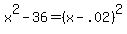
 , expand the binomial using FOIL , expand the binomial using FOIL
 , collect terms , collect terms
 , multiply by -1 and divide by .04 , multiply by -1 and divide by .04
The answer is 900.01 meters.
The problem set up and the equations are the same if you really meant  . The only thing that changes are the numbers. . The only thing that changes are the numbers.
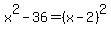
 , expand the binomial using FOIL , expand the binomial using FOIL
 , collect terms , collect terms
 , multiply by -1 and divide by 4 , multiply by -1 and divide by 4
The answer is 10cm.
And to answer your question, no,  has nothing to do with this problem. That is the correct factorization of the has nothing to do with this problem. That is the correct factorization of the  expression for the area of the new square, but as you have seen factoring this expression wasn't necessary. expression for the area of the new square, but as you have seen factoring this expression wasn't necessary.
Hope that helps,
John
| |
|
