Question 120215: A quadrilateral is constructed in the coordinate place with vertices (-2,-2), (2,-2), (6,4), and (6,1). Find the area of the portion of the quadrilateral which lies in the first quadrant.
Answer by solver91311(24713)   (Show Source): (Show Source):
You can put this solution on YOUR website! Here's the situation at the start:

The first thing we need are the equations of the lines that pass through Q and R and through P and S.
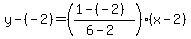
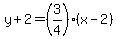
Use the two-point form of the line: 
First QR:



Next: PS:


Since we want the area in the first quadrant, we are interested in the x-intercepts of these two lines:
QR: 

 , giving us point V(2/3,0) , giving us point V(2/3,0)
PS: 

 , giving us point W(14/3,0) , giving us point W(14/3,0)
I've plotted these two points so we now have our first quadrant area defined

Now we could go after the area of the resulting trapezoid directly. That is, we could use the distance formula to calculate the lengths of VR and WS, develop the equation for a line perpendicular to VR passing through either W or S, solve the simultaneous system of this new equation and the equation we developed to define the line through QR, giving us the other end point of our altitude, use the distance formula to determine the length of the altitude, and then apply all of this data to the formula for the area of a trapezoid.
Not only is that a long, drawn-out process, the numbers are very messy -- two digit denominators and such. However, the good news is that there is a much easier way to find the required area.
Notice that if you continue the line segment RS until it crosses the x-axis (we'll call that point T(6,0)), you will have formed two right triangles: VRT and WST. You can see that the desired area is just the area of VRT minus the area of WST.

First the area of VRT:
The triangle base is the segment VT, and the length of VT is 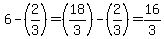
The triangle altitude is the segment RT, and the length of RT is 

Next the area of WST:
The triangle base is the segment WT, and the length of WT is 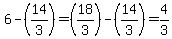
The triangle altitude is the segment ST, and the length of ST is 

Finally, 
Hope this helps,
John
| |
|
