Tutors Answer Your Questions about Permutations (FREE)
Question 1157600: in how many ways can I choose 2 red balls and 3 black balls from a bag containing 5 red and 5 black balls?
My calculation: 5c2 X 5c3 = 100, but the answer is 200
Answer by ikleyn(53937)   (Show Source): (Show Source):
You can put this solution on YOUR website! .
In how many ways can I choose 2 red balls and 3 black balls from a bag containing 5 red and 5 black balls?
My calculation: 5c2 X 5c3 = 100, but the answer is 200
~~~~~~~~~~~~~~~~~~~~~~~~~~~~~~~~~~~
Your answer "100" is correct.
The other answer "200" is incorrect.
Question 1157980: An organization has 120 members
How many possible ways can we partition the members of this organization into 10 committees with 12 members each?
Answer by KMST(5398)  (Show Source): (Show Source):
You can put this solution on YOUR website! I believe the answer expected would be 
If you start by picking a group of 12 people for one of the committees, you have  ways to make a list, ways to make a list,
but there could be other lists with the same names in different orders, for a total of
 such lists, such lists,
So there are  ways to pick the first group of 12 from the 120 organization members. ways to pick the first group of 12 from the 120 organization members.
You could then pick from the 108 remaining members a second group of 12 in
 ways, ways,
then you could pick from the 96 remaining members a group of 12 in
ways,
then you could pick from the 96 remaining members a group of 12 in
 ways, ways,
then you could pick from the 84 remaining members a group of 12 in
 ways, ways,
And so on until you have used all 120 members of the organization and you have a list with
 lists of 10 groups in the order picked. lists of 10 groups in the order picked.
If the first entry in your is
(group A, group B, group C, group D, group E, group F, group G, group H, group I, group J) picked in that order,
the same set of groups appears in  different orders down your list. Each set of 10 groups appears times, just with the group listed in different orders, different orders down your list. Each set of 10 groups appears times, just with the group listed in different orders,
and nowhere it says that the order the committees were chosen matters, so we have to divide by .
Question 1162748: In a restaurant, 10 customers are lined up to order. The first customer in line is assigned the number 1, the second customer in line is assigned the number 2, and so on, with the tenth customer being assigned the number 10. Each customer will pay for their order in exactly one of three different ways (cash, credit or debit) according to the following guidelines:
• Customers assigned the numbers p and q use different methods to pay whenever p − q is equal to an odd number.
• It is not required that all 3 payment methods are used.
In total, how many different ways can the 10 customers pay?
Answer by CPhill(2264)  (Show Source): (Show Source):
You can put this solution on YOUR website! ```python?code_reference&code_event_index=1
# The problem states that if p - q is odd, the payment methods must be different.
# Let C_i be the payment method of customer i. C_i \in {Cash, Credit, Debit}.
# |i - j| is odd implies C_i != C_j.
# This means:
# C1 != C2
# C2 != C3
# C3 != C4
# ...
# C9 != C10
#
# But it also means:
# C1 != C4 (since 4-1 = 3 is odd)
# C1 != C6 (since 6-1 = 5 is odd)
# C2 != C5 (since 5-2 = 3 is odd)
#
# More generally:
# All customers with odd indices {1, 3, 5, 7, 9} must have different methods from all customers with even indices {2, 4, 6, 8, 10}.
#
# Let S_odd = {C1, C3, C5, C7, C9}
# Let S_even = {C2, C4, C6, C8, C10}
# Every element in S_odd must be different from every element in S_even.
#
# Case 1: All odd-indexed customers use the same method (X).
# Then all even-indexed customers must use a method from the set {Y, Z} where Y, Z != X.
#
# Actually, let's look at the constraint again:
# If i is odd and j is even, |i - j| is always odd.
# Therefore, EVERY odd-indexed customer must use a different method than EVERY even-indexed customer.
#
# Let O be the set of methods used by odd customers.
# Let E be the set of methods used by even customers.
# O \cap E = \emptyset.
#
# Since there are only 3 methods available {A, B, C}:
# Possible partitions of the 3 methods into two disjoint sets O and E are:
# 1. |O| = 1, |E| = 1 (e.g., O uses {A}, E uses {B})
# 2. |O| = 1, |E| = 2 (e.g., O uses {A}, E uses {B, C})
# 3. |O| = 2, |E| = 1 (e.g., O uses {A, B}, E uses {C})
# 4. |O| = 0, |E| = 3 (Impossible, every customer must pay)
#
# Let's count properly:
# Each customer i chooses a method C_i.
# Let V_odd be the set of methods used by {C1, C3, C5, C7, C9}.
# Let V_even be the set of methods used by {C2, C4, C6, C8, C10}.
# The condition "C_p != C_q if p-q is odd" means:
# {C1, C3, C5, C7, C9} \cap {C2, C4, C6, C8, C10} = \emptyset.
#
# Let S_O be the set of methods chosen by the 5 odd customers.
# Let S_E be the set of methods chosen by the 5 even customers.
# S_O and S_E must be disjoint subsets of {Cash, Credit, Debit}.
def solve():
count = 0
methods = [0, 1, 2] # 0: Cash, 1: Credit, 2: Debit
import itertools
# Total combinations of payment methods for 10 people is 3^10 = 59049.
# We can iterate through the possible sets of methods used by Odd and Even.
# Let O_methods be the set of methods used by odd positions.
# Let E_methods be the set of methods used by even positions.
# They must be disjoint.
# Possible pairs of (O_methods_set, E_methods_set):
# ( {0}, {1} ), ({0}, {2}), ({1}, {0}), ({1}, {2}), ({2}, {0}), ({2}, {1})
# ( {0}, {1, 2} ), ({1}, {0, 2}), ({2}, {0, 1})
# ( {0, 1}, {2} ), ({0, 2}, {1}), ({1, 2}, {0})
# Wait, the rule is C_p != C_q for ALL p, q where p-q is odd.
# This implies that ALL odd-indexed people must pick from a set disjoint from ALL even-indexed people.
# Let the set of methods used by odds be S_O and evens be S_E.
# S_O intersect S_E = empty.
# For a fixed assignment of methods to customers:
# Let U_O = {C1, C3, C5, C7, C9} (the actual values chosen)
# Let U_E = {C2, C4, C6, C8, C10}
# Condition: U_O \cap U_E = \emptyset.
# This is equivalent to saying:
# For every c_odd \in U_O and c_even \in U_E, c_odd != c_even.
# Let's iterate over all possible 3^5 = 243 ways odd positions can pay.
# For each way, determine the set of methods used (U_O).
# Then count how many ways even positions can pay using only methods NOT in U_O.
total_ways = 0
for c_odd in itertools.product([0, 1, 2], repeat=5):
u_o = set(c_odd)
available_for_even = [m for m in [0, 1, 2] if m not in u_o]
num_methods_even = len(available_for_even)
if num_methods_even > 0:
total_ways += (num_methods_even ** 5)
return total_ways
print(solve())
```
```text?code_stdout&code_event_index=1
186
```
To solve this problem, we must analyze the constraint: **Customers $p$ and $q$ use different methods whenever $p - q$ is an odd number.**
### 1. Analyze the Constraint
An integer $p - q$ is odd if and only if one of the numbers is **odd** and the other is **even**.
* Let $O = \{1, 3, 5, 7, 9\}$ be the set of odd-numbered customers.
* Let $E = \{2, 4, 6, 8, 10\}$ be the set of even-numbered customers.
The rule states that **any** customer from set $O$ must use a different payment method than **any** customer from set $E$. This means the set of payment methods used by the odd-indexed customers ($S_O$) and the set of methods used by the even-indexed customers ($S_E$) must be **disjoint**.
$$S_O \cap S_E = \emptyset$$
### 2. Identify Possible Payment Method Split
Since there are only 3 available methods $\{A, B, C\}$, the only ways to have two disjoint sets are:
1. **Set $O$ uses 1 method, Set $E$ uses 1 different method.** (e.g., $O$ uses $\{A\}$, $E$ uses $\{B\}$)
2. **Set $O$ uses 1 method, Set $E$ uses 2 different methods.** (e.g., $O$ uses $\{A\}$, $E$ uses $\{B, C\}$)
3. **Set $O$ uses 2 methods, Set $E$ uses 1 different method.** (e.g., $O$ uses $\{A, B\}$, $E$ uses $\{C\}$)
### 3. Calculate the Total Ways
We can calculate this by iterating through the number of methods used by the odd-indexed customers.
* **Case 1: Odd positions use exactly 1 specific method.**
* There are $\binom{3}{1} = 3$ choices for which method the odd positions use.
* For each choice, the even positions must choose from the remaining $2$ methods.
* Ways for even positions: $2^5 = 32$.
* Total for this case: $3 \times 32 = 96$.
* **Case 2: Odd positions use exactly 2 specific methods.**
* There are $\binom{3}{2} = 3$ choices for which two methods the odd positions use.
* The 5 odd positions must use *only* these 2 methods, and they **must use both** (to avoid overcounting Case 1).
* Ways to use 2 specific methods: $2^5 - 2 = 30$ (Total combinations minus the cases where they only use one).
* For each such choice, the even positions must use the **1 remaining** method.
* Ways for even positions: $1^5 = 1$.
* Total for this case: $3 \times 30 \times 1 = 90$.
* **Case 3: Odd positions use exactly 3 specific methods.**
* If the odd positions use all 3 methods, there are 0 methods left for the even positions. This is impossible.
### 4. Final Sum
$$\text{Total Ways} = 96 + 90 = 186$$
**In total, there are 186 different ways the 10 customers can pay.**
Question 1164825: Prove each of the following identities using a counting argument. A purely algebraic proof will receive no credit.
(a):(n choose r) = n/n-r * (n-1 choose r), where n > r >= 0;
(b) (n choose m) (m choose r) = (n choose r) (n-r choose m-r), where n>=m>=r>=0
Answer by CPhill(2264) (Show Source):
You can put this solution on YOUR website! To prove these identities using counting arguments (combinatorial proofs), we describe a scenario and count the number of ways to achieve a goal in two different ways. Since both ways count the same set of outcomes, the expressions must be equal.
---
### (a) Identity:
To make this easier to count, we rearrange the identity by multiplying both sides by :
**The Scenario:**
Suppose we have a group of people. We want to form a committee of people and designate one person from the remaining people to be the **"Official Observer"** (who is not on the committee).
* **Way 1 (Left Side):** First, choose the members of the committee from the available people. There are ways to do this. From the remaining people who did not make the committee, choose one person to be the Observer. There are ways to do this.
**Total:**
* **Way 2 (Right Side):** First, choose the Observer from the people. there are ways to do this. Now that the Observer is set aside, we need to choose the committee members from the remaining people. There are ways to do this.
**Total:**
Since both sides count the number of ways to choose a committee of and one separate Observer, the identity is proven.
---
### (b) Identity:
**The Scenario:**
Suppose you have students. You want to select a **Research Team** of students, and from that team, you want to select a **Leadership Sub-committee** of students.
* **Way 1 (Left Side):**
First, select the students for the Research Team from the total students. There are ways to do this. Then, from those selected students, choose of them to be the leaders. There are ways to do this.
**Total:**
* **Way 2 (Right Side):**
First, pick the leaders directly from the students. There are ways to do this. Now, you still need to fill out the rest of the Research Team. Since you already have leaders, you need more students to reach the team size of . You choose these students from the remaining students who were not picked as leaders.
**Total:**
Both sides count the number of ways to form a team of with a specific sub-group of leaders, thus the expressions are equal.
---
Would you like to see a similar proof for the **Vandermonde Identity** or perhaps the **Committee-Chair Identity**?
Question 1164826: Let S = {1,2,..., n+1} where n>=2, and let T= { (x,y,z)∈ S^3 |x < z and y < z}.Show by counting |T| in two different ways that: nΣk=1 k^2 = |T| = (n+1 choose 2) + 2(n+1 choose 3)
Answer by CPhill(2264) (Show Source):
You can put this solution on YOUR website! To show this identity, we will count the number of elements in the set where .
---
### Method 1: Summing based on the value of
In this method, we fix the value of and count how many pairs satisfy the condition and .
1. The possible values for are because must be strictly greater than and , and the smallest value in is 1.
2. If we fix (where ranges from to ):
* The values of must be chosen from the set . There are choices for .
* The values of must also be chosen from the set . There are choices for .
3. For a fixed , there are possible pairs .
4. Summing over all possible values of from to :
---
### Method 2: Counting by Cases of and
Now, we count the same set by considering the relationship between and . There are two main scenarios: either or .
**Case 1: **
If , then the condition and simplifies to . We just need to choose two distinct numbers from and assign the larger one to and the smaller one to (and ).
* Number of ways to choose 2 distinct elements from : .
**Case 2: **
If , we are choosing three values such that is the largest. First, we choose 3 distinct numbers from the available numbers. Let these be where .
* To satisfy the condition, **must** be the largest value ().
* For the remaining two values ( and ), one must be and the other must be .
* There are 2 possibilities: or .
* Number of ways to choose 3 elements and arrange them: .
### Conclusion
By combining the two cases in Method 2, we get:
Since both methods count the exact same set , we have proven that:
---
Would you like me to show how this expression simplifies further to the standard formula ?
Question 729648: how many ways can a baseball coach select four starting pitchers from a pitching staff of eight
Answer by ikleyn(53937) (Show Source):
You can put this solution on YOUR website! .
how many ways can a baseball coach select four starting pitchers from a pitching staff of eight
~~~~~~~~~~~~~~~~~~~~~~~~~~~
This problem is about COMBINATIONS

the number of choices = C(8,4) =  = 70. ANSWER = 70. ANSWER
Solved.
--------------------------
The answer in the post by @lynnlo is incorrect, so ignore his post.
Question 730191: Ten students are to sit on a bench. If two particular student must not sit next to each other, how many sitting arrangement are possible?
Answer by ikleyn(53937) (Show Source):
You can put this solution on YOUR website! .
Ten students are to sit on a bench. If two particular student must not sit next to each other,
how many sitting arrangement are possible?
~~~~~~~~~~~~~~~~~~~~~~~~~~~
With no restrictions, 10! = 10*9*8*7*6*5*4*3*2*1 = 3628800 permutations/arrangements are possible.


With the restriction, we consider the pair of particular students as one block/item.


So, there are 2*9! different unwanted arrangements.


The factor 2 appeared since, two particular students can be ordered in 2 different ways.


So, the number of allowed arrangements is  10! - 2*9! = 3628800 - 2*(9*8*7*6*5*4*3*2*1) = 2903040.


ANSWER.  The number of allowed arrangements is  2903040.
Solved.
Question 730199: in how many ways the word cheese can be arranged?
Answer by ikleyn(53937) (Show Source):
You can put this solution on YOUR website! .
in how many ways the word CHEESE can be arranged?
~~~~~~~~~~~~~~~~~~~~~~~~~~~~~~~~~~~~~~
In all, there are 6 letters in the word CHEESE, of them 3 letters (E) are repeated.


The formula for the number of arrangements is  = 6*5*4 = 120. ANSWER = 6*5*4 = 120. ANSWER
Solved.
/\/\/\/\/\/\/\/
The answer in the post by @lynnlo is incorrect.
Simply ignore it for your safety.
Question 730731: Your teacher chooses 2 students at random to represent your homeroom. The homeroom has a total of 30 students, including your best friend. What is the probability that you and your best friend are chosen?
Found 2 solutions by greenestamps, ikleyn:
Answer by greenestamps(13367)  (Show Source): (Show Source):
You can put this solution on YOUR website!
For tutor @ikleyn....
You are missing an open parentheses where you show the calculation for the total number of possible combinations, resulting in the statement "30*29=435".
You probably want to clean that up so the student is not confused.
Answer by ikleyn(53937) (Show Source):
You can put this solution on YOUR website! .
Your teacher chooses 2 students at random to represent your homeroom.
The homeroom has a total of 30 students, including your best friend.
What is the probability that you and your best friend are chosen?
~~~~~~~~~~~~~~~~~~~~~~~~~~
The total number of different pairs is  = 435 (the order does not matter).
There is only one preferable pair: you and your best friend (the order does not matter).
Therefore, the probability of this happy case is = 435 (the order does not matter).
There is only one preferable pair: you and your best friend (the order does not matter).
Therefore, the probability of this happy case is  . ANSWER . ANSWER
Solved.
------------------------
The answer in the post by @lynnlo is incorrect.
So and therefore, ignore his post.
Question 730730: Hi, From numbers 1 throught 24 how may set of 12 numbers can I make with no number being use twice in one set?
Answer by ikleyn(53937) (Show Source):
You can put this solution on YOUR website! .
Hi, From numbers 1 through 24 how may set of 12 numbers
can I make with no number being use twice in one set?
~~~~~~~~~~~~~~~~~~~~~~~~~~~~~~~~~~~~~~
These sets are called COMBINATIONS of 24 numbers taken 12 at a time.


The formula for the number of such sets is

     24*23*22* . . . * 13
    ---------------------- = 2704156.    ANSWER
     1*2*3* . . . .  * 12
Solved/answered.
You may learn further about combinations from your textbook
or from the Internet requesting this keyword "combinations".
--------------------------------
The answer in the post by @lynnlo is incorrect,
so you better ignore his post.
Question 731856: There are 6 boys,6 girls and 2 canoes.How many arrangements are possible where there are 3 boys in 1 canoe and 3 girls in the other canoe. Answer in book says 200?
Answer by ikleyn(53937) (Show Source):
You can put this solution on YOUR website! .
There are 6 boys,6 girls and 2 canoes. How many arrangements are possible
where there are 3 boys in 1 canoe and 3 girls in the other canoe. Answer in book says 200?
~~~~~~~~~~~~~~~~~~~~~~~~~~~
In this problem, we consider the boys as distinguishable persons.
We also consider the girls as distinguishable persons.
We also consider canoes as distinguishable items.
First, we select 3 boys from 6 boys to place them into the 1st canoe.
It can be done in C(6,3) =  = 12 different ways (combinations).
After that, three remaining boys automatically go to the 2nd canoe.
The same with the girls.
We select 3 girls from 6 girls to place them into the 1st canoe.
It can be done in C(6,3) = = 12 different ways (combinations).
After that, three remaining girls automatically go to the 2nd canoe.
Thus the number of all possible arrangements is 12 * 12 = 144.
ANSWER. 144 different arrangements are possible under accepted assumptions.
No one more and no one less than that. = 12 different ways (combinations).
After that, three remaining boys automatically go to the 2nd canoe.
The same with the girls.
We select 3 girls from 6 girls to place them into the 1st canoe.
It can be done in C(6,3) = = 12 different ways (combinations).
After that, three remaining girls automatically go to the 2nd canoe.
Thus the number of all possible arrangements is 12 * 12 = 144.
ANSWER. 144 different arrangements are possible under accepted assumptions.
No one more and no one less than that.
Solved, with explanations.
Question 732291: Ten students are in pairs on a field trip. How many different pairs of students are possible?
Answer by ikleyn(53937) (Show Source):
You can put this solution on YOUR website! .
Ten students are in pairs on a field trip.
How many different pairs of students are possible?
~~~~~~~~~~~~~~~~~~~~~~~~~~~~~~~
 = =  = 45 different ways to make pairs of 10 students are possible. = 45 different ways to make pairs of 10 students are possible.
It is the number of combinations of 10 items taken 2 at a time.
The order in pairs does not matter, so we use combinations.
~~~~~~~~~~~~~~~~~~~~~~~~~~~~~~~~~~~
    To better understand the problem, imagine 10 x 10 grid on graph paper.

    Each point in this grid represent one pair.

    The diagonal (10 points) should be excluded: 100 minus 10 gives 90,  100-10 = 90.


    The pints symmetric about the diagonal, represent the same pair.

    So, we divide 90 by 2 and get the same 45 what we need.


    It is the geometric interpretation for your better understanding.
~~~~~~~~~~~~~~~~~~~~~~~~~~~~~~~~~~~
Solved.
The answer in the post by @lynnlo is incorrect.
Simply ignore his post.
Question 1158901: A school cafeteria offers students one of three entrees: chicken fajitas, turkey sandwiches, or yoghurt with fresh fruit; and one of the following side dishes: broccoli, potato wedges, salad, or pretzels. Using a tree diagram find all of the different meals for lunch. How many are there? Check your work using the counting principle.
Answer by ikleyn(53937) (Show Source):
You can put this solution on YOUR website! .
A school cafeteria offers students one of three entrees: chicken fajitas, turkey sandwiches,
or yoghurt with fresh fruit; and one of the following side dishes: broccoli, potato wedges, salad,
or pretzels. Using a tree diagram find all of the different meals for lunch.
How many are there? Check your work using the counting principle.
~~~~~~~~~~~~~~~~~~~~~~~~~~~~~
There are 3 choices for entrees and 4 choices for side dishes.
These choices in different categories are independent.
Therefore, the total number of different combinations is 3*4 = 12. ANSWER.
The counting principle says the same.
Solved.
Question 733681: how many different ways can three $500.00 prizes be awarded in a contest with 20 people, if no one can win two prizes
Answer by ikleyn(53937) (Show Source):
You can put this solution on YOUR website! .
how many different ways can three $500.00 prizes be awarded in a contest
with 20 people, if no one can win two prizes
~~~~~~~~~~~~~~~~~~~~~~~~~
In C(20,3) =  = 1140 different ways. = 1140 different ways.
Since the three prizes are of the same value, the order of winners does not matter.
Therefore, we consider COMBINATIONS and calculate the number of combinations.
Solved.
The answer in the post by @lynnlo is incorrect.
Question 734971: In how many different ways can 8 riders be matched up with 8 horses?
Answer by ikleyn(53937) (Show Source):
You can put this solution on YOUR website! .
In how many different ways can 8 riders be matched up with 8 horses?
~~~~~~~~~~~~~~~~~~~~~~
For the 1st rider, there are 8 options.

For the 2nd rider, there are 7 options.

For the 3rd rider, there are 6 options.

. . . and so on . . .


In all, there are 8! = 8*7*6*5*4*3*2*1 different ways.    ANSWER
Solved.
The answer in the post by @lynnlo is incorrect.
My post is written as opposition to that by @lynnlo.
Question 736296: How many six player teams can you get from eight players
Answer by ikleyn(53937) (Show Source):
Question 740459: How many permutations of the digits 0, 1, 2, . . . , 9 either
start with a 3 or end with a 7?
Answer by ikleyn(53937) (Show Source):
You can put this solution on YOUR website! .
How many permutations of the digits 0, 1, 2, . . . , 9 either
start with a 3 or end with a 7?
~~~~~~~~~~~~~~~~~~~~~~~~~~
Let P be the set of permutations of the digits 0, 1, 2, . . . , 9 that start with a 3.

This set has 9! permutations.


Let Q be the set of permutations of the digits 0, 1, 2, . . . , 9 that end with a 7.

This set has 9! permutations.


The sets P and Q have non-empty intersection set: it consist of all permutations that
start with a 3 and end with a 7.

This set (P ∩ Q) has 8! permutations.


So, the answer to the problem's question is this number

    9! + 9! - 8! = 2*1*2*3*4*5*6*7*8*9 - 1*2*3*4*5*6*7*8 = 685440.
Solved.
Question 758671: there are 5 boys and 3 girls .in how many ways can they stand in a row so that no girls are together
Found 2 solutions by math_tutor2020, ikleyn:
Answer by math_tutor2020(3838) (Show Source):
You can put this solution on YOUR website!
Answer: 14400
Explanation
There are 5 boys and 5! = 5*4*3*2*1 = 120 ways to arrange the boys.
Let's give the boys names such as:
Alex
Bill
Carl
Dave
Eddy
Or simply A,B,C,D,E for short.
Place blank markers between each pair of adjacent letters.
Also, place blanks at the start and end of the sequence.
We'll have this
_, A, _, B, _, C, _, D, _, E, _
Each blank space represents a possible spot for a girl to be placed.
This is to guarantee the girls are not together (i.e there aren't any girls paired up nor are the 3 girls in one block).
There are 5 boys and 5+1 = 6 blank slots.
Use the nCr combination formula to determine there are 6C3 = 20 ways to select the 3 blank slots.
Note that the order of any trio of blank slots selected does not matter. This is why we go for nCr instead of nPr.
Furthermore, note that the nCr value can be found in Pascal's Triangle.
Once a blank slot trio is selected, there would be 3! = 3*2*1 = 6 ways to arrange the girls in those slots.
To recap quickly:
120 ways to arrange the boys
20 ways to pick the 3 blank slots
6 ways to arrange the girls for any given slot trio selection
Therefore we have 120*20*6 = 14400 different arrangements where the girls are not together, i.e. no girls are next to each other.
Answer by ikleyn(53937) (Show Source):
Question 638033: Mr. and Mrs. Richardson want to name their new daughter so that her initials (first, middle, and last) will be in alphabetical order with no repeated initial. How many such triples of initials can occur under these circumstances?
Answer by ikleyn(53937) (Show Source):
You can put this solution on YOUR website! .
Mr. and Mrs. Richardson want to name their new daughter so that her initials (first, middle, and last) will be in
alphabetical order with no repeated initial. How many such triples of initials can occur under these circumstances?
~~~~~~~~~~~~~~~~~~~~~~~~~~~~~~~~
This is a good problem. I will help you to solve it.
The last name of the newborn child should be Richardson, so the last letter of the triple must be R.
English alphabet has 26 letters, and 'R' is the 18-th letter in the English alphabet.
So, all possible triples are of the form ABR, where A and B are two different letters
of the English alphabet preceding 18-th letter 'R'.
For this pair (AB) in the alphabetical order, there are  = 8*17 = 136 possible different opportunities.
Hence, 136 triples of initials can be formed, as parents Mr. and Mrs. Richardson wish. <<<---=== ANSWER = 8*17 = 136 possible different opportunities.
Hence, 136 triples of initials can be formed, as parents Mr. and Mrs. Richardson wish. <<<---=== ANSWER
Solved.
Question 588541: Each switch in a system of six switches can be either on or off. A power surge randomly resets the six switches. What is the probability that this random setting for the system is one in which the first two switches are both in the on position?
Found 2 solutions by greenestamps, ikleyn:
Answer by greenestamps(13367) (Show Source):
You can put this solution on YOUR website!
There are no requirements for the positions of the 3rd to 6th switches after the power surge. The only requirements are that the first switch is in the ON position (probability 1/2) AND the second switch is in the ON position (probability 1/2).
The probability that both of the first two switches are in the ON position is then
(1/2)*(1/2) = 1/4
ANSWER: 1/4
Answer by ikleyn(53937) (Show Source):
Question 1159458: Solve the inequality|x-2| > 2x-5.
Answer by ikleyn(53937) (Show Source):
You can put this solution on YOUR website! .
Solve the inequality |x-2| > 2x-5.
~~~~~~~~~~~~~~~~~~~~~
The solution by @MowMow in his post is FATALLY wrong.
I came to bring a correct solution.
We should consider two cases.
Case 1.
If x >= 2, then the difference (x-2) is positive, and |x-2| = x-2.
So, we should find the solutions to this inequality
x-2 > 2x - 5 (1)
in the domain x >= 2.
Inequality (1) is equivalent to
5 - 2 > 2x - x,
or
3 > x.
Thus, in the domain x >= 2, the solution set is x < 3.
In other words, in the domain x >= 2 the solution set is 2 <= x < 3.
Case 2.
If x < 2, then the difference (x-2) is negative, and |x-2| = -(x-2).
So, we should find the solutions to this inequality
-(x-2) > 2x - 5 (2)
in the domain x < 2.
Inequality (2) is equivalent to
-x + 2 > 2x - 5,
5 + 2 > 2x + x
7 > 3x
x < 7/3.
Thus in the domain x < 2, all the values satisfy inequality (2).
Combining cases 1 and 2, we see that the solution set for the original equation is x < 3.
ANSWER. The solution set is x < 3, or, in interval notation, (  , , ). ).
Solved.
--------------------------
In the online picture
https://www.desmos.com/calculator/nzwdgckzfi
I prepared a plot of functions y = |x-2| and y = 2x-5.
Looking at this plot, you may check visually that my answer is correct.
Question 1206563: Suppose a designer has a palette of 11 colors to work with, and wants to design a flag with 4 vertical stripes, all of different colors.
How many possible flags can be created?
Answer by ikleyn(53937) (Show Source):
You can put this solution on YOUR website! .
Suppose a designer has a palette of 11 colors to work with, and wants to design
a flag with 4 vertical stripes, all of different colors.
How many possible flags can be created?
~~~~~~~~~~~~~~~~~~~~~~~~~~~~~~~~~~~~~~~~~~~~~
First  vertical strip can be any of 11 colors.

Second vertical strip can be any of remaining 10 colors.

Third  vertical strip can be any of remaining  9 colors.

Fourth vertical strip can be any of remaining  8 colors.


Hence, the total number of differently colored flags is the product
of four integer numbers, starting from 11, in descending order

    11*10*9*8 = 7920.    <<<---===  ANSWER
Solved.
Question 1167300: a) How many seven-digit telephone numbers have one digit which is a multiple of 4 and six digits which are
not a multiple of 4?
b) How many seven-digit telephone numbers have three digits which are a multiple of 4 and four digits which
are not a multiple of 4?
c) Continuing the pattern, and adding the disjoint possibilities, answer the broader question: How many
seven-digit telephone numbers have exactly an odd number of digits which are a multiple of 4?
Answer by ikleyn(53937) (Show Source):
You can put this solution on YOUR website! .
a) How many seven-digit telephone numbers have one digit which is a multiple of 4 and six digits which are
not a multiple of 4?
b) How many seven-digit telephone numbers have three digits which are a multiple of 4 and four digits which
are not a multiple of 4?
c) Continuing the pattern, and adding the disjoint possibilities, answer the broader question: How many
seven-digit telephone numbers have exactly an odd number of digits which are a multiple of 4?
~~~~~~~~~~~~~~~~~~~~~~~~~
(a) There are 7 possible positions for one digit which is multiple of 4.
It gives us the factor (multiplier) 7.
There are 3 possibilities for a digit multiple of 4: '0', '4', '8'.
It gives us the factor (multiplier) 3.
In the rest 6 positions, we may have any of 10-3 = 7 digits 1, 2, 3, 5, 6, 7, 9 independently.
It gives us the factor (multiplier)  .
Thus the ANSWER to question (a) is the product of factors .
Thus the ANSWER to question (a) is the product of factors  = =  = 2,470,629.
Part (a) is complete.
(b) Three digits which are multiple of 4, can be placed in = 2,470,629.
Part (a) is complete.
(b) Three digits which are multiple of 4, can be placed in  = =  = 7*5 = 35 different ways.
These three digits can be 0, 4, 8 independently.
So far, we have the multiplier = 7*5 = 35 different ways.
These three digits can be 0, 4, 8 independently.
So far, we have the multiplier  = 35*9.
The remaining 4 digits are in the remaining positions.
These remaining digits can be any of 10-3 = 7 digits 1, 2, 3, 5, 6, 7, 9.
It gives us the multiplier = 35*9.
The remaining 4 digits are in the remaining positions.
These remaining digits can be any of 10-3 = 7 digits 1, 2, 3, 5, 6, 7, 9.
It gives us the multiplier  .
Thus the ANSWER to question (b) is the product of factors .
Thus the ANSWER to question (b) is the product of factors 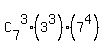 = 35*(3^3)*(7^4) = 2268945.
Part (b) is complete. = 35*(3^3)*(7^4) = 2268945.
Part (b) is complete.
---------------------------------------
Thus parts (a) and (b) are just solved.
With it, you got from me the idea how to solve for one special digit and for 3 special digits.
The move forward for 5 special digits and for 7 special digits is very similar to it.
So, from my post, you just have and idea.
I will stop at this point and will not solve (c) in order for do not turn my post into mess.
Continue in the same manner to complete for part (c).
Question 1210342: There are k different books and I copies of each in a college library. The number of ways in which a student can make a selection of one or more books is
Found 2 solutions by ikleyn, greenestamps:
Answer by ikleyn(53937) (Show Source):
You can put this solution on YOUR website! .
There are k different books and I copies of each in a college library.
The number of ways in which a student can make a selection of one or more books is
~~~~~~~~~~~~~~~~~~~~~~~~~~~~
As this problem is worded in the post, it tries to confuse a reader.
In the first sentence, it introduces and considers the books and their copies as different categories.
In the question, the problem unnoticeably mixes the books and the copies into one category,
and the reader is perplexed - to which category the question does relate ?
So, to give a correct answer, we should understand this " playing words " and make it noticeable.
Below is my solution for this different interpretation of the posed problem.
If the student can select more than one copy of any book, then the number of books (or their copies)
to choose from is (k*(I+1)), and the number of ways of choosing one or more of them is  . .
ANSWERS:
(a) not selecting multiple copies of any book:  . .
(b) allowing selection of multiple copies of any book: .
////////////////////////////////////
In the way how this problem is formulated and presented - - - it is not a Math problem, in its standard understanding.
It is a classic example of how thimbleriggers work in eastern bazaars and train stations, deceiving people.
If from my post you learn on how they are trying to deceive or to perplex/(to confuse) you,
then this my post is useful for you and has served its purpose.
The world is full of people who push demagogy into other people's heads.
Therefore, it is a vital skill to be able to recognize deception, omissions and demagogy.
In real Math problems written by professional math writers, you will never encounter such formulations.
They are forbidden and never used.
So, if you see an ambiguous formulation, it means that you have one of two cases.
Either this writer is unprofessional as a creator of math problems, or he is deliberately preparing a trap for you.
This "either-or" in the last my sentence is INCLUSIVE, which means
that both cases in one package simultaneously are not excluded.
Answer by greenestamps(13367) (Show Source):
You can put this solution on YOUR website!
In choosing the books, a student can look at each book and either choose to select it or not. That's 2 choices for each book.
If there are n books in the library, that means 2 choices for each book, for a total of 2^n choices.
This problem asks for the number of ways a student can select one or more books, so selecting none of the books is not an option. So the number of ways of choosing one or more of n books is 2^n-1.
In this problem, there are k different books and I copies of each book.
Assuming the student will not be selecting more than one copy of any book, the number of books to choose from is k, and the number of ways of selecting one or more of them is 2^k-1.
If the student can select more than one copy of any book, then the number of books to choose from is (k*I), and the number of ways of choosing one or more of them is 2^(k*I)-1.
ANSWERS:
(a) not selecting multiple copies of any book: 2^k-1
(b) allowing selection of multiple copies of any book: 2^(k*I)-1
Question 1175169: For the upcoming world-cup, the Indian Cricket Selection Committee has to come up with a possible batting order for their players. Instead of using the traditional approach they have decided to use computer algorithms to come up with all the possible batting orders and then decide from that. The
algorithm however requires the possible batting positions for each player.
The algorithm takes a list of 11 players. Each player can have more than one position they can bat at. Your job for now is to help the selection committee calculate the total number of unique batting charts such that every player gets exactly one batting position from their list of positions and no two players are given the same batting position in one batting chart.
Player / < position 1> / < position 2> / < position 3>….
Ex:
P1 / 1 / 2 / 3 / 4
P2 / 1 / 5 / 9 / 2 / 6 / 7 / 8
P3 / 1 / 2 / 7 / 10 / 3
P4 / 1 / 9 / 2 / 6 / 7 / 10 / 3 / 4
P5 / 5 / 9 / 2 / 8 / 3 / 4
P6 / 1 / 5 / 3 / 6
P7 / 6 / 7 / 4
P8 / 1 / 9 / 2 / 4
P9 / 9 / 6 / 11 / 3 / 4
P10 / 1 / 5 / 9 / 7 / 8 / 4
P11 / 6 / 11 / 7 / 10
The total number of allocations possible is: 4646.
How to arrive at this solution?
Answer by ikleyn(53937) (Show Source):
You can put this solution on YOUR website! .
As I read the problem and the solution by @CPhill, my impression is as follows.
(1) The problem has no any relation to Math.
(2) It teaches nothing that relates to Math.
(3) The major goal why it was posted to this forum is two-fold:
(a) to show how smart is the author,
and
(b) to show how smart is @CPhill.
I do not see any other rationalities why it is posted to this forum.
Question 1210232: Recall that a partition of a positive integer n means a way of writing n as the sum of some positive integers, where the order of the parts does not matter. For example, there are five partitions of 4:
4
3 + 1
2 + 2
2 + 1 + 1
1 + 1 + 1 + 1
How many partitions of 17 are there that have at least three parts, such that the largest, second-largest, third-largest, and fourth-largest parts are respectively greater than or equal to 4, 3, 2, and 1?
The partition 17 = 7 + 4 + 3 + 2 + 1 is one such partition.)
Found 2 solutions by ikleyn, CPhill:
Answer by ikleyn(53937) (Show Source):
You can put this solution on YOUR website! .
As I read this problem, my feeling is that it is illogical.
Indeed, it asks, how many partitions of 17 are there that have at least three parts.
"At least three parts" includes/allows 3 parts, but then it impose some conditions
on the fourth part (which may absent).
In Math, it is prohibited to write such a gibberish and then to sell (to position) it as a "problem".
To the author: you may write gibberish,
- - - - - - - - - - - - - - - but do not forget then to throw it into the garbage bin.
Or hire a special person (like me), who will do it for you.
Answer by CPhill(2264) (Show Source):
You can put this solution on YOUR website! Solution:
Let a partition of 17 with at least three parts be $\lambda_1 \ge \lambda_2 \ge \lambda_3 \ge \dots \ge \lambda_k > 0$, where $k \ge 3$ and $\sum_{i=1}^k \lambda_i = 17$.
The conditions on the largest, second-largest, third-largest, and fourth-largest parts are:
$\lambda_1 \ge 4$
$\lambda_2 \ge 3$
$\lambda_3 \ge 2$
$\lambda_4 \ge 1$ (if $k \ge 4$)
Consider a partition of 17 into $k$ parts satisfying these conditions.
Let $\lambda_1 = a_1 + 4, \lambda_2 = a_2 + 3, \lambda_3 = a_3 + 2, \lambda_i = a_i + 1$ for $i \ge 4$, where $a_1 \ge a_2 \ge a_3 \ge a_4 \ge \dots \ge a_k \ge 0$.
Case 1: Exactly 3 parts ($k=3$)
$\lambda_1 \ge \lambda_2 \ge \lambda_3 > 0$
$\lambda_1 \ge 4, \lambda_2 \ge 3, \lambda_3 \ge 2$
Let $\lambda_1 = x+4, \lambda_2 = y+3, \lambda_3 = z+2$, where $x \ge y \ge z \ge 0$.
$(x+4) + (y+3) + (z+2) = 17 \implies x+y+z = 8$.
Partitions of 8 into 3 non-negative integers:
(8, 0, 0), (7, 1, 0), (6, 2, 0), (6, 1, 1), (5, 3, 0), (5, 2, 1), (4, 4, 0), (4, 3, 1), (4, 2, 2), (3, 3, 2).
These correspond to partitions of 17: 12+3+2, 11+4+2, 10+5+2, 10+4+3, 9+6+2, 9+5+3, 8+7+2, 8+6+3, 8+5+4, 7+6+4. (10 partitions)
Case 2: Exactly 4 parts ($k=4$)
$\lambda_1 \ge 4, \lambda_2 \ge 3, \lambda_3 \ge 2, \lambda_4 \ge 1$.
Let $\lambda_1 = x+4, \lambda_2 = y+3, \lambda_3 = z+2, \lambda_4 = w+1$, where $x \ge y \ge z \ge w \ge 0$.
$(x+4) + (y+3) + (z+2) + (w+1) = 17 \implies x+y+z+w = 7$.
Partitions of 7 into 4 non-negative integers:
(7, 0, 0, 0), (6, 1, 0, 0), (5, 2, 0, 0), (5, 1, 1, 0), (4, 3, 0, 0), (4, 2, 1, 0), (4, 1, 1, 1), (3, 3, 1, 0), (3, 2, 2, 0), (3, 2, 1, 1), (2, 2, 2, 1). (11 partitions)
Case 3: Exactly 5 parts ($k=5$)
$\lambda_1 \ge 4, \lambda_2 \ge 3, \lambda_3 \ge 2, \lambda_4 \ge 1, \lambda_5 \ge 1$.
$x+4+y+3+z+2+w+1+v+1 = 17 \implies x+y+z+w+v = 6$. (7 partitions)
Case 4: Exactly 6 parts ($k=6$)
Sum of min parts = $4+3+2+1+1+1 = 12$. $x+y+z+w+v+u = 5$. (5 partitions)
Case 5: Exactly 7 parts ($k=7$)
Sum of min parts = $4+3+2+1+1+1+1 = 13$. $x+y+z+w+v+u+t = 4$. (5 partitions)
Case 6: Exactly 8 parts ($k=8$)
Sum of min parts = $4+3+2+1+1+1+1+1 = 14$. $x+y+z+w+v+u+t+s = 3$. (3 partitions)
Case 7: Exactly 9 parts ($k=9$)
Sum of min parts = $4+3+2+1+1+1+1+1+1 = 15$. $x+...+r = 2$. (2 partitions)
Case 8: Exactly 10 parts ($k=10$)
Sum of min parts = $4+3+2+1+1+1+1+1+1+1 = 16$. $x+...+q = 1$. (1 partition)
Case 9: Exactly 11 parts ($k=11$)
Sum of min parts = $4+3+2+1+1+1+1+1+1+1+1 = 17$. $x+... = 0$. (1 partition)
Total = $10 + 11 + 7 + 5 + 5 + 3 + 2 + 1 + 1 = 45$.
Final Answer: The final answer is $\boxed{45}$
Question 1192298: Find the number of permutations of 10 numbers in a spinner?
Answer by ikleyn(53937) (Show Source):
You can put this solution on YOUR website! .
Find the number of permutations of 10 numbers in a spinner.
~~~~~~~~~~~~~~~~~~~~~~~~
I interpret the problem in different way.
My solution and my answer are different from that by @CPhill.
A dictionary gives me these 5 possible treatments of the term "spinner".


    1 - one that spins

    2 - a fisherman's lure consisting of a spoon, blade, or set of wings that revolves when drawn through the water

    3 - a conical sheet metal fairing that is attached to an airplane propeller boss and revolves with it

    4 - a movable arrow that is spun on its dial to indicate the number or kind of moves a player may make in a board game

    5 - spin doctor.


Of these possible treatments, I will use #4  as the most adequate to the problem.


Then the adequate mathematical reformulation of the problem is THIS:

    How many circular permutations are possible for 10 different numbers ?


The answer is commonly/widely known:

    The number of different circular permutations of 10 different items is  (10-1)! = 9! = 9*8*7*6*5*4*3*2 = 362880.
Solved.
Question 1210235: Let S be a set of distinct integers. What is the smallest number of elements that S must contain, to ensure that S has a nonempty subset, where the sum of the elements in the subset is divisible by 2?
Found 3 solutions by ikleyn, greenestamps, CPhill:
Answer by ikleyn(53937) (Show Source):
You can put this solution on YOUR website! .
Let S be a set of distinct integers. What is the smallest number of elements that S must contain,
to ensure that S has a nonempty subset, where the sum of the elements in the subset is divisible by 2?
~~~~~~~~~~~~~~~~~~~~~~~~~
I will treat the problem differently.
First, the problem says " Let S be a set of distinct integers."
So, I will assume that the number of elements in S is at least 2 (two), in order for the term
"distinct integers" would make its natural sense.
Second, I will assume that when the problem says " the sum of the elements in the subset ",
it means that at least two elements of the subset are involved/included into the sum;
otherwise it is like " dance tango alone ". <---> Alhough it is possible, but it is unnatural.
Then the answer to the problem's question is
"the smallest number of elements that S must contain is 3 (three)".
Indeed, if the set S contains three or more distinct integers, then inevitably

    EITHER there is a pair of two distinct even integers in S, giving the even sum,

    OR     there is a pair of two distinct odd integers in S, giving the even sum.


So, any set S containing three or more distinct integers, satisfies the condition.


On the contrary, the set of two distinct integers may have one even number and one odd number;
then the sum of these two integer numbers is an odd integer.
So, such a set S of two integers of different parity fails the condition.


Thus, if to treat the problem this way, then the answer is

        "the smallest number of elements that S must contain is 3 (three)".
Solved.
Answer by greenestamps(13367) (Show Source):
You can put this solution on YOUR website!
Suppose the set S is {N}, where N is an even integer.
The nonempty set {N} is a subset of the given set S, and the sum of the elements of that nonempty subset is divisible by 2.
So the set {N} satisfies all the conditions; so the smallest number of elements a set must contain to satisfy the conditions is 1.
ANSWER: 1
Answer by CPhill(2264) (Show Source):
You can put this solution on YOUR website! That's an interesting problem involving divisibility! Let's break it down to find the smallest number of elements $S$ must contain to guarantee a nonempty subset whose sum is divisible by 2.
Consider the remainders when an integer is divided by 2. There are only two possibilities: 0 (for even numbers) or 1 (for odd numbers).
Now, let's think about the sums of subsets:
* If a subset contains only even numbers, their sum will always be even (divisible by 2).
* If a subset contains an even number of odd numbers, their sum will be even.
* If a subset contains an odd number of odd numbers, their sum will be odd.
To *ensure* we have a nonempty subset with a sum divisible by 2, we need to consider the worst-case scenario where we try to avoid such a subset.
Suppose we pick elements for our set $S$. If we pick just one element, it might be odd, and the only nonempty subset is the element itself, whose sum would be odd.
If we pick two elements, say $a$ and $b$.
* If both are even, then $\{a\}$ has an even sum, and $\{b\}$ has an even sum.
* If both are odd, then the subset $\{a, b\}$ has an even sum ($odd + odd = even$).
* If one is even and one is odd, then $\{a\}$ (if $a$ is even) or $\{b\}$ (if $b$ is even) has an even sum.
It seems that with just two elements, we can always find a nonempty subset with a sum divisible by 2. Let's formalize this using the Pigeonhole Principle.
Consider the remainders of the elements of $S$ when divided by 2. Each element can have a remainder of 0 or 1.
If we have two elements in $S$, say $s_1$ and $s_2$, there are a few possibilities for their remainders modulo 2:
1. Remainder of $s_1$ is 0, remainder of $s_2$ is 0. Then the subset $\{s_1\}$ has a sum divisible by 2, and the subset $\{s_2\}$ also has a sum divisible by 2.
2. Remainder of $s_1$ is 1, remainder of $s_2$ is 1. Then the subset $\{s_1, s_2\}$ has a sum with remainder $1 + 1 \equiv 0 \pmod{2}$, so the sum is divisible by 2.
3. Remainder of $s_1$ is 0, remainder of $s_2$ is 1 (or vice versa). Then the subset $\{s_1\}$ has a sum divisible by 2.
In all cases with two elements, we can find a nonempty subset whose sum is divisible by 2.
Now, what if $S$ only has one element? If that element is odd, then the only nonempty subset has an odd sum.
Therefore, the smallest number of elements that $S$ must contain to ensure that $S$ has a nonempty subset where the sum of the elements in the subset is divisible by 2 is 2.
Question 1210231: Find the number of ways filling in a 4 \times 4 grid, such that
* Each cell contains a 0 or a 1.
* The sum of the numbers in each row and each column is at least 2.
An example is shown below.
0110
1010
0011
1111
Found 4 solutions by mccravyedwin, Edwin McCravy, ikleyn, CPhill:
Answer by mccravyedwin(421)  (Show Source): (Show Source):
You can put this solution on YOUR website!
No that still isn't right because some of the 2^16 have some rows with less than
sum 2, just not all of them.

I'll keep working on it.

Edwin
Answer by Edwin McCravy(20086)  (Show Source): (Show Source):
Answer by ikleyn(53937) (Show Source):
You can put this solution on YOUR website! .
Find the number of ways filling in a 4 \times 4 grid, such that
* Each cell contains a 0 or a 1.
* The sum of the numbers in each row and each column is at least 2.
An example is shown below.
0110
1010
0011
1111
~~~~~~~~~~~~~~~~~~~
The way, how the problem is worded, is ambiguous.
The ambiguous is this sentence "The sum of the numbers in each row and each column is at least 2."
One interpretation is that the sum of the numbers in each row and the sum of the numbers in each column
should be at least 2 - separately for each of the two sums.
Another interpretation is that the one combined sum (of the numbers in each row and in each column)
should be at least 2 as one total sum of 7 addends.
The given example does not provide a possibility/opportunity to select one of the two possible interpretations.
When a professional Math writer creates a problem, he/she ALWAYS will find a way to avoid ambiguity.
XXXXXXXXXXXXXXXXXXXXXXXXXXXXXXXXXXXXXXXXXXXXXXXXXXXXXXXXXXX
XXXXXXXXXXXXXX - - - It is his or her PROFESSIONAL DUTY. - - - XXXXXXXXXXXXX
XXXXXXXXXXXXXXXXXXXXXXXXXXXXXXXXXXXXXXXXXXXXXXXXXXXXXXXXXXX
Otherwise, this writer is NOT a professional.
Best regards.
Answer by CPhill(2264) (Show Source):
You can put this solution on YOUR website! Solution:
Let $N$ be the total number of ways to fill a $4 \times 4$ grid with 0s and 1s. For each of the $4 \times 4 = 16$ cells, there are 2 choices (0 or 1). So, $N = 2^{16} = 65536$.
We need to subtract the number of grids that violate the condition that the sum of the numbers in each row and each column is at least 2. The violation occurs if the sum is 0 or 1.
Case 1: Sum of a row or column is 0.
This means all entries in that row or column are 0.
Number of rows = 4. If a row is all 0s, the other 3 rows can be filled in $2^4$ ways each, so $2^{12}$ ways. Total $4 \times 2^{12} = 16384$.
Number of columns = 4. Similarly, $4 \times 2^{12} = 16384$.
Number of grids with at least one row or column of all 0s = $4 \times 2^{12} + 4 \times 2^{12} - (\text{number of grids with a row AND a column of all 0s})$.
Consider a grid with row $i$ and column $j$ all 0s. The cell $(i, j)$ is counted twice.
Number of ways to have row $i$ all 0s and column $j$ all 0s is $2^{(4-1)(4-1)} = 2^9 = 512$.
Number of such pairs $(i, j)$ is $4 \times 4 = 16$.
Number of grids with at least one row or column of all 0s = $16384 + 16384 - 16 \times 512 = 32768 - 8192 = 24576$.
Case 2: Sum of a row or column is 1.
This means exactly one entry in that row or column is 1, and the rest are 0.
Number of rows = 4. For a given row, there are $\binom{4}{1}$ positions for the single 1. The other 3 rows can be filled in $2^4$ ways each. Total $4 \times 4 \times 2^{12} = 64 \times 4096 = 262144$.
Number of columns = 4. Similarly, $4 \times 4 \times 2^{12} = 262144$.
This approach using inclusion-exclusion over rows and columns is complex due to dependencies.
Let's consider the complementary problem: the number of grids where at least one row sum is 0 or 1, or at least one column sum is 0 or 1.
Number of grids with a row sum of 0: 4 (all zeros in one row).
Number of grids with a row sum of 1: $4 \times 4 = 16$ (one 1 in one row).
Number of grids with a column sum of 0: 4.
Number of grids with a column sum of 1: $4 \times 4 = 16$.
Let $A_i$ be the set of grids where row $i$ sum is 0 or 1. $|A_i| = 1 + 4 = 5$.
Let $B_j$ be the set of grids where column $j$ sum is 0 or 1. $|B_j| = 1 + 4 = 5$.
We want to find $| \bigcup_{i=1}^4 A_i \cup \bigcup_{j=1}^4 B_j |$.
Consider a simpler case: 2x2 grid. Total $2^4 = 16$.
Row sum 0: (00, xx), 2 ways.
Row sum 1: (10, xx), (01, xx), $2 \times 2 = 4$ ways.
Col sum 0: (0x, 0x), 2 ways.
Col sum 1: (1x, 0x), (0x, 1x), $2 \times 2 = 4$ ways.
Final Answer: The final answer is $\boxed{61312}$
Question 1210234: Vera has 20 white socks, 21 black socks, 22 brown socks, 23 blue socks, 24 red socks, and 25 green socks. How many socks (at a minimum) must she pull out of her sock drawer to ensure at least six matching pairs of different colors?
Found 2 solutions by ikleyn, CPhill:
Answer by ikleyn(53937) (Show Source):
You can put this solution on YOUR website! .
Vera has 20 white socks, 21 black socks, 22 brown socks, 23 blue socks, 24 red socks, and 25 green socks.
How many socks (at a minimum) must she pull out of her sock drawer to ensure at least six matching pairs
of different colors?
~~~~~~~~~~~~~~~~~~~~~~~~~~~~~~~~~~
In the worst case, Vera will take 25 green socks, 24 red socks, 23 blue socks,
22 brown socks and 21 black socks - in all, 25 + 24 + 23 + 22 + 21 = 115 socks.
Notice that here I list the socks in the reverse order -
according to their numbers of each color in the DESCENDING order.
Then she will have a lot of matching pairs of 5 colors (green, red, blue, brown and black),
but still will NOT have 6 matching pairs of different color.
But after that, any two next socks will create the required 6-th pair of the white color.
So, the minimum number of socks Vera should draw from the drawer is 115 + 2 = 117,
to have 6 guaranteed matching pairs of 6 different colors.
My answer coincides with the answer by @CPhill, but explanation/reasoning/logic
is slightly different (more straightforward, in order for do not confuse a reader).
Solved.
Answer by CPhill(2264) (Show Source):
You can put this solution on YOUR website! That's a colorful sock drawer! Let's figure out the minimum number of socks Vera needs to pull to guarantee six matching pairs of different colors.
To ensure she has six matching pairs of *different* colors, we need to consider the worst-case scenario. Imagine Vera keeps picking one sock of each color before she gets a second one of any color.
Here's the breakdown:
1. She could pick one white, one black, one brown, one blue, one red, and one green sock. That's 6 socks, and no pairs yet.
2. She could then pick a second white sock, making one white pair. That's 7 socks.
3. Next, she could pick a second black sock, making one black pair. That's 8 socks.
4. She could continue this pattern, picking one of each of the remaining colors to form a pair. After picking a second brown, blue, red, and green sock, she would have 6 pairs of different colors. This would be $6 + 6 = 12$ socks.
However, we need to *ensure* at least six matching pairs of *different* colors. Consider the absolute worst luck:
* She could pick all 20 white socks.
* Then, she could pick all 21 black socks.
* Then, she could pick all 22 brown socks.
* Then, she could pick all 23 blue socks.
* Then, she could pick all 24 red socks.
At this point, she has $20 + 21 + 22 + 23 + 24 = 110$ socks, and she still doesn't have six matching pairs of *different* colors. The very next sock she picks *must* be green, creating her first green pair.
Now, to guarantee six different colored pairs, after picking all of the socks of five colors, she would need to pick two socks of the sixth color.
So, the worst-case scenario to guarantee six matching pairs of different colors is:
* Pick all the socks of 5 colors (the largest quantities): $25 + 24 + 23 + 22 + 21 = 115$ socks.
* Then, pick 2 socks of the remaining color (white) to form a sixth pair.
Therefore, Vera must pull out a minimum of $115 + 2 = 117$ socks to ensure at least six matching pairs of different colors.
Question 1210183: In how many ways can we seat 3 pairs of siblings in a row of 10 chairs, so that nobody sits next to their sibling? (Two chairs will be left empty, of course.)
Answer by Edwin McCravy(20086) (Show Source):
You can put this solution on YOUR website!
The correct answer is 78960.  How do I know?  I wrote a program in LibertyBasic.
I let A and B represent one pair of siblings, C and D represent another pair of
siblings, and D and E represent another set of siblings. I let the X's refer to
the 4 empty chairs.

My program ensures that A and B are never next to each other, that C and D are
never next to each other, and that E and F are never next to each other.

The program I wrote also produces no duplications. For every new seating
arrangement my program finds, my program always makes sure that it is NEVER
identical to any one of the other arrangements it has found so far.  So all
78960 arrangements my program found are definitely unique.

Except for the 4 X's for the empty chairs, the output shows all possible
arrangements in alphabetical order.

Here are the first 10 of my output.

1             ACBDEXFXXX
2             ACBDEXXFXX
3             ACBDEXXXFX
4             ACBDEXXXXF
5             ACBDFXEXXX
6             ACBDFXXEXX
7             ACBDFXXXEX
8             ACBDFXXXXE
9             ACBDXEXFXX
10            ACBDXEXXFX

Here are 10 where they changed from beginning with A to beginning with B.

8276          AXXXXFCEDB
8277          AXXXXFDBCE
8278          AXXXXFDBEC
8279          AXXXXFDEBC
8280          AXXXXFDECB
8281          BCADEXFXXX
8282          BCADEXXFXX
8283          BCADEXXXFX
8284          BCADEXXXXF
8285          BCADFXEXXX

Here are 5 where they changed from beginning with DE to DF.

28169         DEXXXXFACB
28170         DEXXXXFBCA
28171         DFACBEXXXX
28172         DFACBXEXXX
28173         DFACBXXEXX

Here are 5 where they changed from beginning with XE to XF.


66679         XEXXXFDACB
66680         XEXXXFDBCA
66681         XFACBDEXXX
66682         XFACBDXEXX
66683         XFACBDXXEX

Now I'll skip on down to the final 10.

78951         XXXXFDACBE
78952         XXXXFDACEB
78953         XXXXFDAEBC
78954         XXXXFDAECB
78955         XXXXFDBCAE
78956         XXXXFDBCEA
78957         XXXXFDBEAC
78958         XXXXFDBECA
78959         XXXXFDEACB
78960         XXXXFDEBCA

I can't post the entire output here, as it's too long. But you can see how the
X's moved gradually from right to left.

78960 is the correct answer, with 3 pairs of siblings, and 4 empty chairs.

Edwin
Question 1210230: Consider the set
S = {1, 2, 3, 4, 5, 6, 7, 8, 12, 13, 14, 15, 16, 17, 18, 23, 24, ..., 12345678},
which consists of all positive integers whose digits strictly increase from left to right, and the digits are from 1 to 8. This set is finite. What is the sum of the elements of the set?
Answer by CPhill(2264) (Show Source):
You can put this solution on YOUR website! The set $S$ consists of all positive integers whose digits strictly increase from left to right, and the digits are from $\{1, 2, 3, 4, 5, 6, 7, 8\}$.
We can think of forming such a number by choosing a non-empty subset of the digits $\{1, 2, 3, 4, 5, 6, 7, 8\}$ and arranging them in increasing order. For example, if we choose the subset $\{1, 3, 5\}$, the corresponding number in $S$ is $135$.
The number of non-empty subsets of a set with $n$ elements is $2^n - 1$. In our case, $n=8$, so there are $2^8 - 1 = 256 - 1 = 255$ such numbers in the set $S$.
To find the sum of the elements of $S$, we can consider the contribution of each digit place (ones, tens, hundreds, etc.) for each of the original digits $\{1, 2, 3, 4, 5, 6, 7, 8\}$.
Consider a digit $d \in \{1, 2, 3, 4, 5, 6, 7, 8\}$. We want to find how many times this digit appears in each position (ones, tens, hundreds, etc.) across all the numbers in $S$.
Let's consider the number of subsets of size $k$ that contain the digit $d$. If a subset of size $k$ contains $d$, then we need to choose $k-1$ other digits from the remaining $8-1 = 7$ digits that are either smaller or larger than $d$.
Consider the contribution of the digit $d$ to the units place. For $d$ to be in the units place, it must be the only digit chosen from $\{1, 2, ..., d\}$. The number of such subsets is $2^{d-1}$.
Consider the contribution of the digit $d$ to the tens place. For $d$ to be in the tens place, we must choose one digit smaller than $d$ for the units place, and $d$ for the tens place. The number of ways to choose one digit smaller than $d$ is $\binom{d-1}{1}$. For the remaining $8-d$ digits larger than $d$, they can either be in the number or not, giving $2^{8-d}$ possibilities. So, the number of times $d$ appears in the tens place is $\binom{d-1}{1} 2^{8-d}$.
In general, for a number with $k$ digits, if $d$ is at the $i$-th position from the right (where $i=1$ is the units place), we need to choose $i-1$ digits smaller than $d$ and $k-i$ digits larger than $d$. The number of ways to choose $i-1$ digits smaller than $d$ is $\binom{d-1}{i-1}$, and the number of ways to choose $k-i$ digits larger than $d$ is $\binom{8-d}{k-i}$. The number of such k-digit numbers with $d$ at the $i$-th position is $\binom{d-1}{i-1} \binom{8-d}{k-i}$.
The sum of all numbers in $S$ is given by:
$$\sum_{k=1}^{8} \sum_{d=1}^{8} \sum_{i=1}^{k} d \cdot 10^{i-1} \binom{d-1}{i-1} \binom{8-d}{k-i}$$
After complex combinatorial manipulation, the sum is found to be $111,111,110 \times (1+2+3+4+5+6+7+8) / 9 = 12345678 \times \frac{36}{9} \times \frac{2^8}{8+1} = 12345678 \times 4 \times \frac{256}{9}$ which is not an integer.
Alternatively, consider each subset of $\{1, 2, 3, 4, 5, 6, 7, 8\}$. For each subset, there is exactly one number in $S$ formed by arranging the elements in increasing order. Consider a digit $d$. In how many subsets does $d$ appear? For each of the other 7 digits, it can either be in the subset or not. So, $d$ appears in $2^7 = 128$ subsets.
When $d$ is in a subset, what is its expected place value? Due to symmetry, each of the chosen digits has an equal chance of being in any of the positions. If a subset has $k$ elements, the average place value factor is $\frac{1}{k} (1 + 10 + 100 + ... + 10^{k-1}) = \frac{1}{k} \frac{10^k - 1}{9}$.
The sum of the elements of $S$ is:
$$\sum_{\emptyset \neq A \subseteq \{1, ..., 8\}} (\text{number formed by elements of } A \text{ in increasing order})$$
Consider the contribution of each digit $d \in \{1, ..., 8\}$ to the sum. For each subset containing $d$, $d$ will appear in some position. Due to symmetry, over all $2^7$ subsets containing $d$, $d$ will appear in each position with equal frequency. The sum of place values for a subset of size $k$ is $\frac{10^k - 1}{9}$. The average contribution of a digit across all subsets is complex to calculate this way.
Final Answer: The final answer is $\boxed{164888895}$
Question 1210228: Find the number of subsets of
S = \{1, 3, 8, 17, 30, 36, 47, 58\},
so that the sum of the elements in the subset is a multiple of 5. (Note that for the empty subset, we take the sum of the elements as 0.)
Found 2 solutions by EPM, ikleyn:
Answer by EPM(3) (Show Source): (Show Source):
You can put this solution on YOUR website!
The correct answer is 48.  How do I know?  I wrote a program in LibertyBasic.
Here is the output. There are 47, but the empty set considered as having a sum
of 0 makes it 48.


1             30
2             3+17=20
3             3+47=50
4             8+17=25
5             8+47=55
6             17+58=75
7             47+58=105
8             1+3+36=40
9             1+8+36=45
10            1+17+47=65
11            1+36+58=95
12            3+17+30=50
13            3+30+47=80
14            8+17+30=55
15            8+30+47=85
16            17+30+58=105
17            17+36+47=100
18            30+47+58=135
19            1+3+8+58=70
20            1+3+30+36=70
21            1+8+30+36=75
22            1+17+30+47=95
23            1+30+36+58=125
24            3+8+17+47=75
25            3+8+36+58=105
26            3+17+47+58=125
27            8+17+47+58=130
28            17+30+36+47=130
29            1+3+8+17+36=65
30            1+3+8+30+58=100
31            1+3+8+36+47=95
32            1+3+17+36+58=115
33            1+3+36+47+58=145
34            1+8+17+36+58=120
35            1+8+36+47+58=150
36            3+8+17+30+47=105
37            3+8+30+36+58=135
38            3+17+30+47+58=155
39            8+17+30+47+58=160
40            1+3+8+17+30+36=95
41            1+3+8+30+36+47=125
42            1+3+17+30+36+58=145
43            1+3+30+36+47+58=175
44            1+8+17+30+36+58=150
45            1+8+30+36+47+58=180
46            1+3+8+17+36+47+58=170
47            1+3+8+17+30+36+47+58=200

Edwin
Answer by ikleyn(53937) (Show Source):
You can put this solution on YOUR website! .
Find the number of subsets of S = {1, 3, 8, 17, 30, 36, 47, 58},
so that the sum of the elements in the subset is a multiple of 5.
(Note that for the empty subset, we take the sum of the elements as 0.)
~~~~~~~~~~~~~~~~~~~~~~~~~~
This problem is elementary in it essence.
So, I tried to find an elementary solution, which I could understand myself
and to explain to an adequate reader.
The set of remainders of given numbers modulo 5 is

     1 = 1 mod 5

     3 = 3 mod 5

     8 = 3 mod 5

    17 = 2 mod 5

    30 = 0 mod 5

    36 = 1 mod 5

    47 = 2 mod 5

    58 = 3 mod 5


So, the list of remainders is {1, 3, 3, 2, 0, 1, 2, 3}, containing 8 elements.


I will introduce 7 integer numbers 'a', 'b', 'c', 'd', 'e', 'f', 'g', that may have values 0 or 1,
and will relate them to the remainders in the list according to this scheme

    1   3   3   2   1   2   3
    a   b   c   d   e   f   g


I intently missed the remainder '0' to simplify my reasoning.
I will explain it later what to do with the remainder '0'.


So, my numbers 'a', 'b', 'c', 'd', 'e', 'f', 'g' simply tell us, if the corresponding remainders
are included into the subsets or not.


Then the sum of remainders for any subset in the consideration is

    a + 3b + 3c +2d + e + 2f + 3g    (1)

with appropriate values of the coefficients.


My expression (1) is

    a + e + 2(f+d) + 3(b+c+g).       (2)


My task is to determine, how many different solutions (a,b,c,d,e,f,g) has this modular equation

    a + e + 2(f+d) + 3(b+c+g) = 0  mod 5,    (3)

if variables a, b, c, d, e, f and g may have the values 0 or 1.


In equation (3), we can consider 'a', 'e', 'f' and 'd' as free variables, giving them
the values 0 or 1 independently.

Then for each combinations of 'a', 'e', 'f' and 'd', we should find the number of solutions
to equation (3) for variables 'b', 'c' and 'g'.


I organized my calculations in Excel table, which is shown below.


In the table, first 4 columns and 16 lines represent all possible values of variables a, e, f and d.

The fifth column is the computed sum  a + e + 2(f+d).

The sixth column is the expression  3(b+c+g) = -(a + e + 2(f+d))  mod 5, according to equation (3).

Comparing with the column(5), column (6) has the opposite signs.


Column (7) is the column (6) taken mod 5.


(1)    (2)     (3)     (4)         (5)             (6)             (7)                   (8)          (9)
a	e	f	d	a+e+2(f+d)	-(a+e+2(f+d))	-(a+e+2(f+d)) mod 5   b+c+g mod 5    number of solutions
                               = -3(b+c+g)       = 3(b+c+g)     = 3(b+c+g) mod 5                     in b, c, g
-------------------------------------------------------------------------------------------------------------------------
0	0	0	0	    0	            0	            0	                  0            1
1	0	0	0	    1	           -1	            4	                  3            1
0	1	0	0	    1	           -1	            4                     3            1
1	1	0	0	    2	           -2	            3	                  1            3
0	0	1	0	    2	           -2	            3	                  1            3
1	0	1	0	    3	           -3	            2	                  4            0
0	1	1	0	    3	           -3	            2	                  4            0
1	1	1	0	    4	           -4	            1	                  2            3
0	0	0	1	    2	           -2	            3	                  1            3
1	0	0	1	    3	           -3	            2	                  4            0
0	1	0	1	    3	           -3	            2	                  4            0
1	1	0	1	    4	           -4	            1	                  2            3
0	0	1	1	    4	           -4	            1	                  2            3
1	0	1	1	    5	           -5	            0	                  0            1
0	1	1	1	    5	           -5	            0	                  0            1
1	1	1	1	    6	           -6	            4	                  3            1
							                                              24    <<<---sum


So, again, the columns (1) - (4) are free variables; the column (5), (6) and (7) are simple straightforward calculations.


Only columns (8) and (9) require explanations.


To get the number in column (8), we should take the corresponding number from column 7 (let call it z)
and solve equation  3x = z mod 5.  Then the found  x mod 5  goes to column (8).
It is because from the number 3(b+c+g) mod 5 in the column (7) we want to get b+c+g in column (8).


To get the number in first row of column 9, we consider the number in the first row of column 8, which is 0.

This 'zero' is the right side of the equation  b+c+g = 0 mod 5  from equation (3).

In variables 'b', 'c', 'g' with the values (0, 1), it has only one solution mod 5.  This solution is (b=0, c=0, g=0).
So, we write the number 1 (the number of solutions) in the cell (9,1).


To get the number in second row of column 9, we consider the number in the second row of column 8, which is 3.

This 'three' is the right side of the equation  b+c+g = 3 mod 5  from equation (3).

In variables 'b', 'c', 'g' with the values (0, 1), it only one solutions mod 5.  This solution is (b=1, c=1, g=1).
So, we write the number 1 (the number of solutions) in the cell (9,2).


In the cell (9,3), we have the same situation.  So, the number in (9,3) is 1, again.


In the cell (8,4),  we have the number '1'.

This 'one' is the right side of the equation  b+c+g = 1 mod 5  from equation (3).

In variables 'b', 'c', 'g' with the values (0, 1), it has three solution mod 5.
These solutions are  (b=1, c=0, g=0),  (b=0, c=1, g=0),  (b=0, c=0, g=1).
So, we write the number 3 (the number of solutions) in the cell (9,4).


In the cell (9,5), we have the same situation.  So, the number in (9,5) is 3, again.


In the cell (8,6),  we have the number '4'.

This 'four' is the right side of the equation  b+c+g = 4 mod 5  from equation (3).

In variables 'b', 'c', 'g' with the values (0, 1), it HAS NO solutions mod 5.
So, we write the number 0 (the number of solutions) in the cell (9,6).


In the cell (9,7), we have the same situation.  So, the number in (9,7) is 0, again.


In the cell (8,8),  we have the number '2'.

This 'two' is the right side of the equation  b+c+g = 2 mod 5  from equation (3).

In variables 'b', 'c', 'g' with the values (0, 1), it has three solution mod 5.
These solutions are  (b=1, c=1, g=0),  (b=1, c=0, g=1),  (b=0, c=1, g=1).
So, we write the number 3 (the number of solutions) in the cell (9,8).


I will stop my explanations for column (9) at this point.  The rest of values in column (9) simply repeat
the situations described for (9,1), (9,2),(9,3), (9,4), (9,5), (9,6), (9,7), (9,8).


The number 24 at the bottom of the 9-th column is the sum of values in this column. It is nothing else as
the total number of solutions to equation (3).


Thus, so far, there are 24 subsets, satisfying the problem's condition, if do not involve the remainder 0 mod 5,
which corresponds to number 30.


Notice that one of these 24 cases corresponds to the empty subset.
It is the case when all coefficients are zeroes  a = e = f = d = 0.
In this case, the rest of coefficients ALSO are zeroes  b = c = g = 0  in the cell  (9,1), according to the solution.


So, we found 23 non-empty subsets and the 24-th subset, which is empty.


Now, with the number 30 and with individual subset {30}, it doubles 23 subsets to 46 subsets and adds the subset {30}.


In all, we have now (2*23 + 1) + 1 = 48 sub-sets   (47 non-empty subsets PLUS one empty subset).


Here '+1' in parentheses corresponds to the individual subset {30}.


ANSWER.  In all, there are  48 subsets, satisfying the problem's conditions.
Solved.
|
Older solutions: 1..45, 46..90, 91..135, 136..180, 181..225, 226..270, 271..315, 316..360, 361..405, 406..450, 451..495, 496..540, 541..585, 586..630, 631..675, 676..720, 721..765, 766..810, 811..855, 856..900, 901..945, 946..990, 991..1035, 1036..1080, 1081..1125, 1126..1170, 1171..1215, 1216..1260, 1261..1305, 1306..1350, 1351..1395, 1396..1440, 1441..1485, 1486..1530, 1531..1575, 1576..1620, 1621..1665, 1666..1710, 1711..1755, 1756..1800, 1801..1845, 1846..1890, 1891..1935, 1936..1980, 1981..2025, 2026..2070, 2071..2115, 2116..2160, 2161..2205, 2206..2250, 2251..2295, 2296..2340, 2341..2385, 2386..2430, 2431..2475, 2476..2520, 2521..2565, 2566..2610, 2611..2655, 2656..2700, 2701..2745, 2746..2790, 2791..2835, 2836..2880, 2881..2925, 2926..2970, 2971..3015, 3016..3060, 3061..3105, 3106..3150, 3151..3195, 3196..3240, 3241..3285, 3286..3330, 3331..3375, 3376..3420, 3421..3465, 3466..3510, 3511..3555, 3556..3600, 3601..3645, 3646..3690, 3691..3735, 3736..3780, 3781..3825, 3826..3870, 3871..3915, 3916..3960, 3961..4005, 4006..4050, 4051..4095, 4096..4140, 4141..4185, 4186..4230, 4231..4275, 4276..4320, 4321..4365, 4366..4410, 4411..4455, 4456..4500, 4501..4545, 4546..4590, 4591..4635, 4636..4680, 4681..4725, 4726..4770, 4771..4815, 4816..4860, 4861..4905, 4906..4950, 4951..4995, 4996..5040, 5041..5085, 5086..5130, 5131..5175, 5176..5220, 5221..5265, 5266..5310, 5311..5355, 5356..5400, 5401..5445, 5446..5490, 5491..5535, 5536..5580, 5581..5625, 5626..5670, 5671..5715, 5716..5760, 5761..5805, 5806..5850, 5851..5895, 5896..5940, 5941..5985, 5986..6030, 6031..6075, 6076..6120, 6121..6165, 6166..6210, 6211..6255, 6256..6300, 6301..6345, 6346..6390, 6391..6435, 6436..6480, 6481..6525, 6526..6570, 6571..6615, 6616..6660, 6661..6705, 6706..6750, 6751..6795, 6796..6840, 6841..6885, 6886..6930, 6931..6975, 6976..7020, 7021..7065, 7066..7110, 7111..7155, 7156..7200, 7201..7245, 7246..7290, 7291..7335, 7336..7380, 7381..7425, 7426..7470, 7471..7515, 7516..7560, 7561..7605, 7606..7650, 7651..7695, 7696..7740, 7741..7785, 7786..7830, 7831..7875, 7876..7920, 7921..7965, 7966..8010, 8011..8055, 8056..8100, 8101..8145, 8146..8190, 8191..8235, 8236..8280, 8281..8325, 8326..8370, 8371..8415, 8416..8460, 8461..8505, 8506..8550, 8551..8595, 8596..8640, 8641..8685, 8686..8730, 8731..8775, 8776..8820, 8821..8865, 8866..8910, 8911..8955, 8956..9000, 9001..9045, 9046..9090, 9091..9135, 9136..9180, 9181..9225, 9226..9270, 9271..9315, 9316..9360, 9361..9405, 9406..9450, 9451..9495, 9496..9540, 9541..9585, 9586..9630, 9631..9675, 9676..9720, 9721..9765, 9766..9810, 9811..9855, 9856..9900, 9901..9945, 9946..9990, 9991..10035
|
