Tutors Answer Your Questions about Linear-systems (FREE)
Question 53173: I am having trouble solving this equation its so simple but i cant remember please help.
5x-3y=4
y-x=-2
solving by substitution method please show me how to solve I am not getting the answer right.
Found 2 solutions by greenestamps, MathTherapy:
Answer by greenestamps(13367)   (Show Source): (Show Source):
You can put this solution on YOUR website!
5x-3y = 4 [1]
y-x = -2 [2]
The instructions say solve by substitution.
Solve [2] for y:
y = x-2 [3]
Substitute [3] in [1]:
5x-3(x-2) = 4
5x-3x+6 = 4
2x = -2
x = -1 [4]
Substitute [4] in [3]:
y = -1-2
y = -3 [5]
ANSWER: x = -1; y = -3
Answer by MathTherapy(10858)  (Show Source): (Show Source):
You can put this solution on YOUR website!
I am having trouble solving this equation its so simple but i cant remember please help.
5x-3y=4
y-x=-2
solving by substitution method please show me how to solve I am not getting the answer right.
*************
The following response from the other person is RUBBISH!!! Hopefully, no one pays attention to it!
X-Y=-2 OR X=Y-2 THEN SUBSTITUTING (Y-2) FOR X IN THE FIRST EQUATION WE GET
5(Y-2)-3Y=4 OR 5Y-10-3Y=4 OR 2Y=4+10 OR 2Y=14 OR Y=14/2 OR Y=7
THEN X-7=-2 OR X=-2+7 OR X=5
PROOF 5(7-2)-3*7=4 OR 5*5-21=4 OR 25-21=4 OR 4=4
===============
5x - 3y = 4 ---- eq (i)
y - x = - 2___y + 2 = x ---- eq (ii)
5x - 3y = 4 ---- eq (i)
5(y + 2) - 3y = 4 ---- Substituting y + 2 for x in eq (i)
5y + 10 - 3y = 4
5y - 3y = 4 - 10
2y = - 6
 y + 2 = x ---- eq (ii)
- 3 + 2 = x ---- Substituting - 3 for y in eq (ii)
- 1 = x
Solution set:
y + 2 = x ---- eq (ii)
- 3 + 2 = x ---- Substituting - 3 for y in eq (ii)
- 1 = x
Solution set:  You can do the check!!
Question 1049300: I have been attempting this problem and I have no clue as to where to go. I only have on problem left and I was not able to solve it for this section and was wondering if anyone could please provide assistance on how I should go about solving this.
1.) Determine the rate of change for each equation.
3/2x - 5/4y = 15
Here is what I have attempted to do with the problem: I have subtracted the 3/2x to the other side and ended up with -5/4y = -3/2x +15 which is what I am currently stuck on. I feel like I went about this the correct way, but I could be wrong.
Answer by MathTherapy(10858) (Show Source):
You can put this solution on YOUR website!
I have been attempting this problem and I have no clue as to where to go. I only have on problem left and I was not able to
solve it for this section and was wondering if anyone could please provide assistance on how I should go about solving this.
1.) Determine the rate of change for each equation.
3/2x - 5/4y = 15
Here is what I have attempted to do with the problem: I have subtracted the 3/2x to the other side and ended up with -5/4y =
-3/2x +15 which is what I am currently stuck on. I feel like I went about this the correct way, but I could be wrong.
***************
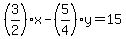 -5/4y = -3/2x +15 "....what I am currently stuck on.
You could continue by DIVIDING each side of the equation by the coefficient of y,
-5/4y = -3/2x +15 "....what I am currently stuck on.
You could continue by DIVIDING each side of the equation by the coefficient of y,  , or MULTIPLYING by its RECIPROCAL, , or MULTIPLYING by its RECIPROCAL,  . .
 ------ Multiplying each side by ------ Multiplying each side by

 , wherein, m, or , wherein, m, or  is your required RATE of CHANGE!
However, it's less complex, less time-consuming and less of a headache, in this author's opinion, when you CLEAR/GET rid of the
fractions, first and foremost, as follows:
6x - 5y = 60 ---- Multiplying by LCD, 4
- 5y = - 6x + 60 is your required RATE of CHANGE!
However, it's less complex, less time-consuming and less of a headache, in this author's opinion, when you CLEAR/GET rid of the
fractions, first and foremost, as follows:
6x - 5y = 60 ---- Multiplying by LCD, 4
- 5y = - 6x + 60
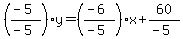 ---- Dividing each side by - 5
, wherein, m, or is your required RATE of CHANGE! ---- Dividing each side by - 5
, wherein, m, or is your required RATE of CHANGE!
Question 546400: solve the system of equations by using the substitution method
3x-4y=29
y=x-8
Found 3 solutions by ikleyn, josgarithmetic, MathTherapy:
Answer by ikleyn(53937)  (Show Source): (Show Source):
You can put this solution on YOUR website! .
In his solution, @mananth used a computer code (which he used practically in all his posts).
One of typical errors this code makes regularly is incorrect reading input data from original posts.
But @mananth never (or very rare) checks what the code produces,
so this is a source of many his faults.
Solutions of the other person, @lwsshar3, who also systematically uses a computer code,
suffer of the same deficiency.
Answer by josgarithmetic(39838) (Show Source):
Answer by MathTherapy(10858) (Show Source):
You can put this solution on YOUR website!
solve the system of equations by using the substitution method

3x-4y=29
y=x-8
***************
Solutions, x= 5.5, and y= -2.5, by @mananth(16949) are WRONG!!

It's extremely mind-blogging to see how this respondent "treated" this math problem, especially since it's EXTREMELY EASY
to solve! This author can only hope that this "solution" was IGNORED by everyone, especially the person who asked for help!

Correct solution set: 
Question 1210619: Fill in the blanks so that the resulting system does not have a unique solution.
8x + 12y = 26
8x + 12y = 1
14x + 16y = 14
14x + 16y = -8
20x + 35y = 19
20x + 35y = 4
Found 2 solutions by KMST, CPhill:
Answer by KMST(5396)  (Show Source): (Show Source):
You can put this solution on YOUR website! I see no blanks. I only see 6 linear equations on 2 variables.
It is not a properly defined question, but I will answer it for educational purposes, making some assumptions.
I am assuming that the answer expected is a system of 2 equations made using the equations listed.
We can make 15 different systems of 2 equations with the equations listed.
A system of 2 equations on 2 variables could have either a unique solution, or no solution, or infinite solutions.
In this case, I will show below that we cannot form a system of equations with infinite solutions from the equation listed.
The only systems of 2 equations with no unique solution that we can form the equations listed are systems with no solution.
From the equations listed, we could form a system of 3 equations with no solution by taking any 3 of the equations listed,
but I do not think that is the answer expected.
The graph of a linear equation on the x-y coordinate plane is a straight line.
Two lines on a plane could
be parallel, having no points in common, or
intersect at only one point.
If the graphs of two linear equations have 2 points in common,
then both equations represent the same line, such as  and and  . .
A system of two linear equations whose graph shows two intersecting straight line has one solution:
the coordinates of the intersection point, the only ordered pair (x,y) that satisfies both equations.
On a coordinate plane, each of the equations listed would represent a straight line, as shown below.
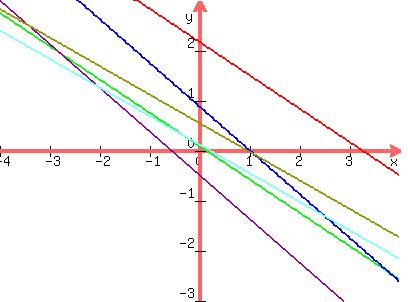
There are 6 lines visible in the graph, and some visible intersection points,
representing unique solutions for some of the possible systems of 2 linear equations.
SYSTEMS WITH UNIQUE SOLUTIONS:
The graph for a system of 2 equations on 2 variables with a unique solution shows 2 lines intersecting at just one point.
The coordinates of the intersection point are the unique solution.
Those systems are not the answer we are looking for.
SYSTEMS WITH INFINITE SOLUTIONS:
A system with infinite solutions does not have a unique solution, and could be a valid answer.
The graph for a system of 2 equations on 2 variables with infinite solutions would show one line because the two equations represent the same line.
That would be the case when you can obtain one of the equations by multiplying the other one by some number other than zero, as in  . .
A system like that cannot be made from the equations listed.
The only way to turn the left hand side of one equations into the left hand side of another is using the first 2,
or the third and fourth equations, or fifth and fourth equations, and multiply by 1,
but we would get the same equation and we see no repeats in the list of equations.
We cannot do it with equations that have different left hand sides, because the ratios of the x and y coefficients are different.
 for the first two, for the first two,
 for the third and fourth equations, and for the third and fourth equations, and
 for third and fourth equations. for third and fourth equations.
We cannot turn one of the left hand sides  , ,  and and  into another by multiplying by any number except zero. into another by multiplying by any number except zero.
So a systems with no unique solution that we can form from the list of
SYTEMS WITH NO SOLUTION:
The graph for a system of 2 equations on 2 variables with no solution shows 2 parallel lines.
There is no point on the x-y coordinate plane that satisfies both equations.
That is obvious for the system 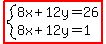 formed by the first 2 equations, formed by the first 2 equations,
because the value of the linear function on 2 variables  cannot be 26 and 1 for the same ordered pair (x,y). cannot be 26 and 1 for the same ordered pair (x,y).
The slope of the lines represented by  <-> <-> and and  <-> <->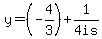 . .
Another system with no solution can be formed by the third and fourth equations; 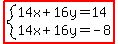 . .
The same can be said of the system formed by the fifth and sixth equations: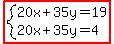 . .
Answer by CPhill(2264)  (Show Source): (Show Source):
Question 282711: Four gallons of a 45% acid solution is obtained by mixing a 90% solution with a 30% solution. How many gallons of each solution must be used to obtain the desired mixture?
Found 3 solutions by greenestamps, josgarithmetic, ikleyn:
Answer by greenestamps(13367) (Show Source):
You can put this solution on YOUR website!
For a formal algebraic solution using the standard method for solving 2-part mixture problems like this, see the response from tutor @ikleyn.
If formal algebra is not required, the answer can be obtained quickly with some mental arithmetic, using the fact that the ratio in which the two ingredients need to be mixed is exactly determined by where the target percentage lies between the percentages of the two ingredients.
Having used a lot of words to explain how this method works, here is the short work needed to get the answer.
(1) use some mental arithmetic to find that 45% is "3 times as close" to 30% as it is to 90%;
(2) that means the mixture needs to contain 3 times as much of the 30% acid as it does the 90% acid
Since the total amount is 4 gallons, you need 3 gallons of the 30% acid and 1 gallon of the 90% acid
ANSWER: 3 gallons of the 30% acid, 1 gallon of the 90% acid
Answer by josgarithmetic(39838) (Show Source):
Answer by ikleyn(53937) (Show Source):
You can put this solution on YOUR website! .
Four gallons of a 45% acid solution is obtained by mixing a 90% solution with a 30% solution.
How many gallons of each solution must be used to obtain the desired mixture?
~~~~~~~~~~~~~~~~~~~~~
The solution by @mananth is fatally wrong due to wrong setup of the basic equation.
I came to bring a correct solution.
let the quantity of 90% solution added be x
the total solution obtained is 4 gallons
So the remaining volume will be 30% solution
=4-x gallons
The sum of the acid content of mixed solutions is equal to acid content in the mixture
0.9x + 0.3*(4-x) = 0.45*4
0.9x + 1.2 - 0.3x = 1.80
0.6x = 1.8 - 1.2
0.6x = 0.6
x = 0.6 / 0.6
x = 1 gallons which is 90% acid solution
Balance will be 30% acid solution.
4 - 1 = 3 gallons
ANSWER. 1 gallon of the 90% solution and 3 gallons of the 30% solution.
CHECK for concentration.  = 0.45, or 45%. ! Precisely correct ! = 0.45, or 45%. ! Precisely correct !
Solved correctly.
Question 1124074: The sum of three numbers is 10. The sum of twice the first number, 5 times the second number, and 6 times the third number is 53. The difference between 7 times the first number and the second number is 4.
Find the three numbers.
first number:
second number:
third number:
Found 2 solutions by josgarithmetic, MathTherapy:
Answer by josgarithmetic(39838) (Show Source):
Answer by MathTherapy(10858) (Show Source):
You can put this solution on YOUR website!
The sum of three numbers is 10. The sum of twice the first number, 5 times the second number, and 6 times
the third number is 53. The difference between 7 times the first number and the second number is 4.
Find the three numbers.
first number:
second number:
third number:
********************
This is MUCH simpler than the other person made it out to be.
Let the 1st number be F, and the 2nd, S
Since the sum of the 3 numbers is 10, the 3rd is: 10 - F - S
The sum of twice the first, 5 times the second, and 6 times the third is 53, gives us:
2F + 5S + 6(10 - F - S) = 53
2F + 5S + 60 - 6F - 6S = 53
- 4F - S = - 7 ---- eq (i)
The difference between 7 times the first and the second number is 4, gives us:
7F - S = 4 ---- eq (ii)
- 4F - S = - 7 --- eq (i)
7F - S = 4 ---- eq (ii)
11F = 11 ---- Subtracting eq (i) from eq (ii)
First number, or  7(1) - S = 4 ---- Substituting 1 for F in eq (ii)
7 - S = 4
- S = 4 - 7
- S = - 3
Second number, or
7(1) - S = 4 ---- Substituting 1 for F in eq (ii)
7 - S = 4
- S = 4 - 7
- S = - 3
Second number, or  Third number: 10 - F - S = 10 - 1 - 3 = 10 - 4 = 6
Question 264851: 7x-4y=-3
2x+5y=8
Found 2 solutions by timofer, ikleyn:
Answer by timofer(159) (Show Source): (Show Source):
Answer by ikleyn(53937) (Show Source):
You can put this solution on YOUR website! .
7x - 4y = -3
2x + 5y = 8
~~~~~~~~~~~~~~~~~~~~~~~~~
The solution and the answer in the post by @mananth are incorrect.
See below my correct solution.
Your starting equation are
7x - 4y = -3 (1)
2x + 5y = 8 (2)
Let' solve the system by the Elimination method.
For it, multiply equation (1) by 2 (both sides) and multiply equation (2) by 7 (both sides).
You will get
14x - 8y = -6 (3)
14x + 35y = 56 (4)
From equation (4), subtract equation (3). The terms '14x' will cancel each other, and you will get
35y - (-8y) = 56 - (-6),
43y = 62,
y = 62/43.
To find 'x', substitute y = 62/43 in equation (2)
2x +  = 8,
2x = = 8,
2x =  = =  = =  .
x = .
x =  .
ANSWER. x = , y = .
ANSWER. x = , y =  . .
At this point the problem is solved completely.
There is no need to convert this solution in rational numbers to decimals as @mananth does.
The meaning of the problem is to get a precise solution in rational numbers,
and the problem does not ask to convert (to round) them in decimals.
Making conversion (rounding), you lose the precision.
Had the problem specially request for rounding, it would be justified.
Without a special request for rounding, in this problem it is better
to present a precise solution in rational numbers.
/\/\/\/\/\/\/\/\/
I perfectly know/understand WHY @mananth makes rounding here - it is because his computer code,
which he permanently uses to generate the solution files, is programmed this way.
But having incorrect (incorrectly written) computer code is not an argument to teach students in a wrong way.
Question 262876: A certain two-digit number has a value that is 2 more than 6 times the sum of its digits. The tens digit is 1 more than the units digit. Find the number by using linear sytems.
Found 2 solutions by josgarithmetic, ikleyn:
Answer by josgarithmetic(39838) (Show Source):
Answer by ikleyn(53937) (Show Source):
You can put this solution on YOUR website! .
A certain two-digit number has a value that is 2 more than 6 times the sum of its digits.
The tens digit is 1 more than the units digit. Find the number by using linear sytem.
~~~~~~~~~~~~~~~~~~~~~~~
In the solution by @mananth, the answer should be " 32 ", not " 31 ".
" 31 " is a mistake (a typo ?)
Question 2732: I am studing the substitution Method.. and for some reason i can not seem to figure out how to do it. My teacher has been trying to work with me, but yet when I look at the problem I go blank on what to do.
I have an equation y = 2x + 7
y = 10x - 1 I dont understand how to do this...
Answer by MathTherapy(10858) (Show Source):
You can put this solution on YOUR website!
I am studing the substitution Method.. and for some reason i can not seem to figure out how to do it.
My teacher has been trying to work with me, but yet when I look at the problem I go blank on what to do.
I have an equation y = 2x + 7
y = 10x - 1 I dont understand how to do this...
********************************************************************
I have no idea why the person who responded did this: y=2x+7
2x=y-7
x=(y-7)/2 ...... [3]
What could possibly make someone solve for "x," and create a 3rd equation, WITH a FRACTION,
and making things MUCH MORE COMPLEX, when the given equations are: y = 2x + 7
y = 10x - 1
Isn't that the MOST SIMPLEST a system can ever be, READY to be solved using the SUBSTITUTION method?
y = 2x + 7 ---- eq (i)
y = 10x - 1 --- eq (ii)
The above system MEANS that 2x + 7 = 10x - 1
2x - 10x = - 1 - 7
- 8x = - 8
x =  y = 2x + 7
y = 2(1) + 7 ----- Substituting 1 for x in eq (i)
y = 2 + 7 = 9
Solution set:
y = 2x + 7
y = 2(1) + 7 ----- Substituting 1 for x in eq (i)
y = 2 + 7 = 9
Solution set: 
Question 1189738: The sum of Mr. Micklow and Mrs. Craft's age is 55. The difference of their age is 3. What are their ages?
Found 2 solutions by josgarithmetic, n2:
Answer by josgarithmetic(39838) (Show Source):
Answer by n2(91) (Show Source): (Show Source):
You can put this solution on YOUR website! .
The sum of Mr. Micklow and Mrs. Craft's age is 55. The difference of their age is 3. What are their ages?
~~~~~~~~~~~~~~~~~~~~~~~~~~~
Regarding this problem and its solutions in the posts by @mananth and @ikleyn (myself),
I'd like to make one notice.
How this problem is worded, we can not determine, for sure, the age of each participant.
After solving the problem, we only can say that
EITHER Mr. Micklow is 29 years old and Mrs. Craft is 26 years old,
OR, in opposite, Mr. Micklow is 26 years old and Mrs. Craft is 29 years old,
In both cases, the statements of the problem are true, so both versions work well as answers.
As the problem is worded, it does not allow to determine their ages in more precise way.
Question 1180346: Will someone please help me with this problem?
A tree that is 8 feet tall is growing at a rate of 2 feet each year. Another tree that is 10 feet tall is growing at a rate of 1 foot each year. Determine how many years it will take for the two trees to reach the same height.
Answer by ikleyn(53937) (Show Source):
You can put this solution on YOUR website! .
A tree that is 8 feet tall is growing at a rate of 2 feet each year. Another tree that is 10 feet tall is growing
at a rate of 1 foot each year. Determine how many years it will take for the two trees to reach the same height.
~~~~~~~~~~~~~~~~~~~~~~~~~~~
@mananth gives the answer 3 years.
But if you check it, you will see that first tree will be 8 + 3*2 = 14 m tall,
while the second tree will be 10 + 3 = 13 m tall in 3 years.
So, the solution and the answer by @mananth both are INCORRECT.
I came to bring a correct solution.
The correct formula for the first tree height is

    h1(t) = 8 + 2t,  where t is the time in years from now, in years.


For the first tree height is

    h2(t) = 10 + t,  where t is the time in years from now, in years.


We equate two heights

    8 + 2t = 10 + t,

    2t - t = 10 - 8,

       t   =    2.


ANSWER.  Two trees will reach the same height in 2 years from now.
Solved correctly.
Question 1201131: Formulate a system of equations for the situation below and solve.
A private investment club has $400,000 earmarked for investment in stocks. To arrive at an acceptable overall level of risk, the stocks that management is considering have been classified into three categories: high-risk, medium-risk, and low-risk. Management estimates that high-risk stocks will have a rate of return of 15%/year; medium-risk stocks, 10%/year; and low-risk stocks, 6%/year. The members have decided that the investment in low-risk stocks should be equal to the sum of the investments in the stocks of the other two categories. Determine how much the club should invest in each type of stock if the investment goal is to have a return of $40,000/year on the total investment. (Assume that all the money available for investment is invested.)
high-risk stocks $
medium-risk stocks $
low-risk stocks $
Found 2 solutions by greenestamps, ikleyn:
Answer by greenestamps(13367) (Show Source):
You can put this solution on YOUR website!
The problem requires that half of the $400,000 be invested in the low-risk stocks that yield a return of 6%. $200,000 invested at 6% yields .06($200000) = $12,000.
The total return required is $40,000, so the $200,000 invested in the stocks that have returns of 10% and 15% must yield a return of $40,000-$12,000 = $28,000.
A yield of $28,000 on an investment of $200,000 requires an average interest rate of $28,000/$200,000 = 0.14 = 14%.
Simple mental arithmetic shows that 14% is four-fifths of the way from 10% to 15%; that means 4/5 of the remaining $200,000, or $160,000, must be invested at the higher rate.
ANSWER:
$160,000 at 15%
$40,000 at 10%
$200,000 at 6%
CHECK: .15($160,000) + .10($40,000) + .06($200,000) = $24,000 + $4000 + $12,000 = $40,000
Answer by ikleyn(53937) (Show Source):
You can put this solution on YOUR website! .
Formulate a system of equations for the situation below and solve.
A private investment club has $400,000 earmarked for investment in stocks. To arrive at an acceptable overall level of risk, the stocks that management is considering have been classified into three categories: high-risk, medium-risk, and low-risk. Management estimates that high-risk stocks will have a rate of return of 15%/year; medium-risk stocks, 10%/year; and low-risk stocks, 6%/year. The members have decided that the investment in low-risk stocks should be equal to the sum of the investments in the stocks of the other two categories. Determine how much the club should invest in each type of stock if the investment goal is to have a return of $40,000/year on the total investment. (Assume that all the money available for investment is invested.)
high-risk stocks $
medium-risk stocks $
low-risk stocks $
~~~~~~~~~~~~~~~~~~~~~~~~~~
Probably, you will be very amazed if I tell you that this problem can be easily solved
using only one unknown and one equation instead of using three unknowns and three equations.
But I will show it right now, in the next 3 minutes.
As the problem says, the total $400,000 is split in two equal parts: low-risk stock and the sum
the investments in the stocks of the other two categories.


So, $200,000 go to the low risk stock at 6%, and another $200,000 go to the other two categories
at 10% and 15%.


Let 'x' be the amount invested at 15%.
Then the amount invested at 10% is (200000-x) dollars.


Write the total interest equation

    0.15x + 0.1*(200000-x) + 0.06*200000 = 40000.


Simplify and find x

    0.15x + 20000 - 0.1x + 12000 = 40000

    0.15x - 0.1x = 40000 - 20000 - 12000

         0.05x   =          8000

             x   =          8000/0.05 = 160000


Thus $160,000 invested at 15% (high-risk);  $200,000 - $160,000 = $40,000 invested at 10% (medium-risk);
and  $200,000 invested at 6%  (low-risk).
At this point, the problem is solved completely using only one unknown and one equation.
It's immeasurably simpler, isn't it?
So, there are two ways to solve this problem: one way is to pretend that you are a stupid person
and follow blindly the problem's stupid instruction. Or learn the advanced way and reduce calculations.
Question 457527: Can someone help me solve the solution of the system by using the elimination method to find the solution?
x + 5y = 20
-x + 8 = 19
Found 4 solutions by n2, mccravyedwin, MathTherapy, ikleyn:
Answer by n2(91) (Show Source):
You can put this solution on YOUR website! .
Edwin,
about 40 years, I worked as a computer programmer, developing computer codes for my own researches
and for customers. After many years of working, I learned the truth: a good programmer knows better
than a customer, what the customer needs.
Working about 15 years at this forum, I can say similarly that I know better than any visitor
what this visitor wants to say or wants to express in his post.
Physicists who work every day with elementary particles on accelerators and observe tracks
of these particles, identifying known and unknown particles, have their professional proverb
"It's shameful to doubt when you know for sure".
Answer by mccravyedwin(421)  (Show Source): (Show Source):
You can put this solution on YOUR website!
This is written:

 x + 5y = 20
-x + 8 = 19

but it's being solved as if it were

 x + 5y = 20
-x + 8y = 19

Is that second term in the second equation supposed to 8, or 8y?

Edwin
Answer by MathTherapy(10858) (Show Source):
You can put this solution on YOUR website!
Can someone help me solve the solution of the system by using the elimination method to find the solution?

x + 5y = 20
-x + 8 = 19

This is the MOST RIDICULOUS and DUMBEST way I've ever seen an EXTREMELY SIMPLE solve-by-elimination
equations-system, solved.

BTW, is this REAL?
Answer by ikleyn(53937) (Show Source):
You can put this solution on YOUR website! .
Can someone help me solve the solution of the system by using the elimination method to find the solution?
x + 5y = 20
-x +8y = 19
~~~~~~~~~~~~~~~~~
When somebody solves such a system by the elimination method, the major question
is to choose a right strategy. The strategy which @mananth chooses in his solution,
is difficult to call a rational or a reasonable. He makes tons of unnecessary calculations,
which is easy to avoid if to use a rational strategy.
Your starting equations are

     x + 5y = 20     (1)
    -x + 8y = 19     (2)


Add the equations.  The terms 'x' of the first equation and '-x' of the second equation
will cancel each other, opening the way to a short and clear straightforward solution

         5y + 8y = 20 + 19,

            13y  =    39

              y  =    39/13 = 3.


Now from equation (1)

    x = 20 - 5y = 20 - 5*3 = 20 - 15 = 5.


ANSWER.  x = 5,  y = 3.


CHECK.  Substitute these values into equations to make sure that the answer is correct.
Solved.
This way of solving by elimination is natural.
The way which @mananth promotes/uses in his post is (a) unnatural and (b) is a   to teach. to teach.
/\/\/\/\/\/\/\/\/\/\/\/
This my addition is specially for tutor @MathTherapy and for other tutors, who want to know the truth.
The truth is that @mananth solutions are not the solutions produced by a living person.
They are the solutions produced by a computer code.
I started checking his solutions systematically somewhen in November-December of 2025.
After checking approximately 70 of his solutions, I noticed repeating patterns in his solutions.
Very often these patterns were errors that a living person in healthy mind would never make.
It was a starting point for me to suggest that @mananth is a computer code.
See my post under this link
https://www.algebra.com/algebra/homework/word/finance/Money_Word_Problems.faq.question.434949.html
https://www.algebra.com/algebra/homework/word/finance/Money_Word_Problems.faq.question.434949.html
where I first time formulated this my idea.
The more I submerged in his solutions the more I became sure that this is true.
Now, after checking about 1000 of his solutions, I am 129% convinced in it.
The other side of this truth is/was that many hundreds (if not thousands) of the same type Math problems,
that were posted to this forum and solved by @mananth, were posted not by real students/visitors,
but were created and posted with the only goal to train this code in solving them, to demonstrate
the abilities of the code in solving such problems, to get checking from free of charge voluntary tutors
and, ultimately, to build a base of knowledge (= a base of solutions) for artificial intelligence.
Question 938535: Hello, I am having issues with my system of equations homework. I was wondering of you could help me. I generally know how to solve them but I cannot get mine to turn out.
The system is:
x+y+z+w=6
2x+3y-w=0
-3x+4y+z+2w=4
x+2y-z+w=0
Thanks in advance! :)
Found 2 solutions by ikleyn, MathTherapy:
Answer by ikleyn(53937) (Show Source):
You can put this solution on YOUR website! .
Hello, I am having issues with my system of equations homework. I was wondering of you could help me.
I generally know how to solve them but I cannot get mine to turn out.
The system is:
x+y+z+w=6
2x+3y-w=0
-3x+4y+z+2w=4
x+2y-z+w=0
Thanks in advance! :)
~~~~~~~~~~~~~~~~~~~~~~~~~~~~~
Use advantages of the modern technology.
Go to web-site www.reshish.com
Find there free of charge online calculator for solving systems of linear equations.
Choose the Gauss-Jordan elimination method there.
Setup the extended matrix of the system and get the step by step solution
with all accompanying detailed explanations
x = 1, y = 0, z = 3, w = 2.
Tutor @mathmate reviewed this problem and gave his interesting suggestions.
One of his suggestion was that the matrix of the system is ill-defined.
I checked it by calculating its determinant.
(Again, I used the online calculator www.reshish.com)
The determinant of the matrix is 54, so it is NOT ill-defined.
@ikleyn, PhD in Math and Physics,
with a professional Math education from a renowned university and
with 40 years experience working as a computer programmer
and a researcher in computational physics/mechanics/civil engineering.
(solid bodies, porous media, heat transfer (thermal conductivity, phase changes, convective heat transfer,
combined thermal, convective and radiative heat transfer, hydrodynamics, fluid-structure interaction etc.)
Answer by MathTherapy(10858) (Show Source):
Question 457528: Can someone help me solve the solutin of the system using the elemination method?
5x + 2y = -11
7x - 3y = 13
Answer by ikleyn(53937) (Show Source):
Question 457531: Can someone help me solve the solution of the system using the elemination method?
0.3x - 0.2y = 4
0.5x + 0.5y = 45/23
Answer by ikleyn(53937) (Show Source):
Question 454259: use substitution method to determine whether the system of linear equations has no solution, one solution,or many solutions
2x - y = 8
x + 4y = 13
Found 4 solutions by n3, josgarithmetic, MathTherapy, ikleyn:
Answer by n3(7) (Show Source): (Show Source):
You can put this solution on YOUR website! .
use substitution method to determine whether the system of linear equations has no solution, one solution,or many solutions
2x - y = 8
x + 4y = 13
~~~~~~~~~~~~~~~~~~~~~
For some reason, @josgarithmetic showed up here and once again brought his wrong solution, stating that y = 9.
He shows up at the forum almost every time as I post my correct solution - and every time he tries to corrupt it.
I don't know how he's tolerated on this forum.
For other visitors - my advice is to ignore his posts, for the peace in your mind.
About him, everybody should know three truths:
(a) @josgarithmetic does not know Math,
(b) can not solve Math problems correctly,
(c) can not teach Math.
Answer by josgarithmetic(39838) (Show Source):
Answer by MathTherapy(10858) (Show Source):
You can put this solution on YOUR website!
use substitution method to determine whether the system of linear equations has no solution, one solution,or many solutions

2x - y =   8 ----- eq (i)
 x + 4y = 13 ----- eq (ii)

Again, this is a real LAUGH! Equation 1 can be easily solved for y, since the coefficient on y is - 1. Likewise,
eq (ii) can be easily solved for x, as its coefficient on x is 1.

So, why on earth would someone choose to SOLVE for a variable that has created FRACTIONS - which most people hate,
and which we normally GET RID OF when solving an equation - when 2 perfectly-stated equations (i) & (ii), already have variables
with coefficients - 1 and 1? This ABSOLUTELY makes NO SENSE, at all!!!

I know another person on this site, who has done the EXACT thing in some, maybe ALL, of her responses!! I wonder who taught them
these RIDICULOUS and NONSENSICAL solving techniques.

This may be one of the reasons why some people FEAR mathematics! I would, if I ever asked for help, and received this response!!
Answer by ikleyn(53937) (Show Source):
You can put this solution on YOUR website! .
use substitution method to determine whether the system of linear equations has no solution, one solution,
or many solutions
2x - y = 8
x + 4y = 13
~~~~~~~~~~~~~~~~~~~~~~~~~
The way how @mananth solves this system of equations in his post makes very bad impression.
Normal people would solve it differently, and no one normal teacher in healthy mind would teach
this way as @mananth does.
In this case, you are lucky, because you easy can express 'y' from the first equation

    y = 2x - 8

and substitute it into the second equation

    x + 4(2x-8) = 13.


Now simplify this equation and find x

    x + 8x - 32 = 13,

    x + 8x = 13 + 32

      9x   =    45

       x   =    45/9 = 5.


Now find 'y' by substituting x= 5 into  y = 2x-8 = 2*5-8 = 10-8 = 2.


ANSWER.  x = 5,  y = 2.
Solved correctly, in a normal way.
Ignore the post by @mananth for the safety of your mind, since it is wrong and inappropriate teaching.
Question 454258: solve using substitution method
x - 5y = 17
-5x - 6y = 8
Found 2 solutions by MathTherapy, ikleyn:
Answer by MathTherapy(10858) (Show Source):
You can put this solution on YOUR website!
solve using substitution method

  x - 5y = 17
-5x - 6y =  8

This is a real LAUGH! Why on earth would someone choose to SOLVE for a variable that'll create FRACTIONS - which most people hate,
and which we normally GET RID OF when solving an equation - when a perfectly-stated equation, in eq (i), already has a variable
with a coefficient of 1? This ABSOLUTELY makes NO SENSE, at all!!!

I know another person on this site, who has done the EXACT thing in some, maybe ALL, of her responses!! I wonder who taught them
these RIDICULOUS and NONSENSICAL solving techniques.

This may be one of the reasons why some people FEAR mathematics! I would, if I ever asked for help, and received this response!!

x - 5y = 17_____x = 17 + 5y ----- eq (i)
Isn't this what's needed to now substitute in eq (ii), so that the value of y can be determined, and then x, subsequently?
Answer by ikleyn(53937) (Show Source):
You can put this solution on YOUR website! .
Linear-systems/454258: solve using substitution method
x - 5y = 17
-5x - 6y = 8
~~~~~~~~~~~~~~~~~~~~~~~~~
The way how @mananth solves the problem in his post is absolutely incorrect.
He makes tons of incorrect calculations and invites visitors follow his wrong way,
which only can lead you to the firm score of '2'.
In this case, you are lucky, because you can easy express 'x' from the first equation
x = 5y + 17.
Now substitute it into the second equation, replacing 'x' there
-5(5y+17) - 6y = 8.
Simplify and find 'y'
-25y - 85 - 6y = 8,
-25y - 6y = 8 + 85
-31y = 93,
y =  = -3.
Now calculate 'x' from that expression which you got above from the first equation
x = 5y + 17 = 5*(-3)+17 = -15 + 17 = 2.
ANSWER. x = 2, y = -3. = -3.
Now calculate 'x' from that expression which you got above from the first equation
x = 5y + 17 = 5*(-3)+17 = -15 + 17 = 2.
ANSWER. x = 2, y = -3.
Solved correctly.
Ignore the post by @mananth and never even try to solve equations in the way he does.
Question 447905: substitution
a - 4b = 2
2a - 5b = 1
with steps too
Answer by ikleyn(53937) (Show Source):
You can put this solution on YOUR website! .
substitution
a - 4b = 2
2a - 5b = 1
~~~~~~~~~~~~~~~~~~~~~
The solution in the post by @mananth is INCORRECT.
His answer a = 1.08, b = 0.23 is INCORRECT. These values do not satisfy second equation.
So, I came to solve the problem in a right way.
From first equation, express  a = 4b+2 and substitute it into the second equation

    2(4b+2) - 5b = 1,

    8b + 4 - 5b = 1,

    3b = 1 - 4 = -3,

     b = -3/3 = -1.


Then  a = 4b+2 = 4*(-1) + 2 = -2.


ANSWER.  The solution is  a = -2,  b = -1.
Solved correctly.
Question 434087: solve this equation by sustitution
x=8-4y
2x-3y=13
Found 2 solutions by josgarithmetic, ikleyn:
Answer by josgarithmetic(39838) (Show Source):
Answer by ikleyn(53937) (Show Source):
You can put this solution on YOUR website! .
solve this equation by  substitution substitution
x=8-4y
2x-3y=13
~~~~~~~~~~~~~~~~
The way, which @mananth took for the solution in his post, I would compare with a driver,
who chooses to drive off-road parallel to a highway, instead of driving on the paved highway.
In this problem, you are very lucky, because one equation (first one of the two)
is just presented in the form ready for substitution.
So, use this (first) equation and replace 'x' in the second equation by 8-4y.
You will get then
2(8-4y) - 3y = 13.
Thus you have single equation for one unknown 'y', and you can easy solve it
16 - 8y - 3y = 13,
16 - 11y = 13,
16 - 13 = 11y,
3 = 11y,
y =  .
Having 'y', substitute this value into the first equation and find 'x'
x = 8 - .
Having 'y', substitute this value into the first equation and find 'x'
x = 8 -  = 8 - = 8 -  = =  = =  .
ANSWER. x = 76/11; y = 3/11. .
ANSWER. x = 76/11; y = 3/11.
Solved. The EXACT solution is obtained in rational numbers,
in opposite to the approximate answer in the post by @mananth, expressed in decimals.
------------------------
It is good to use decimals when it is needed.
But it is not good using decimals when it is not needed.
If to consider the solution by @mananth as a way and a tool for teaching students,
I would say that this way and this solution are inappropriate.
Not because I want to look very smart, but because what I said is a fact.
Question 429409: You invested money in two funds. Last year, the first fund paid a dividend of 8% and the second a dividend of 5%, and you received a total of $1330. This year, the first fund paid a 12% dividend and the second only 2% and you received a total of $1500. How much money did you invest in each fund?
Answer by ikleyn(53937) (Show Source):
You can put this solution on YOUR website! .
You invested money in two funds.
Last year, the first fund paid a dividend of 8% and the second a dividend of 5%, and you received a total of $1330.
This year, the first fund paid a 12% dividend and the second only 2% and you received a total of $1500.
How much money did you invest in each fund?
~~~~~~~~~~~~~~~~~~~~~~~~~~~~~~~
The solution in the post by @mananth is incorrect.
I came to bring a correct solution.
Write equations for the annual dividends for the 1st year and for the 2nd year,
as you read the problem
0.08x + 0.05y = 1330 (1)
0.12x + 0.02y = 1500 (2)
Multiply equation (1) by 2 (both sides). Multiply equation (2) by 5 (both sides). You will get
0.16x + 0.10y = 2660 (1')
0.60x + 0.10y = 7500 (2')
From equation (2'), subtract equation (1'). You will get
0.44x = 7500 - 2660
0.44x = 4840
x = 4840/0.44 = 11000.
Then from equation (1)
y = 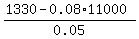 = 9000.
CHECK. Equation (1), left side 0.08*11000 + 0.05*9000 = 1330 dollars. ! correct !
Equation (2), left side 0.12*11000 + 0.02*9000 = 1500 dollars. ! correct !
ANSWER. $11000 were invested in the first fund and $9000 were invested in the second fund. = 9000.
CHECK. Equation (1), left side 0.08*11000 + 0.05*9000 = 1330 dollars. ! correct !
Equation (2), left side 0.12*11000 + 0.02*9000 = 1500 dollars. ! correct !
ANSWER. $11000 were invested in the first fund and $9000 were invested in the second fund.
Solved correctly by the Elimination method.
Question 1165132: Prose rhythm is characterized as the occurrence of five-syllable sequences in long passages of text. This characterization may be used to assess the similarity among passages of text and sometimes the identity of authors. The following information is based on an article by D. Wishart and S. V. Leach appearing in Computer Studies of the Humanities and Verbal Behavior (Vol. 3, pp. 90-99). Syllables were categorized as long or short. On analyzing Plato's Republic, Wishart and Leach found that about 26.1% of the five-syllable sequences are of the type in which two are short and three are long. Suppose that Greek archaeologists have found an ancient manuscript dating back to Plato's time (about 427 - 347 B.C.). A random sample of 317 five-syllable sequences from the newly discovered manuscript showed that 61 are of the type two short and three long. Do the data indicate that the population proportion of this type of five syllable sequence is different (either way) from the text of Plato's Republic? Use α = 0.01.
What is the value of the sample test statistic? (Round your answer to two decimal places.)
(c) Find the P-value of the test statistic.
Answer by CPhill(2264) (Show Source):
You can put this solution on YOUR website! This is a hypothesis test for a single population proportion ($p$).
### 1. State the Hypotheses
The goal is to determine if the proportion in the new manuscript is **different** (either way) from Plato's *Republic*.
* **Null Hypothesis ($H_0$):** The population proportion of the two short and three long (S-S-L-L-L) sequence type in the new manuscript is the same as Plato's Republic ($p = 0.261$).
$$H_0: p = 0.261$$
* **Alternative Hypothesis ($H_1$):** The population proportion is different from Plato's Republic ($p \neq 0.261$). (This is a two-tailed test.)
$$H_1: p \neq 0.261$$
### 2. Identify the Given Data
* **Hypothesized Population Proportion ($p_0$):** $0.261$
* **Sample Size ($n$):** $317$
* **Number of Successes ($x$):** $61$
* **Significance Level ($\alpha$):** $0.01$
### 3. Calculate the Sample Proportion ($\hat{p}$)
$$\hat{p} = \frac{x}{n} = \frac{61}{317} \approx 0.1924$$
### 4. Calculate the Test Statistic ($Z_{\text{test}}$)
The formula for the $Z$-test statistic for a proportion is:
$$Z_{\text{test}} = \frac{\hat{p} - p_0}{\sqrt{\frac{p_0(1 - p_0)}{n}}}$$
1. **Calculate the Standard Error (SE) of the Proportion:**
$$\text{SE} = \sqrt{\frac{0.261(1 - 0.261)}{317}} = \sqrt{\frac{0.261 \times 0.739}{317}} \approx \sqrt{0.00060907}$$
$$\text{SE} \approx 0.02468$$
2. **Calculate the $Z$-score:**
$$Z_{\text{test}} = \frac{0.1924 - 0.261}{0.02468} = \frac{-0.0686}{0.02468}$$
$$Z_{\text{test}} \approx -2.7796$$
Rounding the answer to two decimal places:
$$\mathbf{Z_{\text{test}} \approx -2.78}$$
### 5. Find the $P$-value of the test statistic.
Since this is a two-tailed test, the $P$-value is twice the area in the tail defined by the test statistic.
$$P\text{-value} = 2 \times P(Z \le -|Z_{\text{test}}|) = 2 \times P(Z \le -2.7796)$$
Using a standard normal distribution table or calculator:
$$P(Z \le -2.7796) \approx 0.00273$$
$$P\text{-value} = 2 \times 0.00273 \approx 0.00546$$
Rounding the answer to four decimal places:
$$\mathbf{P\text{-value} \approx 0.0055}$$
---
### Conclusion (Optional)
Since the $P$-value $(0.0055)$ is less than the significance level $\alpha$ $(0.01)$, we **reject the null hypothesis ($H_0$)**. The data indicate that the population proportion of the two short and three long five-syllable sequence type in the newly discovered manuscript is significantly **different** from the text of Plato's *Republic*.
Question 1165134: Let x be a random variable representing dividend yield of bank stocks. We may assume that x has a normal distribution with σ = 2.6%. A random sample of 10 bank stocks gave the following yields (in percents).
5.7 4.8 6.0 4.9 4.0 3.4 6.5 7.1 5.3 6.1
The sample mean is x bar = 5.38%. Suppose that for the entire stock market, the mean dividend yield is μ = 4.9%. Do these data indicate that the dividend yield of all bank stocks is higher than 4.9%? Use α = 0.01.
Compute the z value of the sample test statistic. (Enter a number. Round your answer to two decimal places.)
(c) Find (or estimate) the P-value.
Answer by CPhill(2264) (Show Source):
You can put this solution on YOUR website! ```python?code_reference&code_event_index=2
import numpy as np
from scipy.stats import norm
# Given parameters
mu_0 = 4.9 # Hypothesized population mean (%)
sigma = 2.6 # Population standard deviation (%)
n = 10 # Sample size
x_bar = 5.38 # Sample mean (%)
# --- Part (a): Compute the Z value of the sample test statistic ---
# 1. Calculate the standard error of the mean
SE = sigma / np.sqrt(n)
# 2. Calculate the Z-score
Z_test = (x_bar - mu_0) / SE
# --- Part (c): Find the P-value ---
# Since H1 is mu > 4.9 (right-tailed test), P-value = 1 - P(Z < Z_test)
P_value = 1 - norm.cdf(Z_test)
# Output results rounded as requested
Z_rounded = round(Z_test, 2)
P_rounded = round(P_value, 4)
print(f"Z-test statistic: {Z_test}")
print(f"Z-test statistic (rounded to 2 d.p.): {Z_rounded}")
print(f"P-value: {P_value}")
print(f"P-value (rounded to 4 d.p.): {P_rounded}")
```
```text?code_stdout&code_event_index=2
Z-test statistic: 0.5838051064926233
Z-test statistic (rounded to 2 d.p.): 0.58
P-value: 0.27967572112728867
P-value (rounded to 4 d.p.): 0.2797
```
This is a one-sample $Z$-test for the mean.
### 1\. Compute the $Z$ value of the sample test statistic.
The formula for the $Z$-test statistic is:
$$Z = \frac{\bar{x} - \mu_0}{\sigma / \sqrt{n}}$$
Given values: $\bar{x}=5.38$, $\mu_0=4.9$, $\sigma=2.6$, $n=10$.
1. **Calculate the Standard Error (SE):**
$$\text{SE} = \frac{2.6}{\sqrt{10}} \approx 0.82219$$
2. **Calculate the $Z$-score:**
$$Z = \frac{5.38 - 4.9}{0.82219} = \frac{0.48}{0.82219}$$
$$Z \approx 0.5838$$
Rounding the answer to two decimal places:
$$\mathbf{Z \approx 0.58}$$
-----
### 2\. Find the $P$-value.
Since the alternative hypothesis is $H_1: \mu > 4.9\%$ (a right-tailed test), the $P$-value is the area under the standard normal curve to the right of the test statistic $Z = 0.5838$.
$$P\text{-value} = P(Z \ge 0.5838)$$
Using the standard normal distribution calculation:
$$P\text{-value} \approx 0.279676$$
Rounding the answer to four decimal places:
$$\mathbf{P\text{-value} \approx 0.2797}$$
-----
### Conclusion (Optional)
Since the $P$-value $(0.2797)$ is much greater than the significance level $\alpha$ $(0.01)$, we fail to reject the null hypothesis. The data do not provide sufficient evidence to conclude that the dividend yield of all bank stocks is higher than $4.9\%$.
Question 1165201: Let x be a random variable representing dividend yield of bank stocks. We may assume that x has a normal distribution with σ = 2.6%. A random sample of 10 bank stocks gave the following yields (in percents).
5.7 4.8 6.0 4.9 4.0 3.4 6.5 7.1 5.3 6.1
The sample mean is x bar = 5.38%. Suppose that for the entire stock market, the mean dividend yield is μ = 4.9%. Do these data indicate that the dividend yield of all bank stocks is higher than 4.9%? Use α = 0.01.
Compute the z value of the sample test statistic. (Enter a number. Round your answer to two decimal places.)
0.640
(c) Find (or estimate) the P-value. (Enter a number. Round your answer to four decimal places.
Answer by CPhill(2264) (Show Source):
You can put this solution on YOUR website! The user is asking for the calculation of the $Z$-test statistic and the corresponding $P$-value for a one-sample hypothesis test concerning a population mean ($\mu$), where the population standard deviation ($\sigma$) is known.
### Given Information:
* **Population Mean (Hypothesized), $\mu_0$:** $4.9\%$
* **Population Standard Deviation (Known), $\sigma$:** $2.6\%$
* **Sample Size, $n$:** $10$
* **Sample Mean, $\bar{x}$:** $5.38\%$
* **Level of Significance, $\alpha$:** $0.01$
### Hypothesis Formulation:
* **Null Hypothesis ($H_0$):** The mean dividend yield is equal to $4.9\%$ ($\mu = 4.9$).
* **Alternative Hypothesis ($H_1$):** The mean dividend yield is higher than $4.9\%$ ($\mu > 4.9$). (This is a right-tailed test.)
### (a) Compute the $Z$ value of the sample test statistic.
The formula for the $Z$-test statistic for a sample mean when $\sigma$ is known is:
$$Z = \frac{\bar{x} - \mu_0}{\sigma / \sqrt{n}}$$
### (c) Find the $P$-value.
Since this is a right-tailed test, the $P$-value is the probability of observing a $Z$-score as extreme as the calculated test statistic or more extreme (i.e., further to the right).
$$P\text{-value} = P(Z \ge Z_{\text{test}}) = 1 - P(Z < Z_{\text{test}})$$
I will use the code interpreter to perform these calculations. I will use the provided $Z$-value of $0.64$ to confirm the calculation if possible, and then use the calculated $Z$-value to find the $P$-value. Since the user provided the $Z$-value as "0.640" I will use my calculated value but confirm if it matches the provided one.
```python?code_reference&code_event_index=2
import numpy as np
from scipy.stats import norm
# Given parameters
mu_0 = 4.9 # Hypothesized population mean (%)
sigma = 2.6 # Population standard deviation (%)
n = 10 # Sample size
x_bar = 5.38 # Sample mean (%)
# --- Part (a): Compute the Z value of the sample test statistic ---
# 1. Calculate the standard error of the mean
SE = sigma / np.sqrt(n)
# 2. Calculate the Z-score
Z_test = (x_bar - mu_0) / SE
# --- Part (c): Find the P-value ---
# Since H1 is mu > 4.9 (right-tailed test), P-value = 1 - P(Z < Z_test)
P_value = 1 - norm.cdf(Z_test)
# Output results rounded as requested
Z_rounded = round(Z_test, 2)
P_rounded = round(P_value, 4)
print(f"Standard Error (SE): {SE}")
print(f"Z-test statistic: {Z_test}")
print(f"Z-test statistic (rounded to 2 d.p.): {Z_rounded}")
print(f"P-value: {P_value}")
print(f"P-value (rounded to 4 d.p.): {P_rounded}")
```
```text?code_stdout&code_event_index=2
Standard Error (SE): 0.8221921916437787
Z-test statistic: 0.5838051064926233
Z-test statistic (rounded to 2 d.p.): 0.58
P-value: 0.27967572112728867
P-value (rounded to 4 d.p.): 0.2797
```
The problem asks for the $Z$-test statistic and the $P$-value for a one-tailed hypothesis test.
### 1\. Compute the $Z$ value of the sample test statistic.
The formula for the $Z$-test statistic is:
$$Z = \frac{\bar{x} - \mu_0}{\sigma / \sqrt{n}}$$
Given values: $\bar{x}=5.38$, $\mu_0=4.9$, $\sigma=2.6$, $n=10$.
1. **Calculate the Standard Error (SE):**
$$\text{SE} = \frac{2.6}{\sqrt{10}} \approx 0.82219$$
2. **Calculate the $Z$-score:**
$$Z = \frac{5.38 - 4.9}{0.82219} = \frac{0.48}{0.82219}$$
$$Z \approx 0.5838$$
Rounding the answer to two decimal places:
$$\mathbf{Z \approx 0.58}$$
***Note:*** *The provided $Z$ value of $0.640$ is slightly different from the calculated value of $0.58$. We will use the mathematically derived value of $0.58$ for consistency.*
### 2\. Find the $P$-value.
Since the alternative hypothesis is $H_1: \mu > 4.9$ (a right-tailed test), the $P$-value is the area under the standard normal curve to the right of the test statistic $Z = 0.5838$.
$$P\text{-value} = P(Z \ge 0.5838) = 1 - P(Z < 0.5838)$$
$$P\text{-value} \approx 1 - 0.720324$$
$$P\text{-value} \approx 0.279676$$
Rounding the answer to four decimal places:
$$\mathbf{P\text{-value} \approx 0.2797}$$
Question 1165202: Bill Alther is a zoologist who studies Anna's hummingbird (Calypte anna). (Reference: Hummingbirds, K. Long, W. Alther.) Suppose that in a remote part of the Grand Canyon, a random sample of six of these birds was caught, weighed, and released. The weights (in grams) were as follows.
3.7 2.9 3.8 4.2 4.8 3.1
The sample mean is x bar = 3.75 grams. Let x be a random variable representing weights of hummingbirds in this part of the Grand Canyon. We assume that x has a normal distribution and σ = 0.64 gram. Suppose it is known that for the population of all Anna's hummingbirds, the mean weight is μ = 4.30 grams. Do the data indicate that the mean weight of these birds in this part of the Grand Canyon is less than 4.30 grams? Use α = 0.10
Compute the z value of the sample test statistic. (Enter a number. Round your answer to two decimal places.)
(c) Find (or estimate) the P-value. (Enter a number. Round your answer to four decimal places.)
Answer by CPhill(2264) (Show Source):
You can put this solution on YOUR website! The user is asking for the calculation of the $Z$-test statistic and the corresponding $P$-value for a one-sample hypothesis test concerning a population mean ($\mu$), where the population standard deviation ($\sigma$) is known.
### Given Information:
* **Population Mean (Hypothesized), $\mu_0$:** $4.30$ grams
* **Population Standard Deviation (Known), $\sigma$:** $0.64$ grams
* **Sample Size, $n$:** $6$
* **Sample Mean, $\bar{x}$:** $3.75$ grams
* **Level of Significance, $\alpha$:** $0.10$
### Hypothesis Formulation:
* **Null Hypothesis ($H_0$):** The mean weight is equal to $4.30$ grams ($\mu = 4.30$).
* **Alternative Hypothesis ($H_1$):** The mean weight is less than $4.30$ grams ($\mu < 4.30$). (This is a left-tailed test.)
### (a) Compute the $Z$ value of the sample test statistic.
The formula for the $Z$-test statistic for a sample mean when $\sigma$ is known is:
$$Z = \frac{\bar{x} - \mu_0}{\sigma / \sqrt{n}}$$
### (c) Find the $P$-value.
Since this is a left-tailed test, the $P$-value is the probability of observing a $Z$-score as extreme as the calculated test statistic or more extreme (i.e., further to the left).
$$P\text{-value} = P(Z \le Z_{\text{test}})$$
I will use the code interpreter to perform these calculations.
```python?code_reference&code_event_index=2
import numpy as np
from scipy.stats import norm
# Given parameters
mu_0 = 4.30 # Hypothesized population mean
sigma = 0.64 # Population standard deviation
n = 6 # Sample size
x_bar = 3.75 # Sample mean
# --- Part (a): Compute the Z value of the sample test statistic ---
# 1. Calculate the standard error of the mean
SE = sigma / np.sqrt(n)
# 2. Calculate the Z-score
Z_test = (x_bar - mu_0) / SE
# --- Part (c): Find the P-value ---
# Since H1 is mu < 4.30 (left-tailed test), P-value = P(Z <= Z_test)
P_value = norm.cdf(Z_test)
# Output results rounded as requested
Z_rounded = round(Z_test, 2)
P_rounded = round(P_value, 4)
print(f"Standard Error (SE): {SE}")
print(f"Z-test statistic: {Z_test}")
print(f"Z-test statistic (rounded to 2 d.p.): {Z_rounded}")
print(f"P-value: {P_value}")
print(f"P-value (rounded to 4 d.p.): {P_rounded}")
```
```text?code_stdout&code_event_index=2
Standard Error (SE): 0.26127890589687236
Z-test statistic: -2.105030247704293
Z-test statistic (rounded to 2 d.p.): -2.11
P-value: 0.017644337582746063
P-value (rounded to 4 d.p.): 0.0176
```
Here are the required calculations for the hypothesis test:
### (a) Compute the $Z$ value of the sample test statistic.
The $Z$-test statistic is calculated as:
$$Z = \frac{\bar{x} - \mu_0}{\sigma / \sqrt{n}}$$
Using the given values ($\bar{x}=3.75$, $\mu_0=4.30$, $\sigma=0.64$, $n=6$):
1. **Calculate the Standard Error (SE):**
$$\text{SE} = \frac{0.64}{\sqrt{6}} \approx 0.26128$$
2. **Calculate the $Z$-score:**
$$Z = \frac{3.75 - 4.30}{0.26128} = \frac{-0.55}{0.26128}$$
$$Z \approx -2.1050$$
Rounding the answer to two decimal places:
$$\mathbf{Z \approx -2.11}$$
### (c) Find the $P$-value.
Since the alternative hypothesis is $H_1: \mu < 4.30$ (a left-tailed test), the $P$-value is the area under the standard normal curve to the left of the test statistic $Z = -2.1050$.
$$P\text{-value} = P(Z \le -2.1050)$$
$$P\text{-value} \approx 0.017644$$
Rounding the answer to four decimal places:
$$\mathbf{P\text{-value} \approx 0.0176}$$
-----
*(For context: Since the $P$-value $(0.0176)$ is less than the significance level $\alpha$ $(0.10)$, we would reject the null hypothesis and conclude that the data indicates the mean weight of these birds in this part of the Grand Canyon is indeed less than $4.30$ grams.)*
|
Older solutions: 1..45, 46..90, 91..135, 136..180, 181..225, 226..270, 271..315, 316..360, 361..405, 406..450, 451..495, 496..540, 541..585, 586..630, 631..675, 676..720, 721..765, 766..810, 811..855, 856..900, 901..945, 946..990, 991..1035, 1036..1080, 1081..1125, 1126..1170, 1171..1215, 1216..1260, 1261..1305, 1306..1350, 1351..1395, 1396..1440, 1441..1485, 1486..1530, 1531..1575, 1576..1620, 1621..1665, 1666..1710, 1711..1755, 1756..1800, 1801..1845, 1846..1890, 1891..1935, 1936..1980, 1981..2025, 2026..2070, 2071..2115, 2116..2160, 2161..2205, 2206..2250, 2251..2295, 2296..2340, 2341..2385, 2386..2430, 2431..2475, 2476..2520, 2521..2565, 2566..2610, 2611..2655, 2656..2700, 2701..2745, 2746..2790, 2791..2835, 2836..2880, 2881..2925, 2926..2970, 2971..3015, 3016..3060, 3061..3105, 3106..3150, 3151..3195, 3196..3240, 3241..3285, 3286..3330, 3331..3375, 3376..3420, 3421..3465, 3466..3510, 3511..3555, 3556..3600, 3601..3645, 3646..3690, 3691..3735, 3736..3780, 3781..3825, 3826..3870, 3871..3915, 3916..3960, 3961..4005, 4006..4050, 4051..4095, 4096..4140, 4141..4185, 4186..4230, 4231..4275, 4276..4320, 4321..4365, 4366..4410, 4411..4455, 4456..4500, 4501..4545, 4546..4590, 4591..4635, 4636..4680, 4681..4725, 4726..4770, 4771..4815, 4816..4860, 4861..4905, 4906..4950, 4951..4995, 4996..5040, 5041..5085, 5086..5130, 5131..5175, 5176..5220, 5221..5265, 5266..5310, 5311..5355, 5356..5400, 5401..5445, 5446..5490, 5491..5535, 5536..5580, 5581..5625, 5626..5670, 5671..5715, 5716..5760, 5761..5805, 5806..5850, 5851..5895, 5896..5940, 5941..5985, 5986..6030, 6031..6075, 6076..6120, 6121..6165, 6166..6210, 6211..6255, 6256..6300, 6301..6345, 6346..6390, 6391..6435, 6436..6480, 6481..6525, 6526..6570, 6571..6615, 6616..6660, 6661..6705, 6706..6750, 6751..6795, 6796..6840, 6841..6885, 6886..6930, 6931..6975, 6976..7020, 7021..7065, 7066..7110, 7111..7155, 7156..7200, 7201..7245, 7246..7290, 7291..7335, 7336..7380, 7381..7425, 7426..7470, 7471..7515, 7516..7560, 7561..7605, 7606..7650, 7651..7695, 7696..7740, 7741..7785, 7786..7830, 7831..7875, 7876..7920, 7921..7965, 7966..8010, 8011..8055, 8056..8100, 8101..8145, 8146..8190, 8191..8235, 8236..8280, 8281..8325, 8326..8370, 8371..8415, 8416..8460, 8461..8505, 8506..8550, 8551..8595, 8596..8640, 8641..8685, 8686..8730, 8731..8775, 8776..8820, 8821..8865, 8866..8910, 8911..8955, 8956..9000, 9001..9045, 9046..9090, 9091..9135, 9136..9180, 9181..9225, 9226..9270, 9271..9315, 9316..9360, 9361..9405, 9406..9450, 9451..9495, 9496..9540, 9541..9585, 9586..9630, 9631..9675, 9676..9720, 9721..9765, 9766..9810, 9811..9855, 9856..9900, 9901..9945, 9946..9990, 9991..10035, 10036..10080, 10081..10125, 10126..10170, 10171..10215, 10216..10260, 10261..10305, 10306..10350, 10351..10395, 10396..10440, 10441..10485, 10486..10530, 10531..10575, 10576..10620, 10621..10665, 10666..10710, 10711..10755, 10756..10800, 10801..10845, 10846..10890, 10891..10935, 10936..10980, 10981..11025, 11026..11070, 11071..11115, 11116..11160, 11161..11205, 11206..11250, 11251..11295, 11296..11340, 11341..11385, 11386..11430, 11431..11475, 11476..11520, 11521..11565, 11566..11610, 11611..11655, 11656..11700, 11701..11745, 11746..11790, 11791..11835, 11836..11880, 11881..11925, 11926..11970, 11971..12015, 12016..12060, 12061..12105, 12106..12150, 12151..12195, 12196..12240, 12241..12285, 12286..12330, 12331..12375, 12376..12420, 12421..12465, 12466..12510, 12511..12555, 12556..12600, 12601..12645, 12646..12690, 12691..12735, 12736..12780, 12781..12825, 12826..12870, 12871..12915, 12916..12960, 12961..13005, 13006..13050, 13051..13095, 13096..13140, 13141..13185, 13186..13230, 13231..13275, 13276..13320, 13321..13365, 13366..13410, 13411..13455, 13456..13500, 13501..13545, 13546..13590, 13591..13635, 13636..13680, 13681..13725, 13726..13770, 13771..13815, 13816..13860, 13861..13905, 13906..13950, 13951..13995, 13996..14040, 14041..14085, 14086..14130, 14131..14175, 14176..14220, 14221..14265, 14266..14310, 14311..14355, 14356..14400, 14401..14445, 14446..14490, 14491..14535, 14536..14580, 14581..14625, 14626..14670, 14671..14715, 14716..14760, 14761..14805, 14806..14850, 14851..14895, 14896..14940, 14941..14985, 14986..15030, 15031..15075, 15076..15120, 15121..15165, 15166..15210, 15211..15255, 15256..15300, 15301..15345, 15346..15390, 15391..15435, 15436..15480, 15481..15525, 15526..15570, 15571..15615, 15616..15660, 15661..15705, 15706..15750, 15751..15795, 15796..15840, 15841..15885, 15886..15930, 15931..15975, 15976..16020, 16021..16065, 16066..16110, 16111..16155, 16156..16200, 16201..16245, 16246..16290, 16291..16335, 16336..16380, 16381..16425, 16426..16470, 16471..16515, 16516..16560, 16561..16605
|
