Question 1187741: Find the maximum value and the minimum value of the function and the values of x and y for which they occur. P = 17x - 4y + 61, subject to 7x + 9y ≤ 63, 0 ≤ y ≤ 4, and 0 ≤ x ≤ 7.
Found 2 solutions by Edwin McCravy, greenestamps:
Answer by Edwin McCravy(20081)   (Show Source): (Show Source):
You can put this solution on YOUR website!
Graph all the boundary lines' equations using = signs for ≤
7x + 9y = 63 <--that's a slanted line with intercepts (0,7) and (9,0)
y = 0 <--that's the x-axis
y = 4 <--that's a horizontal line thru 4 on the y-axis
x = 0 <--that's the y-axis
x = 7 <--that's a vertical line through 7 on the x axis
 Consider 0 ≤ y ≤ 4 as y ≥ 0 and y ≤ 4
Consider 0 ≤ x ≤ 7 as x ≥ 0 and x ≤ 7
We decide which sides of all these lines to shade:
7x + 9y ≤ 63 <--shade below the slanted line because (0,0) satisfies it
y ≥ 0 <--shade above the x-axis (y greater than 0)
y ≤ 4 <--shade below the horizontal line (less than 4)
x ≥ 0 <--shade to the right of the y-axis (greater than 0)
x ≤ 7 <--shade left of the vertical line (less than 7)
Consider 0 ≤ y ≤ 4 as y ≥ 0 and y ≤ 4
Consider 0 ≤ x ≤ 7 as x ≥ 0 and x ≤ 7
We decide which sides of all these lines to shade:
7x + 9y ≤ 63 <--shade below the slanted line because (0,0) satisfies it
y ≥ 0 <--shade above the x-axis (y greater than 0)
y ≤ 4 <--shade below the horizontal line (less than 4)
x ≥ 0 <--shade to the right of the y-axis (greater than 0)
x ≤ 7 <--shade left of the vertical line (less than 7)
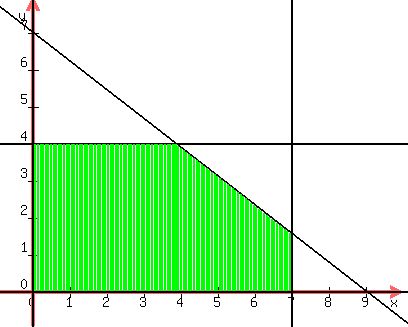 We find all the corner points of the feasible region.
We already have three of them, (0,0), (0,4), and (7,0).
We find the other two by
substituting y=4 into the slanted line's equation and solving for x, and
substituting x=7 into the slanted line's equation and solving for y.
7x + 9y = 63 7x + 9y = 63
7x + 9(4) = 63 7(7) + 9y = 63
7x + 36 = 63 49 + 9y = 63
7x = 27 9y = 14
x = 27/7 y = 14/9
So the other two corner points are (27/7, 4) and (7, 14/9)
We find all the corner points of the feasible region.
We already have three of them, (0,0), (0,4), and (7,0).
We find the other two by
substituting y=4 into the slanted line's equation and solving for x, and
substituting x=7 into the slanted line's equation and solving for y.
7x + 9y = 63 7x + 9y = 63
7x + 9(4) = 63 7(7) + 9y = 63
7x + 36 = 63 49 + 9y = 63
7x = 27 9y = 14
x = 27/7 y = 14/9
So the other two corner points are (27/7, 4) and (7, 14/9)
 Now we find the maximum and minimum values by substituting each corner point
into P = 17x - 4y + 61.
Corner point P = 17x - 4y + 61 = value
(0,0) P = 17(0)-4(0)+61 = 0-0+61 = 61
(7,0) P = 17(7)-4(0)+61 = 119-0+61 = 180
(7,14/9) P = 17(7)-4(14/9)+61 = 119-56/9+61 = 1564/9 = 173 7/9
(27/4,4) P = 17(27/4)-4(4)+61 = 459/4-16+61 = 639/4 = 159 3/4
(0,4) P = 17(0)-4(4)+61 = 0-16+61 = 45
So:
The maximum value is P = 180 when x = 7 and y = 0.
The minimum value is P = 45 when x = 0 and y = 4.
Edwin
Now we find the maximum and minimum values by substituting each corner point
into P = 17x - 4y + 61.
Corner point P = 17x - 4y + 61 = value
(0,0) P = 17(0)-4(0)+61 = 0-0+61 = 61
(7,0) P = 17(7)-4(0)+61 = 119-0+61 = 180
(7,14/9) P = 17(7)-4(14/9)+61 = 119-56/9+61 = 1564/9 = 173 7/9
(27/4,4) P = 17(27/4)-4(4)+61 = 459/4-16+61 = 639/4 = 159 3/4
(0,4) P = 17(0)-4(4)+61 = 0-16+61 = 45
So:
The maximum value is P = 180 when x = 7 and y = 0.
The minimum value is P = 45 when x = 0 and y = 4.
Edwin
Answer by greenestamps(13338)  (Show Source): (Show Source):
You can put this solution on YOUR website!
Nearly all resources on linear programming will say that you need to evaluate the objective function at all corners of the feasibility region to find the minimum and maximum values.
That is not true.
You can find the corners of the feasibility region that give the minimum and maximum values of the objective function by looking at the slope of the objective function.
Here is the nice drawing of the feasibility region that I pirated from Edwin's response:
The objective function in this problem (which, by the way, is not a reasonable one) is
P = 17x - 4y + 61
In slope-intercept form, that equation is
y = (17/4)x + (61-P)/4
So the slope of the objective function is 17/4.
***** THE MINIMUM AND MAXIMUM VALUES OF THE OBJECTIVE FUNCTION WILL BE OBTAINED WHERE LINES WITH SLOPES OF 17/4 JUST TOUCH THE FEASIBILITY REGION. *****
Here is the graph of the feasibility region again, with a few lines with slope 17/4 added:
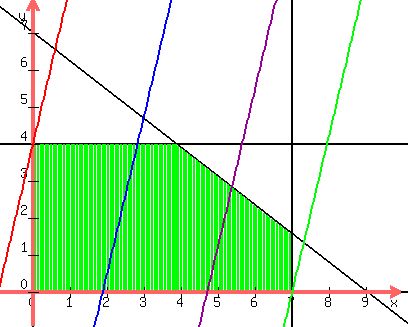
It should be clear, even without those extra lines drawn in the figure, that the two corners of the feasibility region where lines with slopes of 17/4 just touch the feasibility region are at (0,4) and (7,0).
Then, evaluating the objective function at those two points...
(0,4): 17(0)-4(4)+61 = -16+61 = 45
(7,0): 17(7)-4(0)+61 = 119+61 = 180
ANSWER: the minimum value of P is 45 at (0,4); the maximum value is 180 at (7,0)
|
|
|
