Question 618720: for the quadratic equation -16t^2+125t what is the maximum and minimum?
Found 3 solutions by Alan3354, josmiceli, math-vortex:
Answer by Alan3354(69443)   (Show Source): (Show Source):
You can put this solution on YOUR website! for the quadratic equation -16t^2+125t what is the maximum and minimum?
----------------
No equation is given.
-16t^2+125t is a binomial, not an equation.
Equations have equal signs.
-16t^2+125t might = 0
-16t^2+125t might = -1000
etc
Answer by josmiceli(19441)  (Show Source): (Show Source):
Answer by math-vortex(648)  (Show Source): (Show Source):
You can put this solution on YOUR website! Hi, there--
.
A quadratic equation only has one, either a maximum or a minimum. It won't have both.
.
The shape of the graph of a quadratic is a parabola. If the parabola opens upward, the the equation has a minimum at the vertex. If the parabola opens downward, the equation has a maximum at the vertex.
.
There are many ways to solve this problem. I'm not sure what math level you are studying, so I'll show an Algebra I method.
.
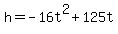
Since the minimum or maximum is located at the vertex, we'll end the vertex of this equation. The vertex will be an ordered pair (t,h). We have
.
.
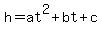
Notice that I added an h to be the 2nd variable of the equation. You could use any variable. When a quadratic equation is in standard form,
.
.
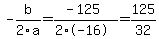
the t-value of the vertex is the value -b/2a, where a and b are the coefficients of the t^2 term and the t term in your equation. In your case a=-16 and b=125. Therefore,
.
.
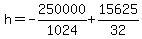
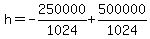
So the t-value of the vertex is 125/32. To find the h-value, we use substitution:
.


.
Now we know that the vertex of the parabola is at the point (125/32, 15625/64).
.
When a quadratic equation is in standard form, we can use the leading coefficient---the a-value---to determine if the parabola opens upward or downward. If a>0, the parabola opens up; if a<0, it opens down. In your case the parabola opens downward. This means that the vertex is a maximum for your parabola.
.
Hope this helps. Feel free to email if you have questions about this.
.
Ms.Figgy
math.in.the.vortex@gmail.com
|
|
|
