Question 1163416: You want to be able to withdraw $35,000 each year for 20 years. Your account earns 5% interest.
a) How much do you need in your account at the beginning?
$
b) How much total money will you pull out of the account?
$
c) How much of that money is interest?
$
Answer by ikleyn(53751)   (Show Source): (Show Source):
You can put this solution on YOUR website! .
Use the general formula X =  .
In this case the withdrawal annual rate is W = $35000, the annual compounding rate
is r = 0.05, p = 1 + 0.05 = 1.05, the number of withdrawal periods is n = 20. So
X = .
In this case the withdrawal annual rate is W = $35000, the annual compounding rate
is r = 0.05, p = 1 + 0.05 = 1.05, the number of withdrawal periods is n = 20. So
X = 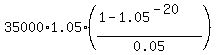 = 457,986.24 dollars.
It is how much your account should have at the beginning.
You will pull out 35000*20 = 700,000 dollars.
The difference 700,000 - 457,986.24 = 700,000 - 457,986.24 = 242,013.76 is the interest. = 457,986.24 dollars.
It is how much your account should have at the beginning.
You will pull out 35000*20 = 700,000 dollars.
The difference 700,000 - 457,986.24 = 700,000 - 457,986.24 = 242,013.76 is the interest.
Solved. All questions are answered.
--------------
See my lessons in this site associated with annuity saving plans and retirement plans
- Ordinary Annuity saving plans and geometric progressions
- Annuity Due saving plans and geometric progressions
- Solved problems on Ordinary Annuity saving plans
- Withdrawing a certain amount of money periodically from a compounded saving account (*)
- Miscellaneous problems on retirement plans
and especially lesson marked (*) in the list as the most relevant to the given problem.
|
|
|
