|
Tutors Answer Your Questions about Distributive-associative-commutative-properties (FREE)
Question 53088: I have to use the distributive property to simplify these problems, please let me know if these are correct.
98*7= 7(90+8)
9*28 = 9(20+8)
78*8 = (70+8)8
7(2,009) = 7(2,009)
899*5 = (800 +99)5
30*105 = 30(100*5)
8*5-12*5 = 5(5+3)-5(10+2) or 5(8)-5(12)
7*10+7(-3) = 7(10+3)
-4(3)+(-4)(6) = -4(3+6)
6(8) +6(-2) = 6(8+2)
Found 2 solutions by timofer, ikleyn:
Answer by timofer(159)  (Show Source): (Show Source):
You can put this solution on YOUR website! 98*7= 7(90+8)
wrong
9*28 = 9(20+8)
wrong
78*8 = (70+8)8
wrong
7(2,009) = 7(2,009)
wrong
899*5 = (800 +99)5
wrong
30*105 = 30(100*5)
wrong
8*5-12*5 = 5(5+3)-5(10+2) or 5(8)-5(12)
strange or wrong
7*10+7(-3) = 7(10+3)
wrong
-4(3)+(-4)(6) = -4(3+6)
CORRECT
6(8) +6(-2) = 6(8+2)
wrong
Answer by ikleyn(53937)  (Show Source): (Show Source):
You can put this solution on YOUR website! .
I have to use the distributive property to simplify these problems, please let me know if these are correct.
98*7= 7(90+8)
9*28 = 9(20+8)
78*8 = (70+8)8
7(2,009) = 7(2,009)
899*5 = (800 +99)5
30*105 = 30(100*5)
8*5-12*5 = 5(5+3)-5(10+2) or 5(8)-5(12)
7*10+7(-3) = 7(10+3)
-4(3)+(-4)(6) = -4(3+6)
6(8) +6(-2) = 6(8+2)
~~~~~~~~~~~~~~~~~~~~~~~~~~~~~~~~~
The other person (@consc198) says in his post "Yes they are correct".
Be aware: his answer is WRONG.
See my solution below with my comments.
98*7= 7(90+8)                            correct.

9*28 = 9(20+8)                           correct.

78*8 = (70+8)8                           correct.

7(2,009) = 7(2,009)                      Probably, it is 7*2.009 = 7*2 + 7*0.009.  In this form, it is correct.

899*5 = (800 +99)5                       I would simplify it THIS WAY:  899*5 = (900-1)*5 = 900*5 - 5.

30*105 = 30(100*5)                       In this form, it is wrong.  The correct form is  30*105 = 30(100+5).

8*5-12*5 = 5(5+3)-5(10+2) or 5(8)-5(12)  My interpretation is 8*5 - 12*5 = (8-12)*5.

7*10+7(-3) = 7(10+3)                     Wrong. A correct form is 7*10 + 7*(-3) = 7*(10-3).

-4(3)+(-4)(6) = -4(3+6)                  correct.

6(8) +6(-2) = 6(8+2)                     Wrong.  A correct form is  6(8) + 6(-2) = 6(8-2).
Solved correctly.
As I read and checked several solutions by @consc198, I see that this person produces wrong solutions without any hesitation.
By producing gibberish, he invites readers to visit his web-site for more help.
By observing the quality of his solutions, I would stay a cannon shot away from his website.
Question 955965: 2x to the third power + 3x to the second power minus 8x +12 =0
Found 4 solutions by greenestamps, ikleyn, timofer, MathTherapy:
Answer by greenestamps(13367)  (Show Source): (Show Source):
Answer by ikleyn(53937) (Show Source):
You can put this solution on YOUR website! .
To this visitor, I would recommend to take classes on mathematical writing
equations and expressions, using a computer keyboard, before posting to the forum.
Only after getting a certificate of successful completing such a class,
this visitor can be allowed to post to the forum.
Answer by timofer(159) (Show Source):
Answer by MathTherapy(10858)  (Show Source): (Show Source):
You can put this solution on YOUR website!
2x to the third power + 3x to the second power minus 8x +12 =0
The other person's solutions are correct, if the equation is: 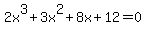 , as this trinomial factors nicely.
But, what I see is: , as this trinomial factors nicely.
But, what I see is: 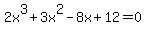 , which DOESN'T factor nicely. Am I the only one? , which DOESN'T factor nicely. Am I the only one?
Question 744472: What is the answer to (y+6)(y-7)
Answer by ikleyn(53937) (Show Source):
You can put this solution on YOUR website! .
The answer depends on what is the question.
Special clarification.
Before asking "what is the answer ?", you should provide a complete description
of the problem, word-in-word as it is given in the source, including the question.
Question 1210409: w-18=7
Found 2 solutions by Edwin McCravy, josgarithmetic:
Answer by Edwin McCravy(20086)  (Show Source): (Show Source):
Answer by josgarithmetic(39838) (Show Source):
Question 1210408: a-20=-3
Answer by josgarithmetic(39838) (Show Source):
Question 1170955: IQ is normally distributed with a mean of 100 and a standard deviation of 15.
a) Suppose one individual is randomly chosen. Find the probability that this person has an IQ greater than 95.
Write your answer in percent form. Round to the nearest tenth of a percent.
P
P
(IQ greater than 95) = %
b) Suppose one individual is randomly chosen. Find the probability that this person has an IQ less than 125.
Write your answer in percent form. Round to the nearest tenth of a percent.
P
P
(IQ less than 125) = %
c) In a sample of 600 people, how many people would have an IQ less than 110?
people
d) In a sample of 600 people, how many people would have an IQ greater than 140?
people
Answer by CPhill(2264)  (Show Source): (Show Source):
You can put this solution on YOUR website! Here's how to solve each part of the problem:
**Given:**
* Mean (μ) = 100
* Standard deviation (σ) = 15
* IQ is normally distributed.
**a) Probability of IQ greater than 95:**
1. **Calculate the z-score:**
* z = (x - μ) / σ
* z = (95 - 100) / 15 = -5 / 15 = -1/3 ≈ -0.3333
2. **Find the probability:**
* Use a z-table or calculator to find P(Z > -0.3333).
* P(Z > -0.3333) = 1 - P(Z < -0.3333) ≈ 1 - 0.3707 ≈ 0.6293
3. **Convert to percentage and round:**
* 0.6293 * 100 = 62.93%
* Rounded to the nearest tenth: 62.9%
**b) Probability of IQ less than 125:**
1. **Calculate the z-score:**
* z = (125 - 100) / 15 = 25 / 15 = 5/3 ≈ 1.6667
2. **Find the probability:**
* Use a z-table or calculator to find P(Z < 1.6667).
* P(Z < 1.6667) ≈ 0.9525
3. **Convert to percentage and round:**
* 0.9525 * 100 = 95.25%
* Rounded to the nearest tenth: 95.3%
**c) Number of people with IQ less than 110 in a sample of 600:**
1. **Calculate the z-score:**
* z = (110 - 100) / 15 = 10 / 15 = 2/3 ≈ 0.6667
2. **Find the probability:**
* Use a z-table or calculator to find P(Z < 0.6667).
* P(Z < 0.6667) ≈ 0.7475
3. **Calculate the expected number:**
* Expected number = 600 * 0.7475 ≈ 448.5
* Rounded to the nearest whole number: 449
**d) Number of people with IQ greater than 140 in a sample of 600:**
1. **Calculate the z-score:**
* z = (140 - 100) / 15 = 40 / 15 = 8/3 ≈ 2.6667
2. **Find the probability:**
* Use a z-table or calculator to find P(Z > 2.6667).
* P(Z > 2.6667) = 1 - P(Z < 2.6667) ≈ 1 - 0.9962 ≈ 0.0038
3. **Calculate the expected number:**
* Expected number = 600 * 0.0038 ≈ 2.28
* Rounded to the nearest whole number: 2
**Answers:**
* a) P(IQ greater than 95) = 62.9%
* b) P(IQ less than 125) = 95.3%
* c) 449 people
* d) 2 people
Question 1179597: Formulate a simple geometric statement that can be proven using
any combination of the following: congruence axioms, substitution, and
definitions. Show two different ways to prove this statement.
Answer by CPhill(2264) (Show Source):
You can put this solution on YOUR website! Okay, let's formulate a simple geometric statement and prove it in two different ways using congruence axioms, substitution, and definitions.
**Geometric Statement:**
**Given:** Two line segments AB and CD, where AB ≅ CD. Let E be a point on AB such that AE ≅ EB. Let F be a point on CD such that CF ≅ FD.
**Prove:** AE ≅ CF.
**Proof 1: Using Substitution and Congruence**
| Statement | Reason |
|---|---|
| 1. AB ≅ CD | Given |
| 2. AE ≅ EB | Given |
| 3. CF ≅ FD | Given |
| 4. AE = EB | Definition of congruent segments (If segments are congruent, their lengths are equal) |
| 5. CF = FD | Definition of congruent segments |
| 6. AB = CD | Definition of congruent segments |
| 7. AE + EB = AB | Segment Addition Postulate |
| 8. CF + FD = CD | Segment Addition Postulate |
| 9. AE + AE = AB | Substitution (Substitute AE for EB in step 7) |
| 10. CF + CF = CD | Substitution (Substitute CF for FD in step 8) |
| 11. 2AE = AB | Simplification |
| 12. 2CF = CD | Simplification |
| 13. 2AE = CD | Substitution (Substitute CD for AB in step 11, using step 6) |
| 14. 2AE = 2CF | Substitution (Substitute 2CF for CD in step 13, using step 12) |
| 15. AE = CF | Division Property of Equality (Divide both sides by 2) |
| 16. AE ≅ CF | Definition of congruent segments |
**Proof 2: Using a Different Substitution Approach**
| Statement | Reason |
|---|---|
| 1. AB ≅ CD | Given |
| 2. AE ≅ EB | Given |
| 3. CF ≅ FD | Given |
| 4. AE = EB | Definition of congruent segments |
| 5. CF = FD | Definition of congruent segments |
| 6. AB = CD | Definition of congruent segments |
| 7. AE + EB = AB | Segment Addition Postulate |
| 8. CF + FD = CD | Segment Addition Postulate |
| 9. AB/2 = AE | Division Property of Equality and Substitution(Using step 4, 7, and the fact that since AE=EB, AB is 2AE) |
| 10. CD/2 = CF | Division Property of Equality and Substitution(Using step 5, 8, and the fact that since CF=FD, CD is 2CF) |
| 11. AB/2 = CD/2 | Division Property of Equality (Dividing both sides of step 6 by 2) |
| 12. AE = CD/2 | Substitution (Substitute AE for AB/2 in step 11, using step 9) |
| 13. AE = CF | Substitution(Substitute CF for CD/2 in step 12, using step 10)|
| 14. AE ≅ CF | Definition of congruent segments |
**Explanation of the Proofs:**
* Both proofs rely on the fundamental definitions of congruent segments, which state that if segments are congruent, their lengths are equal, and vice versa.
* The Segment Addition Postulate is used to express the lengths of the given segments in terms of their parts.
* The proofs then use substitution to manipulate the equations and arrive at the desired conclusion.
* The division property of equality is used to isolate the segment lengths.
These proofs are simple yet demonstrate the power of combining definitions, postulates, and substitution to prove geometric statements.
Question 1179598: Write a proof for each of the following.
1. Given: 𝑚∠1 = 90°;∠1 ≅ ∠2
Prove: ∠2 is a right angle
2. Given: 3(x + 1) = 6(x - 3)
Prove: x = 7
3. Given: 𝑚∠1 = 180°;∠1 ≅ ∠2; 𝑚∠2 ≅ 𝑚∠3
Prove: ∠3 is a straight angle.
4. Given 8.5s - 81.7 = -9.23s + 148.79
Prove: s = 13
Answer by CPhill(2264) (Show Source):
You can put this solution on YOUR website! You got it! Let's write out the proofs in a clear, structured way.
**1. Given: 𝑚∠1 = 90°; ∠1 ≅ ∠2
Prove: ∠2 is a right angle**
**Proof:**
| Statement | Reason |
|---|---|
| 1. 𝑚∠1 = 90° | Given |
| 2. ∠1 ≅ ∠2 | Given |
| 3. 𝑚∠1 = 𝑚∠2 | Definition of congruent angles (If angles are congruent, their measures are equal) |
| 4. 𝑚∠2 = 90° | Substitution Property of Equality (Substitute 90° for 𝑚∠1 in step 3) |
| 5. ∠2 is a right angle | Definition of a right angle (An angle with a measure of 90° is a right angle) |
**2. Given: 3(x + 1) = 6(x - 3)
Prove: x = 7**
**Proof:**
| Statement | Reason |
|---|---|
| 1. 3(x + 1) = 6(x - 3) | Given |
| 2. 3x + 3 = 6x - 18 | Distributive Property (Multiply through the parentheses) |
| 3. 3x + 21 = 6x | Addition Property of Equality (Add 18 to both sides) |
| 4. 21 = 3x | Subtraction Property of Equality (Subtract 3x from both sides) |
| 5. 7 = x | Division Property of Equality (Divide both sides by 3) |
| 6. x = 7 | Symmetric Property of Equality (If a = b, then b = a) |
**3. Given: 𝑚∠1 = 180°; ∠1 ≅ ∠2; 𝑚∠2 ≅ 𝑚∠3
Prove: ∠3 is a straight angle**
**Proof:**
| Statement | Reason |
|---|---|
| 1. 𝑚∠1 = 180° | Given |
| 2. ∠1 ≅ ∠2 | Given |
| 3. 𝑚∠1 = 𝑚∠2 | Definition of congruent angles |
| 4. 𝑚∠2 = 180° | Substitution Property of Equality (Substitute 180° for 𝑚∠1 in step 3) |
| 5. 𝑚∠2 ≅ 𝑚∠3 | Given |
| 6. 𝑚∠2 = 𝑚∠3 | Definition of congruent angles |
| 7. 𝑚∠3 = 180° | Substitution Property of Equality (Substitute 180° for 𝑚∠2 in step 6) |
| 8. ∠3 is a straight angle | Definition of a straight angle (An angle with a measure of 180° is a straight angle) |
**4. Given: 8.5s - 81.7 = -9.23s + 148.79
Prove: s = 13**
**Proof:**
| Statement | Reason |
|---|---|
| 1. 8.5s - 81.7 = -9.23s + 148.79 | Given |
| 2. 17.73s - 81.7 = 148.79 | Addition Property of Equality (Add 9.23s to both sides) |
| 3. 17.73s = 230.49 | Addition Property of Equality (Add 81.7 to both sides) |
| 4. s = 13 | Division Property of Equality (Divide both sides by 17.73) |
Question 1179644: 1. Given: 𝑚∠1 = 90°;∠1 ≅ ∠2
Prove: ∠2 is a right angle
2. Given: 3(x + 1) = 6(x - 3)
Prove: x = 7
3. Given: 𝑚∠1 = 180°;∠1 ≅ ∠2; 𝑚∠2 ≅ 𝑚∠3
Prove: ∠3 is a straight angle.
4. Given 8.5s - 81.7 = -9.23s + 148.79
Prove: s = 13
Answer by CPhill(2264) (Show Source):
You can put this solution on YOUR website! Absolutely! Let's go through each proof step-by-step.
**1. Given: 𝑚∠1 = 90°;∠1 ≅ ∠2
Prove: ∠2 is a right angle**
**Proof:**
| Statement | Reason |
|---|---|
| 1. 𝑚∠1 = 90° | Given |
| 2. ∠1 ≅ ∠2 | Given |
| 3. 𝑚∠1 = 𝑚∠2 | Definition of congruent angles |
| 4. 𝑚∠2 = 90° | Substitution Property (substitute 𝑚∠1 with 90° from step 1 into step 3) |
| 5. ∠2 is a right angle | Definition of a right angle (an angle with measure 90°) |
**2. Given: 3(x + 1) = 6(x - 3)
Prove: x = 7**
**Proof:**
| Statement | Reason |
|---|---|
| 1. 3(x + 1) = 6(x - 3) | Given |
| 2. 3x + 3 = 6x - 18 | Distributive Property |
| 3. 3x + 21 = 6x | Addition Property of Equality (add 18 to both sides) |
| 4. 21 = 3x | Subtraction Property of Equality (subtract 3x from both sides) |
| 5. x = 7 | Division Property of Equality (divide both sides by 3) |
**3. Given: 𝑚∠1 = 180°;∠1 ≅ ∠2; 𝑚∠2 ≅ 𝑚∠3
Prove: ∠3 is a straight angle.**
**Proof:**
| Statement | Reason |
|---|---|
| 1. 𝑚∠1 = 180° | Given |
| 2. ∠1 ≅ ∠2 | Given |
| 3. 𝑚∠1 = 𝑚∠2 | Definition of congruent angles |
| 4. 𝑚∠2 = 180° | Substitution Property (substitute 𝑚∠1 with 180° from step 1 into step 3) |
| 5. 𝑚∠2 ≅ 𝑚∠3 | Given |
| 6. 𝑚∠2 = 𝑚∠3 | Definition of congruent angles |
| 7. 𝑚∠3 = 180° | Substitution Property (substitute 𝑚∠2 with 180° from step 4 into step 6) |
| 8. ∠3 is a straight angle | Definition of a straight angle (an angle with measure 180°) |
**4. Given 8.5s - 81.7 = -9.23s + 148.79
Prove: s = 13**
**Proof:**
| Statement | Reason |
|---|---|
| 1. 8.5s - 81.7 = -9.23s + 148.79 | Given |
| 2. 17.73s - 81.7 = 148.79 | Addition Property of Equality (add 9.23s to both sides) |
| 3. 17.73s = 230.49 | Addition Property of Equality (add 81.7 to both sides) |
| 4. s = 13 | Division Property of Equality (divide both sides by 17.73) |
Question 1184157: Construct two examples of bijective function from ZxZ to Q where Z is set of all integers and Q is set of rational numbers?
Found 2 solutions by ikleyn, CPhill:
Answer by ikleyn(53937) (Show Source):
You can put this solution on YOUR website! .
Construct two examples of bijective function from ZxZ to Q where Z is set
of all integers and Q is set of rational numbers?
~~~~~~~~~~~~~~~~~~~~~~~~~~~~
In his post, @CPhill states and insists that there is no bijective function from Z×Z to Q.
"The difference in their " denseness " properties prevents such a mapping from being constructed."
It is not correct, and below I explain  . .
The set ZxZ is countably infinite. It means that there is a bijection
f: ZxZ <---> Z
The set Q is also countably infinite. It means that there is a bijection
g: Z <---> Q
It  that the composition gof is the bijection ZxZ and Q
f g
ZxZ <--------> Z <--------> Q.
It disproves the statement by @CPhill. that the composition gof is the bijection ZxZ and Q
f g
ZxZ <--------> Z <--------> Q.
It disproves the statement by @CPhill.
Another question is IF it is possible to construct an explicit bijective function .
I asked Google. Google AI created this response under this link
https://www.google.com/search?q=Construct+two+examples+of+bijective+function+from+ZxZ+to+Q+where+Z+is+set+of+all+integers+and+Q+is+set+of+rational+numbers%3F&rlz=1C1CHBF_enUS1071US1071&oq=Construct+two+examples+of+bijective+function+from+ZxZ+to+Q+where+Z+is+set+of+all+integers+and+Q+is+set+of+rational+numbers%3F&gs_lcrp=EgZjaHJvbWUyBggAEEUYOTIGCAEQRRhA0gEJMTg1NWowajE1qAIIsAIB8QXIg8hlL4FHy_EFyIPIZS-BR8s&sourceid=chrome&ie=UTF-8
             - - - START of the Google response - - - (of 2/21/2025)


Two examples of bijective functions from ℤxℤ to ℚ (where ℤ is the set of all integers and ℚ is the set
of all rational numbers) are:

Example 1: Function using a numerator-denominator pairing

• Definition: f(m, n) =
	• If n ≠ 0, then f(m, n) = m/n
	• If n = 0, then f(m, n) = m


Explanation:

• This function maps each ordered pair (m, n) from ℤxℤ to a unique rational number.
• When n is not zero, it represents the rational number "m/n".
• When n is zero, the function effectively maps the pair to infinity (or any other fixed value depending on your interpretation of division by zero).

Example 2: Function using a "diagonal" mapping with a sign convention

• Definition: f(m, n) = (2m + n) / (2*(abs(n) + 1))

Explanation:

• This function creates a unique mapping by leveraging the "diagonal" pattern of adding 2m and n, while ensuring that the denominator always has a positive even value.
• The absolute value of n in the denominator is used to handle cases where n is negative, preventing duplicate values.

Key points about bijective functions: [1, 2]

• A bijective function needs to be both injective (one-to-one) and surjective (onto), meaning each element in the domain maps to a unique element in the codomain, and every element in the codomain is reached by some element in the domain. [1, 2]


Generative AI is experimental.


             - - - END of the Google response - - -
Below is my comment about the Google AI response
Example 1 above is INCORRECT. The function defined in Example 1 is NOT bijective.
It is not bijective, since the pairs (m,1) and (m,0) map into the same rational/(integer) number m.
Surely, I reported to Google about it.
Example 2 looks like to be correct. At least, I do not see the way to disprove it.
Answer by CPhill(2264) (Show Source):
You can put this solution on YOUR website! It's impossible to construct a bijective function from Z×Z to Q. Here's why:
* **Cardinality:** The set Z×Z (the set of all ordered pairs of integers) is countably infinite. This means its cardinality is the same as the set of integers (denoted by ℵ₀). The set of rational numbers Q is also countably infinite (cardinality ℵ₀).
* **Bijection Requirement:** A bijection requires a one-to-one and onto mapping between two sets. While both Z×Z and Q are countably infinite, that *alone* doesn't guarantee a bijection is possible. The *way* the elements are ordered or structured matters.
The crucial issue is that while both sets are countably infinite, any attempt to create an ordered list of elements in Z×Z and Q so that you can pair them off one-to-one will fail. You can list all the elements of Z×Z, and you can list all the elements of Q. But the fundamental difference is that between any two elements in Q, there are infinitely many other rational numbers. This "denseness" of Q is something Z×Z does not have. You can't create a mapping that preserves the "gaps" between integers when mapping to a set with no gaps.
**Why the "interleaving" approach doesn't work:**
You might think you could "interleave" the elements of Z×Z and Q. For example, you could list the elements of Z×Z in a spiral pattern and try to pair them with the rational numbers in some order. However, no matter how clever your interleaving method, you'll always run into the problem of the density of Q. You'll use up infinitely many pairs from ZxZ to cover a single "gap" between two elements in Q.
**In summary:** There is no bijective function from Z×Z to Q. The difference in their "denseness" properties prevents such a mapping from being constructed.
Question 1182545: In the 1992 presidential election, Alaska's 40 election districts averaged 2150 votes per district for President Clinton.
The standard deviation was 593.
(There are only 40 election districts in Alaska).
The distribution of the votes per district for President Clinton was bell-shaped.
Let X = number of votes for President Clinton for an election district.
Round all answers except part e. to 4 decimals.
a. What is the distribution of X?
X - N = 2150,593
b. Is 2150 a population mean or sample mean? Mean
c. Find the probability that a randomly selected district had fewer than 2142 votes for President Clinton.
d. Find the probability that a randomly selected district had between 2291 and 2561 votes for President Clinton.
e. Find the third quartile for votes President Clinton.
Round to the nearest whole number
Answer by CPhill(2264) (Show Source):
You can put this solution on YOUR website! Here's how to solve this problem:
**a. What is the distribution of X?**
X ~ N(2150, 593)
This means X follows a normal distribution with a mean (μ) of 2150 and a standard deviation (σ) of 593.
**b. Is 2150 a population mean or sample mean?**
Population mean. The problem states that 2150 is the *average* of *all* 40 election districts in Alaska. Since it pertains to the entire population, it's the population mean.
**c. Find the probability that a randomly selected district had fewer than 2142 votes for President Clinton.**
To find this probability, we need to calculate the z-score and then use a standard normal distribution table (or calculator) to find the corresponding probability.
* z = (x - μ) / σ
* z = (2142 - 2150) / 593
* z ≈ -0.0135
Now, we look up the probability associated with z = -0.0135. P(X < 2142) = P(Z < -0.0135) ≈ 0.4946
**d. Find the probability that a randomly selected district had between 2291 and 2561 votes for President Clinton.**
We need to calculate two z-scores and find the area under the normal curve between them.
* z₁ = (2291 - 2150) / 593 ≈ 0.2378
* z₂ = (2561 - 2150) / 593 ≈ 0.7099
Now, find the probabilities associated with these z-scores: P(Z < 0.7099) and P(Z < 0.2378) and subtract to find the probability between the two Z-scores:
P(2291 < X < 2561) = P(0.2378 < Z < 0.7099) = P(Z < 0.7099) - P(Z < 0.2378) ≈ 0.7611-0.5937 ≈ 0.1674
**e. Find the third quartile for votes President Clinton. Round to the nearest whole number.**
The third quartile (Q3) is the value below which 75% of the data falls. We need to find the z-score corresponding to 0.75 and then convert it to the corresponding number of votes.
* Find z such that P(Z < z) = 0.75. z ≈ 0.674
* Now, convert the z-score to the corresponding value of X:
X = μ + zσ
X = 2150 + (0.674 * 593)
X ≈ 2549.982
Rounding to the nearest whole number, the third quartile is approximately 2550 votes.
Question 1209234: Fill in the blank with a constant, so that the resulting expression can be
factored as the product of two linear expressions:
2ab - a + b + ___
Found 3 solutions by greenestamps, ikleyn, Edwin McCravy:
Answer by greenestamps(13367) (Show Source):
Answer by ikleyn(53937) (Show Source):
You can put this solution on YOUR website! .
Write three first terms in this form

    2ab - a + b + ___ = 2*(ab - a/2 + b/2 + ___).


Look at the expression in parentheses.

It is clear that it should be

    (ab - a/2 + b/2 - 1/4),


which is the product of linear binomials (a+1/2)*(b-1/2).


Now you have this identity

    2ab - a + b - 1/2  = 2*(a+1/2)*(b-1/2).


You can relate the factor 2 to the first or to the second binomial factor.
It will give you two possible decompositions

    2ab - a + b - 1/2 = (2a+1)*(b-1/2)

or

    2ab - a + b - 1/2 = (a+1/2)*(2b-1).


In any case, the blank term is -1/2.
Solved.
Answer by Edwin McCravy(20086) (Show Source):
You can put this solution on YOUR website!
I hope you understand FOIL, i.e., FIRSTS, OUTERS, INNERS, LASTS. I'm assuming you do.

2ab - a + b + ___

Write this:

(__ ± __)(__ ± __)

Let's fix up the FIRSTS to be 2ab.  We will split 2ab up into factors 2a and b
and put them for the FIRSTS

(2a ± __)(b ± __)

Now let's fix up the OUTERS.  We notice to get the term " -a " for the OUTERS,
we will need the term on the far right to be -1/2.

(2a ± __)(b - 1/2)

Now let's fix up the INNERS.  We notice to get the term +b for the
INNERS, we will need the term +1 in the remaining blank:

(2a + 1)(b - 1/2)  <--factorization as the product of two linear expressions

The LASTS are now already fixed up.

So we proceed to FOIL that out:

(2a)(b)+(2a)(-1/2)+(+1)(b)+(1)(-1/2)

2ab - a + b + (-1/2)

So we see that the answer is -1/2

Edwin
Question 1209235: Find the number of ordered pairs (m,n) of integers that satisfy
mn = 3m + 3n + 17.
Found 4 solutions by math_tutor2020, ikleyn, AnlytcPhil, greenestamps:
Answer by math_tutor2020(3838) (Show Source):
You can put this solution on YOUR website!
Answer: 8
Work Shown
mn = 3m+3n+17
mn-3m-3n = 17
mn-3m-3n+9 = 17+9
(mn-3m)+(-3n+9) = 26
m(n-3)-3(n-3) = 26
(m-3)(n-3) = 26
n = 26 = 2^1*13^1 = p^a*q^b shows that a = 1, b = 1
d(n) = number of positive divisors of n
n = p^a*q^b
d(n) = (1+a)*(1+b)
d(26) = (1+1)*(1+1)
d(26) = 4
There are 4 positive divisors of 26 and they are: 1, 2, 13, 26.
When including the negative divisors we get 8 total divisors:
1, 2, 13, 26,
-1, -2, -13, -26
So there must be 8 ordered pairs (m,n) that make (m-3)(n-3) = 26 true and that make m*n = 3m+3n+17 true as well; where m,n are integers.
If m,n were allowed to be decimal numbers, then there would be infinitely many ordered pair solutions.
-----------------------
Extra info:
If you want to find each ordered pair, then set the factors m-3 and n-3 equal to the factors of 26.
Some examples:
m-3 = 1 and n-3 = 26 lead to (m,n) = (4,29)
m-3 = 2 and n-3 = 13 lead to (m,n) = (5,16)
m-3 = 13 and n-3 = 2 lead to (m,n) = (16,5)
Here are all 8 integer solutions
(-23,2), (-10,1), (1,-10), (2,-23),
(4,29), (5,16), (16,5), (29,4)
They are sorted from smallest x coordinate to the largest x coordinate.
We have symmetry going on since (5,16) swaps to (16,5) as one example.
Side notes: - x*y = 3x+3y+17 solves to y = (3x+17)/(x-3)
- If you graphed y = (3x+17)/(x-3) using a tool like Desmos or GeoGebra (among many others), you can then determine the locations of the lattice points. A lattice point (x,y) is where both x and y are integers.
Answer by ikleyn(53937) (Show Source):
You can put this solution on YOUR website! .
Find the number of ordered pairs (m,n) of integers that satisfy
mn = 3m + 3n + 17.
~~~~~~~~~~~~~~~~~~~~~~~~~~~~~
Transform the given equation this way

    mn - 3m - 3n + 9 = 26,

    (n-3)*(m-3) = 26.


So, n-3 and m-3 are divisors of 26.


There are 4 different decompositions of 26 into the product of positive integer numbers

    8 = 1*26 = 2*13 = 13*2 = 26*1


It gives 4 different pairs (m,n).         // Since the problem does not ask to find them,
                                             I will not find them.


There are 4 different decompositions of 26 into the product of negative integer numbers

    26 = (-1)*(-26) = (-2)*(-13) = (-13)*(-2) = (-26)*(-1).


It gives 4 other different pairs (m,n).   // Since the problem does not ask to find them,
                                             I will not find them.


In all, there are 4+4 = 8 different pairs of integer numbers, satisfying the given equation.
Solved.
Answer by AnlytcPhil(1810)  (Show Source): (Show Source):
You can put this solution on YOUR website!



 Long division:
3
n-3)3n+17
3n- 9
26
Long division:
3
n-3)3n+17
3n- 9
26
   n-3 must divide evenly into 26, so n-3 is either ±1,±2,±13, or ±26
That's 8 possibilities, so we know the answer is 8. To check, we find them:
1. if n-3 = -26, then n = -23, and m = 3+26/(-23-3) = 2, ordered pair (2,-23).
2. if n-3 = -13, then n = -10, and m = 3+26/(-10-3) = 1, ordered pair (1,-10).
3. if n-3 = -2, then n = 1, and m = 3+26/(1-3) = -10, ordered pair (-10,1).
4. if n-3 = -1, then n = 2, and m = 3+26/(2-3) = -23, ordered pair (-23,2).
5. if n-3 = 1, then n = 4, and m = 3+26/(4-3) = 29, ordered pair (29,4).
6. if n-3 = 2, then n = 5, and m = 3+26/(5-3) = 16, ordered pair (16,5).
7. if n-3 = 13, then n = 16, and m = 3+26/(16-3) = 5, ordered pair (5,16).
8. if n-3 = 26, then n = 29, and m = 3+26/(29-3) = 4, ordered pair (4,29).
So indeed, there are 8 such ordered pairs.
Here is a plot of all 8. See how nicely they fit on that curve.
Can you guess what the equation of that curve is?
n-3 must divide evenly into 26, so n-3 is either ±1,±2,±13, or ±26
That's 8 possibilities, so we know the answer is 8. To check, we find them:
1. if n-3 = -26, then n = -23, and m = 3+26/(-23-3) = 2, ordered pair (2,-23).
2. if n-3 = -13, then n = -10, and m = 3+26/(-10-3) = 1, ordered pair (1,-10).
3. if n-3 = -2, then n = 1, and m = 3+26/(1-3) = -10, ordered pair (-10,1).
4. if n-3 = -1, then n = 2, and m = 3+26/(2-3) = -23, ordered pair (-23,2).
5. if n-3 = 1, then n = 4, and m = 3+26/(4-3) = 29, ordered pair (29,4).
6. if n-3 = 2, then n = 5, and m = 3+26/(5-3) = 16, ordered pair (16,5).
7. if n-3 = 13, then n = 16, and m = 3+26/(16-3) = 5, ordered pair (5,16).
8. if n-3 = 26, then n = 29, and m = 3+26/(29-3) = 4, ordered pair (4,29).
So indeed, there are 8 such ordered pairs.
Here is a plot of all 8. See how nicely they fit on that curve.
Can you guess what the equation of that curve is?
 Edwin
Edwin
Answer by greenestamps(13367) (Show Source):
You can put this solution on YOUR website!

Solve the equation for one variable in terms of the other:

Perform the indicated division and express the result as quotient and remainder:
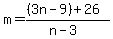

In that last equation, m and 3 are integers, so  must be an integer. must be an integer.
The number of ordered pair solutions is the number of integer factors of 26, which is 4.
NOTE: In typical problems like this, we are looking for solutions in positive integers. However, this problem does not specify positive integers; counting positive and negative integers, the number of integer factors of 26 is 8.
So there are 8 ordered pair solutions.
ANSWER: 8
The problem doesn't ask us to find the solutions, but we can do so to verify that there are 4 pairs of solutions. Note that the expression is symmetrical in m and n, so if (a,b) is a solution the (b,a) will be a solution. So to find the 8 solutions we only need to find 4 of them and switch the order of the two numbers to get the other solutions.
   n-3  n  m=3+26/(n-3)   solutions (m,n)
  ---------------------------------------
    1   4   3+26/1 = 29     (4,29) and (29,4)
    2   5   3+26/2 = 16     (5,16) and (16,5)
   -1   2   3+26/-1 = -23   (2,-23) and (-23,2)
   -2   1   3+26/-2 = -10   (1,-10) and (-10,1)
Question 1208689: Fill in the blanks with positive integers:
(3 + sqrt(6))^3 = ___ + ___ * sqrt(6)
Found 2 solutions by math_tutor2020, ikleyn:
Answer by math_tutor2020(3838) (Show Source):
Answer by ikleyn(53937) (Show Source):
Question 1208682: Fill in the blanks with positive integers:
(3 + sqrt(6))*3 = ___ + ___ * sqrt(6)
Answer by ikleyn(53937) (Show Source):
You can put this solution on YOUR website! .
Fill in the blanks with positive integers:
(3 + sqrt(6))*3 = ___ + ___ * sqrt(6)
~~~~~~~~~~~~~~~~~~~~~~~~~~~~~~~~~~~~~~~~~~~~~~~~
(3 + sqrt(6))*3 = 9 + 3*sqrt(6). ANSWER
Question 1208683: Expand (sqrt(x) + 3x)*4 + (sqrt(x) - 3x)*4.
Answer by greenestamps(13367) (Show Source):
You can put this solution on YOUR website!
Expand (sqrt(x) + 3x)*4 + (sqrt(x) - 3x)*4.
As posted....

Or perhaps the "4"s were supposed to be exponents?
Use "^" (shift-6) to denote exponentiation.
This problem would have been more interesting:
Expand (sqrt(x) + 3x)^4 + (sqrt(x) - 3x)^4.
If in fact that is what you intended, re-post showing the expression correctly.
Question 1207639: 75+72+69+66+.....21+18+15
Found 2 solutions by ikleyn, MathLover1:
Answer by ikleyn(53937) (Show Source):
Answer by MathLover1(20855)  (Show Source): (Show Source):
Question 1206996: To expand its business, Kingston Outlet Factory would like to issue a bond with par value of
₱1,000, coupon rate 10%, and maturity of 10 years. Calculate the bond amount given each of the
required rate of return.
a. 85%? b. 10%? c. 12%
Answer by Theo(13342)  (Show Source): (Show Source):
You can put this solution on YOUR website! par value of the bond is 1000
coupon rate is 10% per year.
maturity is 10 years.
if the required rate is 8.5%, the price of the bond will be 1098.42.
if the required rate is 10%, the price of the bond will be 1000.
if the required rate if 12%, the price of the bond will be 887.
this was found using the bond price calculator at https://www.fncalculator.com/financialcalculator?type=bondCalculator
here's a result from the calculator at 8.5%.

you fill in the inputs and click on price.
to do the other rates, leave the other inputs as is and change the rate to 10 and 12 respectively.
there are financial formulas that allow you to do this manually, using a stand alone calculator, but i wouldn't bother doing that unless you are required to.
the results will be, and should be, the same as provided by the calculator.
annual coupon rate of 10% is based on the face value of the bond = .10 * 1000 = 100.
Question 1206748: graph the inequalities of -24x+6y>18
Answer by greenestamps(13367) (Show Source):
Question 1204582: -6a+7(-2a-4)
Found 2 solutions by MathLover1, mananth:
Answer by MathLover1(20855) (Show Source):
Answer by mananth(16949)  (Show Source): (Show Source):
Question 1204292: Consider the binary operation defined by x * y=xy-2x-15 Solve x *2=0
Found 2 solutions by ikleyn, josgarithmetic:
Answer by ikleyn(53937) (Show Source):
You can put this solution on YOUR website! .
Consider the binary operation defined by x * y = xy-2x-15. Solve x * 2=0
~~~~~~~~~~~~~~~~~~
The solution in the post by @josgarithmetic is WRONG.
I came to bring a correct solution.
To get a tradition form of the x * 2 = equation,

we should substitute y= 2 in the expression  xy - 2x - 15.


By doing it, you get this equation

  2x - 2x - 15 = 0.


This equation is reduced to -15 = 0 after combining like term.


The last equation, -15 = 0, is self-contradictory and does not have solutions.


Therefore, the original equation x * 2 = 0 does not have solutions.


ANSWER.  The given equation does not have solution.
Solved.
-----------------
Ignore the post by @josgarithmetic, for the safety of your mind.
Answer by josgarithmetic(39838) (Show Source):
You can put this solution on YOUR website! Substituting and following the definition
x*y=xy-2x-15
x*(2)=(2)(y)-2(2)-15=0
2y-4-15=0
2y=19
y=19/2------------------nineteen halves
Question 1098110: Use the Commutative Property of Multiplication and the Associative Property of Multiplication to show the Power of a Product Property (a * b)^n = a^n * b^n is true.
Found 2 solutions by math_tutor2020, ikleyn:
Answer by math_tutor2020(3838) (Show Source):
You can put this solution on YOUR website!
The expression (a * b)^n means we have n copies of (a*b) multiplied together, where n is a positive integer.
Let's say for example we have (a*b)^3
That leads to 3 copies of (a*b) multiplied
(a*b)^3 = (a*b)*(a*b)*(a*b)
Then use the commutative property of multiplication
a*b = b*a
So,
(a*b)*(a*b)*(a*b)
is the same as
(a*b)*(b*a)*(a*b)
Then we use the associative property of multiplication
(a*b)*(b*a)*(a*b)
becomes
a*(b*b)*a*(a*b)
Use the associative and commutative properties to rearrange terms so that we end up with
(a*a*a)*(b*b*b)
that condenses down into
a^3*b^3
This example shows that (a*b)^3 = a^3*b^3
This can be extended more generally to (a*b)^n = a^n*b^n
Answer by ikleyn(53937) (Show Source):
Question 1201311: 3v^2 -33v+27
Answer by ikleyn(53937) (Show Source):
You can put this solution on YOUR website! .
You forgot to attach your question.
It's the same (or similar) as not looking at the traffic lights when crossing the street
(i.e. extreme carelessness).
Question 1200518: 8-3z=2z+9
Found 2 solutions by josgarithmetic, Alan3354:
Answer by josgarithmetic(39838) (Show Source):
Answer by Alan3354(69443)  (Show Source): (Show Source):
Question 1091106: Is the following true false or open?
6-t=12
Found 2 solutions by MathTherapy, math_tutor2020:
Answer by MathTherapy(10858) (Show Source):
Answer by math_tutor2020(3838) (Show Source):
You can put this solution on YOUR website!
Answer: Open
Reason:
A true equation is something like x+2x = 3x
It is true for all values of x in the domain. Another word for this is "identity". No matter what we pick for x, that equation is always true.
A false equation would be something like 3x = 3x+1
Subtract 3x from both sides and you'll end up with 0 = 1, which is clearly false.
False equations are known as contradictions. No matter what we pick for x, that equation is always false.
Open equations are equations that have at least one solution, but not every value of the variable will work (like it did with the identity).
In the equation 6-t = 12, the solution is t = -6. No other value of t will work.
Another way to think of open equations is to think of it like an open case.
It's open in the sense that we don't have a definitive yes or no. It depends on what the value of t is.
Further Reading:
https://www.mathsisfun.com/algebra/open-sentences.html
Question 1200110: 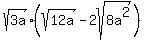
Does the  distribute to the distribute to the  factor in the 2nd term or to just the factor in the 2nd term or to just the
 factor? factor?
Either

or
 ??? ???
Can you please give a complete explanation of this?
Thank you
jadams
Answer by MathTherapy(10858) (Show Source):
Question 1200234: what is 4m=z but to determine how many ounces of water z he will need for the number of miles he hikes,if he hikes 20 miles, how many ounces of water will he need
Answer by ikleyn(53937) (Show Source):
You can put this solution on YOUR website! .
According to the text and to the context, there is the formula

    4m = z,

where m represents miles and z represents number of ounces of water.


If he hikes m= 20 miles, then the number of ounces of water z is

     4*20 = 80 ounces.


ANSWER.  80 ounces of water.
|
Older solutions: 1..45, 46..90, 91..135, 136..180, 181..225, 226..270, 271..315, 316..360, 361..405, 406..450, 451..495, 496..540, 541..585, 586..630, 631..675, 676..720, 721..765, 766..810, 811..855, 856..900, 901..945, 946..990, 991..1035, 1036..1080, 1081..1125, 1126..1170, 1171..1215, 1216..1260, 1261..1305, 1306..1350, 1351..1395, 1396..1440, 1441..1485, 1486..1530, 1531..1575, 1576..1620, 1621..1665, 1666..1710, 1711..1755, 1756..1800, 1801..1845, 1846..1890, 1891..1935, 1936..1980, 1981..2025, 2026..2070, 2071..2115, 2116..2160, 2161..2205, 2206..2250, 2251..2295, 2296..2340, 2341..2385, 2386..2430, 2431..2475, 2476..2520, 2521..2565, 2566..2610, 2611..2655, 2656..2700, 2701..2745, 2746..2790, 2791..2835, 2836..2880, 2881..2925, 2926..2970, 2971..3015, 3016..3060, 3061..3105, 3106..3150, 3151..3195, 3196..3240, 3241..3285, 3286..3330, 3331..3375, 3376..3420, 3421..3465, 3466..3510, 3511..3555, 3556..3600, 3601..3645, 3646..3690, 3691..3735, 3736..3780, 3781..3825, 3826..3870, 3871..3915, 3916..3960, 3961..4005, 4006..4050, 4051..4095, 4096..4140, 4141..4185, 4186..4230, 4231..4275, 4276..4320, 4321..4365, 4366..4410, 4411..4455, 4456..4500
|
| |
