Tutors Answer Your Questions about Complex Numbers (FREE)
Question 1210634: Fill in the blanks to make a true statement.
___ + ____i * 2 = ___ + 60i + ___ + ___ i
Answer by KMST(5396)   (Show Source): (Show Source):
You can put this solution on YOUR website! This is sort of a riddle to make a student think of an answer, but there are many possible answers.
I was introduced to complex numbers in math as a 7th grader and much later reintroduced to them again as a college student.
This question could be from a young student, new to algebra, so I will try not to use many mathematical terms that such as student would not have heard before.
There are 3 complex numbers in that equation, represented as the "___ + ____i" before *2 , ___ + 60i, and the other ___ + ___ i.
All those blanks are to be filled with numbers that could all be different.
I would like to name the blanks  , ,  , ,  , ,  , and , and  , in that order, to be able to tell those numbers apart. , in that order, to be able to tell those numbers apart.
If ___ + ____i is a complex number, then ___ + ____i*2 must mean the whole ___ + ____i complex number is multiplied times 2, not just its imaginary part.
Then, when filling the blanks with the letters above, I write
 . .
I have to work with the real parts (a, c, and d) of those numbers separate from the imaginary parts d, 60, and e.
Then the problem becomes a set of equations that have to be made true at the same time, what we call a system of equations.
-->  --> -->  --> --> 
There are only 2 equations in the system to determine the 5 numbers a, b, c, d, and e.
Of course, 2 equations is not enough to determine a set of 5 numbers, so there will be many posible answers.
Any of the infinte number of solutions to that system of equations will make the statement true.
To make it simple I could choose  as part of the solution. as part of the solution.
Then, substituting those values for a and b, I get  . .
I still have many choices to finish finding a single set of values for my solution to that riddle.
For a simple solution, I could choose  as a solution to as a solution to  . .
After that, I just need to solve  --> -->  to have to have  as one solution to the problem, as one solution to the problem,
and I could complete the blanks as

Question 963738: Sqrt of -15 times the sqrt of -5
Found 2 solutions by greenestamps, ikleyn:
Answer by greenestamps(13367)  (Show Source): (Show Source):
Answer by ikleyn(53937)  (Show Source): (Show Source):
Question 1027375: Find all the roots of (sqrt -1), leave the answer in polar form.
Found 2 solutions by greenestamps, ikleyn:
Answer by greenestamps(13367) (Show Source):
You can put this solution on YOUR website!
In order to answer this question, we first have to try to guess what the real question is. The presentation of the problem is exceedingly bad.
To start with, we have to guess what the meaning is of "(sqrt -1)". This looks like an expression involving the subtraction of one number from another; but "sqrt" is not a number. So the only reasonable guess is that this is supposed to be "sqrt(-1)".
Next, the question asks us to find roots. Roots are solutions to an equation; but there is no equation anywhere in the statement of the problem. "sqrt(-1)" is a number; numbers do not have roots.
Another tutor APPEARS to have interpreted the question to be asking for the SQUARE roots of "sqrt(-1)", giving two answers. But in fact what she showed in her response was dangerously wrong. She said  has the two values of i and -i. But is A number -- it can't have two different values. has the two values of i and -i. But is A number -- it can't have two different values.
But the problem ask for "all" the roots of "sqrt(-1)", and while that number has two square roots, is also has three cube roots, and four 4th roots, and 93 93rd roots....
So the reader in the end has no idea what the question is really asking.
Answer by ikleyn(53937) (Show Source):
Question 652351: square root of -15 multiplied by square root of -3 divided by square root of 5
Answer by MathTherapy(10858)  (Show Source): (Show Source):
You can put this solution on YOUR website!
square root of -15 multiplied by square root of -3 divided by square root of 5
*************************************
x = 5 or - 4, as stated by the other person, is WRONG!
The statement by the other person, ".....BUT, if you multiply a negative square root by another
negative square root, you get a positive!", is DEAD WRONG! As a result, his/her answer, 3, is WRONG!


 ----- Applying ----- Applying  , , 
 ---- Changing ---- Changing  to i to i

Question 170747: I need some help with this problem.
i asked my friend to help me with a previous problem and he ended up just giving me the answer cause i still don't get it.
The one already answered ==
"":How i tried to work it out.
[]:my answer
1. 
"2(x+6)(x-1)"
[x=6,(-1)]
Was that correct?
2. 
?????
Please help me.
Answer by MathTherapy(10858) (Show Source):
You can put this solution on YOUR website!
I need some help with this problem.
i asked my friend to help me with a previous problem and he ended up just giving me the answer cause i still don't get it.
The one already answered ==
"":How i tried to work it out.
[]:my answer
1.
"2(x+6)(x-1)"
[x=6,(-1)]
Was that correct?
2.
?????
Please help me.
===============
For 1.  , your factorization to get: "2(x+6)(x-1)" is WRONG!! Your solutions: [x=6,(-1)] are also WRONG!
FOILing 2(x + 6)(x - 1), we get: , your factorization to get: "2(x+6)(x-1)" is WRONG!! Your solutions: [x=6,(-1)] are also WRONG!
FOILing 2(x + 6)(x - 1), we get:  = =  , which doesn't correspond to the given trinomial, , which doesn't correspond to the given trinomial,  The person who responded also has a different factorized form [(x-6)(x+1)=0--], but unfortunately, this is also WRONG! FOILing
(x - 6)(x + 1) =
The person who responded also has a different factorized form [(x-6)(x+1)=0--], but unfortunately, this is also WRONG! FOILing
(x - 6)(x + 1) =  , which doesn't correspond with the reduced trinomial, , which doesn't correspond with the reduced trinomial,  (see below). His/her solutions,
x = 6, and x = - 1 are obviously WRONG too!
The correct factorization and solutions follow! (see below). His/her solutions,
x = 6, and x = - 1 are obviously WRONG too!
The correct factorization and solutions follow!

 (x - 3)(x - 2) = 0 <==== Correct factorized form
x - 3 = 0 OR x - 2 = 0
x = 3 OR x = 2 <===== CORRECT solutions
============================
Problem 2.
(x - 3)(x - 2) = 0 <==== Correct factorized form
x - 3 = 0 OR x - 2 = 0
x = 3 OR x = 2 <===== CORRECT solutions
============================
Problem 2.  CANNOT be factorized using integers. So, to get its roots/solutions, you'll need to use
the QUADRATIC EQUATION formula CANNOT be factorized using integers. So, to get its roots/solutions, you'll need to use
the QUADRATIC EQUATION formula
Question 453794: solve by completing the square.
x^2+4x-12=0
Answer by ikleyn(53937) (Show Source):
You can put this solution on YOUR website! .
Solve by completing the square.
x^2+4x-12=0
~~~~~~~~~~~~~~~~~~~~~~~~
In his post, @mananth found one root, but missed/lost another root.
So, his solution is incomplete.
I came to bring a complete solution.
x^2 + 4x - 12 = 0
x^2 + 4x = 12
x^2 + 4x + 4 = 12 + 4
(x+2)^2 = 16
x + 2 = +/-  x + 2 = +/- 4
Case (a). x + 2 = 4 ---> x = 4 - 2 = 2.
Vase (b). x + 2 = -4 ---> x = -4 - 2 = -6.
Thus, equation x^2 + 4x - 12 = 0 has two roots: x = 2 and x = -6.
Substitute these values into the equation to make sure that they do satisfy this equation.
x + 2 = +/- 4
Case (a). x + 2 = 4 ---> x = 4 - 2 = 2.
Vase (b). x + 2 = -4 ---> x = -4 - 2 = -6.
Thus, equation x^2 + 4x - 12 = 0 has two roots: x = 2 and x = -6.
Substitute these values into the equation to make sure that they do satisfy this equation.
Solved correctly and completely.
Question 1165360: If Z1,Z2 are part of C such that Im(z1) = sqrt(3), |z2| = 2 and z1*z2 = 4(cos( 5pi/6 ) + sin( 5pi/6)i ). Find the values of Z1 and Z2.
Answer by CPhill(2264)  (Show Source): (Show Source):
You can put this solution on YOUR website! This problem requires using the properties of complex numbers in both rectangular and polar forms, along with the geometric interpretation of multiplication.
Let $z_1 = x_1 + i y_1$ and $z_2 = x_2 + i y_2$.
### 1. Analyze the Given Information
* **$z_1$ in Rectangular Form:** We are given $\operatorname{Im}(z_1) = \sqrt{3}$.
$$z_1 = x_1 + i\sqrt{3}$$
* **$z_2$ in Polar Form:** We are given $|z_2| = 2$.
Let $z_2 = 2(\cos\theta_2 + i\sin\theta_2)$.
* **Product ($z_p$):** $z_p = z_1 z_2 = 4\left(\cos\left(\frac{5\pi}{6}\right) + i\sin\left(\frac{5\pi}{6}\right)\right)$.
### 2. Convert the Product to Rectangular Form
First, find the exact value of the product $z_p$.
$$\cos\left(\frac{5\pi}{6}\right) = -\cos\left(\frac{\pi}{6}\right) = -\frac{\sqrt{3}}{2}$$
$$\sin\left(\frac{5\pi}{6}\right) = \sin\left(\frac{\pi}{6}\right) = \frac{1}{2}$$
$$z_p = 4\left(-\frac{\sqrt{3}}{2} + i\frac{1}{2}\right)$$
$$z_p = -2\sqrt{3} + 2i$$
### 3. Use the Modulus Property of the Product
The modulus of the product is the product of the moduli: $|z_1 z_2| = |z_1| |z_2|$.
From the product's polar form, $|z_1 z_2| = 4$.
We are given $|z_2| = 2$.
$$4 = |z_1| \cdot 2$$
$$|z_1| = 2$$
### 4. Determine $z_1$
We have $z_1 = x_1 + i\sqrt{3}$ and $|z_1| = 2$.
The modulus is calculated as $|z_1| = \sqrt{x_1^2 + y_1^2}$:
$$2 = \sqrt{x_1^2 + (\sqrt{3})^2}$$
$$4 = x_1^2 + 3$$
$$x_1^2 = 1$$
$$x_1 = \pm 1$$
Therefore, there are two possible solutions for $z_1$:
$$\mathbf{z_{1a} = 1 + i\sqrt{3}} \quad \text{or} \quad \mathbf{z_{1b} = -1 + i\sqrt{3}}$$
### 5. Determine $z_2$ (using $z_2 = \frac{z_p}{z_1}$)
We use the relationship $z_2 = \frac{z_p}{z_1}$, where $z_p = -2\sqrt{3} + 2i$.
#### Case A: Using $z_{1a} = 1 + i\sqrt{3}$
To divide, it's simplest to use the polar form for $z_{1a}$.
$|z_{1a}| = 2$.
$$\arg(z_{1a}) = \arctan\left(\frac{\sqrt{3}}{1}\right) = \frac{\pi}{3}$$
$$z_{1a} = 2\left(\cos\left(\frac{\pi}{3}\right) + i\sin\left(\frac{\pi}{3}\right)\right)$$
The argument of the quotient is the difference of the arguments: $\arg(z_2) = \arg(z_p) - \arg(z_{1a})$.
From $z_p = 4\left(\cos\left(\frac{5\pi}{6}\right) + i\sin\left(\frac{5\pi}{6}\right)\right)$, we have $\arg(z_p) = \frac{5\pi}{6}$.
$$\theta_{2a} = \frac{5\pi}{6} - \frac{\pi}{3} = \frac{5\pi}{6} - \frac{2\pi}{6} = \frac{3\pi}{6} = \frac{\pi}{2}$$
Since $|z_2| = 2$:
$$z_{2a} = 2\left(\cos\left(\frac{\pi}{2}\right) + i\sin\left(\frac{\pi}{2}\right)\right) = 2(0 + i\cdot 1)$$
$$\mathbf{z_{2a} = 2i}$$
#### Case B: Using $z_{1b} = -1 + i\sqrt{3}$
Polar form for $z_{1b}$:
$|z_{1b}| = 2$.
$$\arg(z_{1b}) = \pi - \arctan\left(\frac{\sqrt{3}}{1}\right) = \pi - \frac{\pi}{3} = \frac{2\pi}{3}$$
$$z_{1b} = 2\left(\cos\left(\frac{2\pi}{3}\right) + i\sin\left(\frac{2\pi}{3}\right)\right)$$
$$\theta_{2b} = \arg(z_p) - \arg(z_{1b})$$
$$\theta_{2b} = \frac{5\pi}{6} - \frac{2\pi}{3} = \frac{5\pi}{6} - \frac{4\pi}{6} = \frac{\pi}{6}$$
Since $|z_2| = 2$:
$$z_{2b} = 2\left(\cos\left(\frac{\pi}{6}\right) + i\sin\left(\frac{\pi}{6}\right)\right) = 2\left(\frac{\sqrt{3}}{2} + i\frac{1}{2}\right)$$
$$\mathbf{z_{2b} = \sqrt{3} + i}$$
### Final Solution
There are two pairs of complex numbers $(z_1, z_2)$ that satisfy the given conditions:
$$\text{Pair 1: } \mathbf{z_1 = 1 + i\sqrt{3}} \quad \text{and} \quad \mathbf{z_2 = 2i}$$
$$\text{Pair 2: } \mathbf{z_1 = -1 + i\sqrt{3}} \quad \text{and} \quad \mathbf{z_2 = \sqrt{3} + i}$$
Question 1210495: Calculate the area of the triangle formed by the complex numbers , , and in the Argand plane, where is a complex number.
Answer by CPhill(2264) (Show Source):
You can put this solution on YOUR website! The area of the triangle formed by the complex numbers $z_1 = 0$, $z_2 = 1$, and $z_3 = i$ in the Argand plane is **$\frac{1}{2}$ square units**.
***
### Step 1: Identify the Coordinates
In the Argand plane, a complex number $z = x + yi$ corresponds to the Cartesian coordinate point $(x, y)$.
1. $z_1 = 0 = 0 + 0i \implies P_1 = (0, 0)$
2. $z_2 = 1 = 1 + 0i \implies P_2 = (1, 0)$
3. $z_3 = i = 0 + 1i \implies P_3 = (0, 1)$
### Step 2: Determine the Type of Triangle
Plotting these points reveals a right-angled triangle:
* The side from $P_1$ to $P_2$ lies along the positive **Real axis** (the $x$-axis) and has a length of **1**.
* The side from $P_1$ to $P_3$ lies along the positive **Imaginary axis** (the $y$-axis) and has a length of **1**.
* Since the Real and Imaginary axes are perpendicular, the angle at the origin ($P_1$) is $90^\circ$.
### Step 3: Calculate the Area
The area of a right-angled triangle is given by the formula:
$$\text{Area} = \frac{1}{2} \times \text{base} \times \text{height}$$
In this case:
* Base $= \text{length of the side from } (0, 0) \text{ to } (1, 0) = 1$
* Height $= \text{length of the side from } (0, 0) \text{ to } (0, 1) = 1$
$$\text{Area} = \frac{1}{2} \times 1 \times 1 = \frac{1}{2}$$
***
### Alternative Method: Using the Determinant Formula
The area of a triangle with vertices $(x_1, y_1)$, $(x_2, y_2)$, and $(x_3, y_3)$ is also given by:
$$\text{Area} = \frac{1}{2} \left| x_1(y_2 - y_3) + x_2(y_3 - y_1) + x_3(y_1 - y_2) \right|$$
Plugging in the coordinates $(0, 0)$, $(1, 0)$, and $(0, 1)$:
$$\text{Area} = \frac{1}{2} \left| 0(0 - 1) + 1(1 - 0) + 0(0 - 0) \right|$$
$$\text{Area} = \frac{1}{2} \left| 0 + 1(1) + 0 \right|$$
$$\text{Area} = \frac{1}{2} \times 1 = \frac{1}{2}$$
Question 1165887: Express the roots of (-14+3i)^-2/5 complex number in polar form.
Answer by CPhill(2264) (Show Source):
You can put this solution on YOUR website! ```python?code_reference&code_event_index=2
import numpy as np
# W = -14 + 3i
# Modulus r = sqrt(14^2 + 3^2) = sqrt(205)
r_squared = 205
R = 1 / r_squared # Modulus of C = W^-2
# Argument calculation for W
alpha = np.arctan(3/14) # Reference angle
# phi_W = pi - alpha (Argument of W)
# Argument calculation for C = W^-2
# phi = -2 * phi_W = -2 * (pi - alpha) = -2*pi + 2*alpha. We use the principal argument 2*alpha.
phi = 2 * alpha
# Modulus of the roots (R_root)
R_root = R**(1/5)
R_root_decimal = R_root # (1/205)^(1/5)
# Calculate phi in degrees for understanding
phi_degrees = np.degrees(phi)
# Calculate the argument for k=0
theta_0 = phi / 5
# Calculate the arguments for k=0, 1, 2, 3, 4 (in radians)
k_values = np.arange(5)
theta_k = (phi + 2 * np.pi * k_values) / 5
print(f"Modulus of the roots (R_root): {R_root_decimal}")
print(f"Base angle phi (radians): {phi}")
print(f"Argument theta_k (radians): {theta_k}")
```
```text?code_stdout&code_event_index=2
Modulus of the roots (R_root): 0.34486508519906256
Base angle phi (radians): 0.4221866664454931
Argument theta_k (radians): [0.08443733 1.34107439 2.59771146 3.85434852 5.11098558]
```
The problem asks for the roots of the complex number $Z = (-14+3i)^{-2/5}$ in polar form. We interpret this as finding the **five fifth roots** of the complex number $C = (-14+3i)^{-2}$.
The polar form of a complex number is $Z = R e^{i\theta}$. The $n$-th roots of $Z$ are given by De Moivre's Theorem:
$$Z_k = \sqrt[n]{R} \cdot e^{i \left(\frac{\theta + 2\pi k}{n}\right)}, \quad \text{for } k=0, 1, 2, \dots, n-1$$
Here, $n=5$.
## 1\. Convert the Base Complex Number to Polar Form
Let $W = -14 + 3i$. We first convert $W$ to polar form $W = r e^{i\theta}$.
$$r = \sqrt{(-14)^2 + 3^2} = \sqrt{196 + 9} = \sqrt{205}$$
$$\theta = \pi - \tan^{-1}\left(\frac{3}{14}\right) \quad (\text{Since } W \text{ is in QII})$$
Now we find $C = W^{-2}$:
* **Modulus ($R$):**
$$R = r^{-2} = (\sqrt{205})^{-2} = \frac{1}{205}$$
* **Argument ($\phi$):**
$$\phi = -2\theta = -2\left(\pi - \tan^{-1}\left(\frac{3}{14}\right)\right)$$
Using the periodicity of the argument, we take the principal argument, $\phi = 2 \tan^{-1}\left(\frac{3}{14}\right)$.
$$\phi \approx 2 \times 0.211093 \approx 0.42219 \text{ radians}$$
Thus, $C \approx \frac{1}{205} e^{i(0.42219)}$.
## 2\. Find the Five Fifth Roots ($Z_k$)
The roots $Z_k$ are the five distinct values of $C^{1/5}$.
### A. Modulus of the Roots ($R_{\text{root}}$)
$$R_{\text{root}} = \sqrt[5]{R} = \sqrt[5]{\frac{1}{205}} \approx \mathbf{0.3449}$$
### B. Arguments of the Roots ($\theta_k$)
The arguments are calculated using the formula:
$$\theta_k = \frac{\phi + 2\pi k}{5}, \quad \text{for } k=0, 1, 2, 3, 4$$
We use the exact value $\phi = 2 \tan^{-1}\left(\frac{3}{14}\right)$ and the approximation $\phi \approx 0.42219$.
| k | Argument $\theta_k$ (Exact Form) | Argument $\theta_k$ (Approx. Radians) |
| :---: | :---: | :---: |
| 0 | $\frac{1}{5} \left( 2 \tan^{-1}\left(\frac{3}{14}\right) \right)$ | $\mathbf{0.0844}$ |
| 1 | $\frac{1}{5} \left( 2 \tan^{-1}\left(\frac{3}{14}\right) + 2\pi \right)$ | $\mathbf{1.3411}$ |
| 2 | $\frac{1}{5} \left( 2 \tan^{-1}\left(\frac{3}{14}\right) + 4\pi \right)$ | $\mathbf{2.5977}$ |
| 3 | $\frac{1}{5} \left( 2 \tan^{-1}\left(\frac{3}{14}\right) + 6\pi \right)$ | $\mathbf{3.8543}$ |
| 4 | $\frac{1}{5} \left( 2 \tan^{-1}\left(\frac{3}{14}\right) + 8\pi \right)$ | $\mathbf{5.1110}$ |
The roots of the complex number $(-14+3i)^{-2/5}$ in polar form are:
$$Z_k = \frac{1}{\sqrt[5]{205}} \cdot e^{i \left( \frac{2 \tan^{-1}(3/14) + 2\pi k}{5} \right)}, \quad \text{for } k=0, 1, 2, 3, 4$$
Question 736989: 5-i / 4-3i
Answer by ikleyn(53937) (Show Source):
You can put this solution on YOUR website! .
(5-i) / (4-3i)
~~~~~~~~~~~~~~~
You are given a fraction of complex numbers  .
They want you transform it to the standard form complex number.
To do it, multiply the numerator and denominator by the complex number,
which is conjugate to the denominator of the given fraction.
So, you write
= .
They want you transform it to the standard form complex number.
To do it, multiply the numerator and denominator by the complex number,
which is conjugate to the denominator of the given fraction.
So, you write
=  = =  .
Now, to avoid a mess, let's work with the numerator and the denominator separately.
In the numerator, you have
(5-i)*(4+3i) = 20 + 15i - 4i - 3i^2 = 20 + 11i - 3*(-1) = 20 + 3 + 11i = 23 + 11i.
In the denominator, you have the product of a complex number (4-3i) and its conjugate (4+3i),
which is a real number
(4-3i)*(4+3i) = 4^2 + 3^2 = 16 + 9 = 25.
Thus, the ratio is
= .
Now, to avoid a mess, let's work with the numerator and the denominator separately.
In the numerator, you have
(5-i)*(4+3i) = 20 + 15i - 4i - 3i^2 = 20 + 11i - 3*(-1) = 20 + 3 + 11i = 23 + 11i.
In the denominator, you have the product of a complex number (4-3i) and its conjugate (4+3i),
which is a real number
(4-3i)*(4+3i) = 4^2 + 3^2 = 16 + 9 = 25.
Thus, the ratio is
=  = =  = 0.92 + 0.44i.
It is a standard form of a complex number.
At this point, the assignment is complete.
ANSWER. = = 0.92 + 0.44i.
It is a standard form of a complex number.
At this point, the assignment is complete.
ANSWER. =  .
Or, which is the same, = 0.92 + 0.44*i. .
Or, which is the same, = 0.92 + 0.44*i.
Solved.
Question 742206: 4-i over
2-6i
can you walk me through the steps Im a little rusty.
This is what I got.
2 % i
7
Answer by ikleyn(53937) (Show Source):
You can put this solution on YOUR website! .
4-i over
2-6i
can you walk me through the steps Im a little rusty.
~~~~~~~~~~~~~~~~~~~~~~~~~~~~~~~
You are given a fraction of complex numbers  .
They want you transform it to the standard form complex number.
To do it, multiply the numerator and denominator by the complex number,
which is conjugate to the denominator of the given fraction.
So, you write
= .
They want you transform it to the standard form complex number.
To do it, multiply the numerator and denominator by the complex number,
which is conjugate to the denominator of the given fraction.
So, you write
=  = =  .
Now, to avoid a mess, let's work with the numerator and the denominator separately.
In the numerator, you have
(4-i)*(2+6i) = 8 -2i + 24i - 6i^2 = 8 + 22i - 6*(-1) = 8 + 6 + 22i = 14 + 22i.
In the denominator, you have the product of a complex number (2-6i) and its conjugate (2+6i),
which is a real number
(2-6i)*(2+6i) = 2^2 + 6^2 = 4 + 36 = 40.
Thus, the ratio is
= .
Now, to avoid a mess, let's work with the numerator and the denominator separately.
In the numerator, you have
(4-i)*(2+6i) = 8 -2i + 24i - 6i^2 = 8 + 22i - 6*(-1) = 8 + 6 + 22i = 14 + 22i.
In the denominator, you have the product of a complex number (2-6i) and its conjugate (2+6i),
which is a real number
(2-6i)*(2+6i) = 2^2 + 6^2 = 4 + 36 = 40.
Thus, the ratio is
=  = =  .
It is a standard form of a complex number.
At this point, the assignment is complete.
ANSWER. = .
It is a standard form of a complex number.
At this point, the assignment is complete.
ANSWER. =  .
Or, which is the same, = 0.35 + 0.55*i. .
Or, which is the same, = 0.35 + 0.55*i.
Solved.
----------------------
The answer in the post by @lynnlo is incorrect.
Question 1210422: prove that : |{{ bc , c ^2, b ^2},{ c ^2, ca , a ^2},{ b ^2, a ^2, ab }}| = abc |{{ a , c , b },{ c , b , a },{ b , a , c }}|
Answer by ikleyn(53937) (Show Source):
You can put this solution on YOUR website! .
prove that : |{{ bc , c ^2, b ^2},{ c ^2, ca , a ^2},{ b ^2, a ^2, ab }}| = abc |{{ a , c , b },{ c , b , a },{ b , a , c }}|
~~~~~~~~~~~~~~~~~~~~~~~~~~~~~~~~~~~~~~~~~~~~~~~~~~
Your post was read but not understood.
What this post is about ?
In this form, your post is soup of letters, digits, parentheses and punctuation marks
with totally unclear meaning.
Is it a secret code to hidden treasures ?
Or, may be, it was retrieved from the sea in a sealed bottle ?
Can you explain/clarify the meaning of these hieroglyphs ?
Also, for your info: at this forum we work intensively to solve Math problems
for students and for Artificial Intelligence.
Deciphering mysterious messages is not our job at this forum. Try next door.
Question 1210420: In how many ways can 5 people be seated in 8 chairs around a round table?
Answer by ikleyn(53937) (Show Source):
You can put this solution on YOUR website! .
In how many ways can 5 people be seated in 8 chairs around a round table?
~~~~~~~~~~~~~~~~~~~~~~~~~~~~~~
For linear arrangements, the number of all possible distinguishable arrangements
is 8*7*6*5*4, the number of all permutations of 5 different objects from 8 objects.
To account for the circular symmetry, we must divide this number by 8.
It gives the answer to the problem's question  = 7*6*5*4 = 840.
ANSWER. For this problem there are 840 distinguishable circular permutations. = 7*6*5*4 = 840.
ANSWER. For this problem there are 840 distinguishable circular permutations.
Solved.
Question 1210412: if limit e ^(x) sec (((b sin x))^2) = 0 as x \[LongRightArrow] - \[Infinity] , , then the possible values of b belong to the int erval ....
Answer by CPhill(2264) (Show Source):
You can put this solution on YOUR website! This problem is solved by analyzing the behavior of the two components of the function, $e^x$ and $\sec((b \sin x)^2)$, as $x \to -\infty$.
The limit is given as:
$$\lim_{x \to -\infty} e^x \sec((b \sin x)^2) = 0$$
### 1. Analyze the Exponential Term
As $x \to -\infty$, the term $e^x$ approaches **zero** very rapidly:
$$\lim_{x \to -\infty} e^x = 0$$
### 2. Analyze the Secant Term
The secant function is $\sec(\theta) = \frac{1}{\cos(\theta)}$. The argument is $\theta = (b \sin x)^2$.
* The term $\sin x$ is a bounded function: $-1 \le \sin x \le 1$.
* Therefore, the argument $\theta = (b \sin x)^2$ is also bounded: $0 \le (b \sin x)^2 \le b^2$.
The behavior of the limit is determined by whether the secant term is bounded, or whether it becomes unbounded (oscillating between $-\infty$ and $+\infty$).
$$\sec((b \sin x)^2) = \frac{1}{\cos((b \sin x)^2)}$$
For the limit of the product, $0 \times (\text{Term})$, to be $0$, the $(\text{Term})$ must be **bounded** or, at worst, approach a finite value.
If the secant term is **unbounded**, the limit would be of the indeterminate form $0 \times (\text{Unbounded})$, which may not be $0$. The secant term becomes unbounded (approaches $\pm \infty$) when its denominator, $\cos((b \sin x)^2)$, approaches $0$.
### 3. Determine the Condition for Boundedness
The secant function $\sec(\theta)$ is unbounded if its argument $\theta$ can take the form $\frac{\pi}{2} + n\pi$ for any integer $n$.
For $\sec((b \sin x)^2)$ to be **unbounded**, the value $(b \sin x)^2$ must pass through a singularity, i.e., satisfy:
$$(b \sin x)^2 = \frac{\pi}{2} + n\pi \quad \text{for some integer } n \ge 0$$
(Since the argument is a square, it must be non-negative, so $n$ starts at $0$).
For the secant term to be **bounded** for all $x$, its argument $(b \sin x)^2$ must *never* equal a singularity. Since $0 \le (b \sin x)^2 \le b^2$, we must ensure that the entire range of values $[0, b^2]$ does not contain any singularity.
The first singularity occurs at $\frac{\pi}{2}$.
The first two singularities are $\frac{\pi}{2}$ and $\frac{3\pi}{2}$.
For the secant term to be bounded, the maximum value of the argument, $b^2$, must be strictly less than the first singularity:
$$b^2 < \frac{\pi}{2}$$
If $b^2 < \frac{\pi}{2}$, then $\frac{1}{\cos((b \sin x)^2)}$ is a continuous function whose argument is always strictly between $0$ and $\frac{\pi}{2}$. Its value is therefore bounded between $\sec(0)=1$ and $\lim_{\theta \to (\pi/2)^-} \sec(\theta) = +\infty$, but the maximum value is $\sec(b^2)$, which is finite.
$$\lim_{x \to -\infty} \underbrace{e^x}_{\to 0} \underbrace{\sec((b \sin x)^2)}_{\text{Bounded}} = 0 \times (\text{Bounded}) = 0$$
### 4. Solve for $b$
We require:
$$b^2 < \frac{\pi}{2}$$
$$|b| < \sqrt{\frac{\pi}{2}}$$
$$-\sqrt{\frac{\pi}{2}} < b < \sqrt{\frac{\pi}{2}}$$
The possible values of $b$ belong to the interval:
$$\left(-\sqrt{\frac{\pi}{2}}, \sqrt{\frac{\pi}{2}}\right)$$
Question 1184007: prove by mathematical induction:
1^5 + 2^5 + 3^5 + ... + n^5 = (1/12)n^2(n+1)^2(2n^2 + 2n -1)
Answer by ikleyn(53937) (Show Source):
You can put this solution on YOUR website! .
Prove by induction that for all n >= 1
1^ 5 +2^ 5 +3^ 5 +^ ...+ n ^ 5 = [n ^ 2 * (n + 1) ^ 2 * (2n ^ 2 + 2n - 1)] / 12 .
~~~~~~~~~~~~~~~~~~~~~~~~~~~~~~~~~
(a) The base of induction: n = 1.
Then the sum is one single term  , which is 1.
The formula (*) at n = 1 gives , which is 1.
The formula (*) at n = 1 gives
 = = 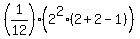 = =  = =  = 1,
so the base of induction is established.
(b) The step of induction.
We assume that for some integer k >= 1 this formula is valid
1^5 + 2^5 + 3^5 + . . . + k^5 = = 1,
so the base of induction is established.
(b) The step of induction.
We assume that for some integer k >= 1 this formula is valid
1^5 + 2^5 + 3^5 + . . . + k^5 =  . (1)
We want to prove that then the formula is valid for the next integer number k+1, too:
1^5 + 2^5 + 3^5 + . . . + k^5 + (k+1)^5 = . (1)
We want to prove that then the formula is valid for the next integer number k+1, too:
1^5 + 2^5 + 3^5 + . . . + k^5 + (k+1)^5 =  . (2)
At this point, the proof of the formula (2) is started.
In the left side of (2), we replace the sum of the first k addends by the right side expression (1).
Thus we want to prove
+ . (2)
At this point, the proof of the formula (2) is started.
In the left side of (2), we replace the sum of the first k addends by the right side expression (1).
Thus we want to prove
+  = . (3)
Let's transform left side of (3). We factor it, taking the common factor = . (3)
Let's transform left side of (3). We factor it, taking the common factor  out of parentheses.
Then left side of (3) takes the form out of parentheses.
Then left side of (3) takes the form
 =
= =
=  =
= =
=  . (4)
Now, I used an online calculator to factor an expression in the internal parentheses,
and the calculator produced this decomposition . (4)
Now, I used an online calculator to factor an expression in the internal parentheses,
and the calculator produced this decomposition
 = = 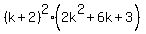 . (5)
( the link to the calculator is https://www.pocketmath.net , the mode is "Factor" ) )
This factorization can be continued this way
= = . (5)
( the link to the calculator is https://www.pocketmath.net , the mode is "Factor" ) )
This factorization can be continued this way
= =  . (6)
Now, combining all pieces (4), (5) and (6) in one whole block, we have
+ = . (7)
It is the same as (identical to) formula (3). Thus formula (3) is proven.
(3) Due to the principle of the mathematical induction, it means that formula . (6)
Now, combining all pieces (4), (5) and (6) in one whole block, we have
+ = . (7)
It is the same as (identical to) formula (3). Thus formula (3) is proven.
(3) Due to the principle of the mathematical induction, it means that formula
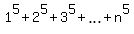 = =  .
is proved for all integer n >= 1. .
is proved for all integer n >= 1.
Solved.
Question 1210411: Prove by induction that for all n >= 1
1^ 5 +2^ 5 +3^ 5 +^ ...+ n ^ 5 = [n ^ 2 * (n + 1) ^ 2 * (2n ^ 2 + 2n - 1)] / 12 .
Answer by ikleyn(53937) (Show Source):
You can put this solution on YOUR website! .
Prove by induction that for all n >= 1
1^ 5 +2^ 5 +3^ 5 +^ ...+ n ^ 5 = [n ^ 2 * (n + 1) ^ 2 * (2n ^ 2 + 2n - 1)] / 12 .
~~~~~~~~~~~~~~~~~~~~~~~~~~~~~~~~~
(a) The base of induction: n = 1.

    Then the sum is one single term  ,  which is 1.

    The formula (*) at n = 1 gives

         =  =  =  = 1,

    so the base of induction is established.


(b)  The step of induction.

     We assume that for some integer k >= 1 this formula is valid

         1^5 + 2^5 + 3^5 + . . . + k^5 = .     (1)


     We want to prove that then the formula is valid for the next integer number k+1, too:

         1^5 + 2^5 + 3^5 + . . . + k^5 + (k+1)^5 = .     (2)


     At this point, the proof of the formula (2) is started.


     In the left side of (2), we replace the sum of the first k addends by the right side expression (1).

     Thus we want to prove

          +  = .     (3)


     Let's transform left side of (3). We factor it, taking the common factor  out of parentheses.

     Then left side of (3) takes the form

            =

         =  =

         = .    (4)


     Now, I used an online calculator to factor an expression in the internal parentheses,
     and the calculator produced this decomposition

          = .     (5)

     ( the link to the calculator is  https://www.pocketmath.net , the mode is "Factor" )  )


     This factorization can be continued this way

          =  = .    (6)


     Now, combining all pieces (4), (5) and (6) in one whole block, we have

          +  = .   (7)


     It is the same as (identical to) formula (3).  Thus formula (3) is proven.


(3)  Due to the principle of the mathematical induction, it means that formula

          = .

     is proved for all integer n >= 1.
Solved.
Question 1210398: Let f(x)= 1/(x+1). Determine the derivative of the -th iterate of , that is, compute , where denotes the composition of with itself times."
Answer by ikleyn(53937) (Show Source):
You can put this solution on YOUR website! .
See nice solution produced by Artificial Intelligence at this link
https://www.google.com/search?q=Let+f(x)%3D+1%2F(x%2B1).+Determine+the+derivative+of+the+-th+iterate+of+%2C+that+is%2C+compute+%2C+where+denotes+the+composition+of+with+itself+times.%22&rlz=1C1CHBF_enUS1071US1071&oq=Let+f(x)%3D+1%2F(x%2B1).+Determine+the+derivative+of+the+-th+iterate+of+%2C+that+is%2C+compute+%2C+where+denotes+the+composition+of+with+itself+times.%22&gs_lcrp=EgZjaHJvbWUyBggAEEUYOTIHCAEQIRiPAjIHCAIQIRiPAtIBCTIwOTFqMGoxNagCCLACAfEFH9zaLFZD0wI&sourceid=chrome&ie=UTF-8
(first output under this link).
Question 1210400: Let f(x)= 1/(x+1).
Determine the derivative of the -th iterate of , that is, compute , where denotes the composition of with itself times."
Answer by ikleyn(53937) (Show Source):
You can put this solution on YOUR website! .
See nice solution produced by Artificial Intelligence at this link
https://www.google.com/search?q=Let+f(x)%3D+1%2F(x%2B1).+Determine+the+derivative+of+the+-th+iterate+of+%2C+that+is%2C+compute+%2C+where+denotes+the+composition+of+with+itself+times.%22&rlz=1C1CHBF_enUS1071US1071&oq=Let+f(x)%3D+1%2F(x%2B1).+Determine+the+derivative+of+the+-th+iterate+of+%2C+that+is%2C+compute+%2C+where+denotes+the+composition+of+with+itself+times.%22&gs_lcrp=EgZjaHJvbWUyBggAEEUYOTIHCAEQIRiPAjIHCAIQIRiPAtIBCTIwOTFqMGoxNagCCLACAfEFH9zaLFZD0wI&sourceid=chrome&ie=UTF-8
(first output under this link).
Question 1210389: The function f(x) = (1\x) is decreasing on its domain ( true or false)
Found 3 solutions by math_tutor2020, ikleyn, josgarithmetic:
Answer by math_tutor2020(3838) (Show Source):
You can put this solution on YOUR website!
Answer: true
Explanation
I think you meant to type
f(x) = 1/x
As x gets bigger, i.e. as we move to the right, what happens to y = 1/x?
We can look at a graph to note how it goes downhill throughout its entire domain.
Therefore the answer is true

As x gets bigger, y gets smaller.
As we move to the right the curve goes downhill.
A way to do this without a graph is to plug in a value like x = 2
1/x = 1/2 = 0.50
Then plug in x = 3
1/x = 1/3 = 0.33 approximately
Comparing 0.50 with 0.33 shows that y has gone down, which helps show the function decreases.
Keep in mind that this does not prove it always decreases over the entire domain.
You'll have to use the method mentioned in the next paragraph.
Let's do a formal proof.
Let a > 0 and b > 0.
Since both are positive this means a+b > 0.
Plug in x = a to arrive at 1/a which is also positive.
Plug in x = a+b to arrive at 1/(a+b) which is also positive.
Now to compare 1/a with 1/(a+b)
Assume for now they are equal,
1/a = 1/(a+b)
a+b = a .... cross multiply
b = 0
We arrive at a contradiction since we made b > 0 earlier.
To fix those errors, replace each equal sign with a greater than sign
1/a > 1/(a+b)
a+b > a .... cross multiply
b > 0
Or basically we move through those steps backwards like so
b > 0
a+b > a
1/a > 1/(a+b)
This basically shows that for some input x = a, if we nudge that input to the right a bit to arrive at x = a+b, then we have shown that 1/a is larger than 1/(a+b)
In short we have proven the function is always going downhill no matter where you're on it.
Note that we can follow very similar steps when a < 0 and b > 0, to effectively mirror things over the y axis.
Answer by ikleyn(53937) (Show Source):
You can put this solution on YOUR website! .
The function f(x) = (1\x) is decreasing on its domain ( true or false)
~~~~~~~~~~~~~~~~~~~~~~~~~~~~~~~~~~~
First of all, I read this function as f(x) = 1/x,
following to the standard rules commonly accepted in Math.
The domain is the set of all real numbers except of 0 (zero).
Function f(x) = 1/x has two branches: one over the set of positive 'x',
another over the set of negative 'x'.
For each branch separately, function f(x) = 1/x is monotonic in each sub-domain.
Or, more accurately, function f(x) = 1/x is monotonically decreases locally in each sib-domain.
To prove it, take the derivative: it is -  . .
The denominator  is always positive for all 'x' of the domain; so, the derivative is always negative. is always positive for all 'x' of the domain; so, the derivative is always negative.
You also can convince yourself by making a plot of this function.
For it, go to website https:\\www.desmos.com/calculator/
Print the formula for the function y = 1/x.
You will get the plot instantly.
The plot clearly shows that the function monotonically decreases as 'x' increases in the domain.
So, locally for each branch, the function f(x) = 1/x monotonically decreases.
You have this answer proved formally and demonstrated / illustrated visually.
But we can not say that function f(x) = 1/x is globally decreasing: when 'x' moves
from negative values to positive values, the function 1/x jumps from negative values to positive,
breaking monotonicity.
So, locally this function is monotonically decreasing, but globally it is not monotonic.
//////////////////////////////////////
This problem is an elementary  . .
As I explained in my post above, locally and piece-wisely, the function is monotonically decreasing.
But globally, it is NOT monotonic.
It is OBVIOUS: compare these values of the function
    x     -2     -1     1     2

    1/x   -0.5   -1     1     0.5

          decrease      decrease
                 increase
They show non-monotonic behavior.
Tutor @math_tutor2000 fell into this trap.
Answer by josgarithmetic(39838) (Show Source):
Question 1210388: The function f(x) = (1\x) is monotonic on its domain ( true or false) ?
Answer by ikleyn(53937) (Show Source):
You can put this solution on YOUR website! .
The function f(x) = (1\x) is monotonic on its domain ( true or false) ?
~~~~~~~~~~~~~~~~~~~~~~~~~~~~~~~~~~~~~~~~~~~~~~~~~~~~~~~~~~~~
First of all, I read this function as f(x) = 1/x,
following to the standard rules commonly accepted in Math.
The domain is the set of all real numbers except of 0 (zero).
Function f(x) = 1/x has two branches: one over the set of positive 'x',
another over the set of negative 'x'.
For each branch separately, function f(x) = 1/x is monotonic in each sub-domain.
Or, more accurately, function f(x) = 1/x is monotonically decreases locally in each sib-domain.
To prove it, take the derivative: it is - .
The denominator is always positive for all 'x' of the domain; so, the derivative is always negative.
You also can convince yourself by making a plot of this function.
For it, go to website https:\\www.desmos.com/calculator/
Print the formula for the function y = 1/x.
You will get the plot instantly.
The plot clearly shows that the function monotonically decreases as 'x' increases in the domain.
So, locally for each branch, the function f(x) = 1/x monotonically decreases.
You have this answer proved formally and demonstrated / illustrated visually.
But we can not say that function f(x) = 1/x is globally decreasing: when 'x' moves
from negative values to positive values, the function 1/x jumps from negative values to positive,
breaking monotonicity.
So, locally this function is monotonically decreasing, but globally it is not monotonic.
/////////////////////////////////
After reading the post by @math_tutor2020
https://www.algebra.com/algebra/homework/complex/Complex_Numbers.faq.question.1210389.html
This problem is an elementary .
As I explained, locally and piece-wisely, the function is monotonically decreasing.
But globally, it is NOT monotonic.
It is OBVIOUS: compare these values
    x     -2      -1      1      2

    1/x   -0.5    -1      1      0.5

           decease        decrease
                   increase
They show non-monotonic behavior.
Tutor @math_tutor2000 fell into this trap.
Question 1210380: Solve the equation [x² + 2x + 5] - [x + 1] = 6, where the symbol [ ] denotes the greatest integer function (floor function).
Answer by ikleyn(53937) (Show Source):
You can put this solution on YOUR website! .
Solve the equation [x² + 2x + 5] - [x + 1] = 6, where the symbol [ ] denotes
the greatest integer function (floor function).
~~~~~~~~~~~~~~~~~~~~~~~~~~~~~~~
For clarity, I will write this equation in this form
floor(x^2 + 2x + 5) - floor(x+1) = 6. (1)
I will solve it step by step.
(1) x^2 + 2x + 5 = (x+1)^2 + 4.
Therefore, floor(x^2 + 2x + 5) = floor((x+1)^2 + 4).
Next, it is clear that floor((x+1)^2+4) = floor((x+1)^2) + 4.
Therefore, equation (1) is equivalent to
floor((x+1)^2) + 4 - floor(x+1) = 6,
or
floor((x+1)^2 - floor(x+1) = 2.
(2) Now I will introduce new variable u = x+1 to simplify writing.
So, now an equation to solve is
floor(u^2) - floor(u) = 2. (2)
(3) For what will follow, it is convenient to look at the plot of the functions
u --> y = floor(u^2) - floor(u) and y = 2.
These functions are shown in the plot https://www.desmos.com/calculator/9eg9wmaonb
(4) In the interval -1 < u < 0, floor(u^2) = 0 and floor(u) = -1, so floor(u^2) - floor(u) = 0 - (-1) = 1,
which means that there are no solutions to equation (2) in this interval.
(5) At point u = -1, floor(u^2) = 1; floor(u) = -1, so floor(u^2) - floor(u) = 1 - (-1) = 2,
which means that u = -1 is a solution to equation (2).
(5) In the interval -2 < u < -1, floor(u^2) has values 1 or 2 or 3; floor(u) = -2,
so floor(u^2) - floor(u) has values 3, or 4, or 5,
which means that there are no solutions to equation (2) in this interval.
At this point, it is clear that there is no sense to analyze further
for negative 'u' lesser than -2, because there are no solutions to equation (2) there.
(6) In the interval 0 < u < 1, floor(u^2) has value 0; floor(u) has value 0, so floor(u^2) - floor(u) = 0 - 0 = 0,
which means that there are no solutions to equation (2) in this interval.
(7) At point u = 1, floor(u^2) = 1; floor(u) = 1, so floor(u^2) - floor(u) = 1 - 1 = 0,
which means that u = 1 is not a solution to equation (2).
(8) In the interval 1 < u <  , floor(u^2) has value1 1; floor(u) = 1,
so floor(u^2) - floor(u) = 1 - 1 = 0,
which means that there are no solutions to equation (2) in this interval.
(9) At point u = , floor(u^2) = 2; floor(u) = 1, so floor(u^2) - floor(u) = 2 - 1 = 1,
which means that u = is not a solution to equation (2).
(10) In the interval < u < , floor(u^2) has value1 1; floor(u) = 1,
so floor(u^2) - floor(u) = 1 - 1 = 0,
which means that there are no solutions to equation (2) in this interval.
(9) At point u = , floor(u^2) = 2; floor(u) = 1, so floor(u^2) - floor(u) = 2 - 1 = 1,
which means that u = is not a solution to equation (2).
(10) In the interval < u <  , floor(u^2) has value 2; floor(u) = 1,
so floor(u^2) - floor(u) = 2 - 1 = 1,
which means that there are no solutions to equation (2) in this interval.
(11) At point u = , floor(u^2) = 3; floor(u) = 1, so floor(u^2) - floor(u) = 3 - 1 = 2,
which means that u = is a solution to equation (2).
(12) In the interval <= u < 2, floor(u^2) has value 3; floor(u) = 1,
so floor(u^2) - floor(u) = 3 - 1 = 2,
which means that all this interval is the solution to equation (2).
(13) At point u = 2, floor(u^2) = 4; floor(u) = 2, so floor(u^2) - floor(u) = 4 - 2 = 2,
which means that u = 2 is a solution to equation (2).
(14) In the interval 2 < u < , floor(u^2) has value 2; floor(u) = 1,
so floor(u^2) - floor(u) = 2 - 1 = 1,
which means that there are no solutions to equation (2) in this interval.
(11) At point u = , floor(u^2) = 3; floor(u) = 1, so floor(u^2) - floor(u) = 3 - 1 = 2,
which means that u = is a solution to equation (2).
(12) In the interval <= u < 2, floor(u^2) has value 3; floor(u) = 1,
so floor(u^2) - floor(u) = 3 - 1 = 2,
which means that all this interval is the solution to equation (2).
(13) At point u = 2, floor(u^2) = 4; floor(u) = 2, so floor(u^2) - floor(u) = 4 - 2 = 2,
which means that u = 2 is a solution to equation (2).
(14) In the interval 2 < u <  , floor(u^2) has value 4; floor(u) = 2,
so floor(u^2) - floor(u) = 4 - 2 = 2,
which means that all this interval is the solution to equation (2).
(15) At point u = , floor(u^2) = 5; floor(u) = 2, so floor(u^2) - floor(u) = 5 - 2 = 3,
which means that u = is not a solution to equation (2).
At this point, it is clear that there is no sense to analyze further
for positive 'u' greater than , because there are no solutions to equation (2) there.
At this point, we can summarize the solution set for variable u: it is the union of sets of real numbers
< -1 > U [ <= u < ).
Now we can return to variable x and to describe the solution set for the given equation (1) in terms of x. It is
< -2 > U [ , floor(u^2) has value 4; floor(u) = 2,
so floor(u^2) - floor(u) = 4 - 2 = 2,
which means that all this interval is the solution to equation (2).
(15) At point u = , floor(u^2) = 5; floor(u) = 2, so floor(u^2) - floor(u) = 5 - 2 = 3,
which means that u = is not a solution to equation (2).
At this point, it is clear that there is no sense to analyze further
for positive 'u' greater than , because there are no solutions to equation (2) there.
At this point, we can summarize the solution set for variable u: it is the union of sets of real numbers
< -1 > U [ <= u < ).
Now we can return to variable x and to describe the solution set for the given equation (1) in terms of x. It is
< -2 > U [  <= x < <= x <  ). <<<---=== ANSWER ). <<<---=== ANSWER
Thus the problem is solved completely.
/////////////////////////////////////////////////////
What to do if in the future you will get a similar problem ?
First, make a plot using an advanced computer plotting tool like DESMOS:
it will tell you a lot about the possible solution.
Then start analyze, and pay a special attention analyzing all possible relevant intervals
and all possible points of discontinuity of the floor function at every term in the equation.
XXXXXXXXXXXXXXXXXXXXXXXXXXXXXXXXXXXXXXXXXXXXXXXXXXXXXXXXX
The Google AI solution for this problem under the link
https://www.google.com/search?q=Solve+the+equation+%5Bx%C2%B2+%2B+2x+%2B+5%5D+-+%5Bx+%2B+1%5D+%3D+6%2C+where+the+symbol+%5B+%5D+denotes+the+greatest+integer+function+(floor+function).&rlz=1C1CHBF_enUS1071US1071&oq=Solve+the+equation+%5Bx%C2%B2+%2B+2x+%2B+5%5D+-+%5Bx+%2B+1%5D+%3D+6%2C+where+the+symbol+%5B+%5D+denotes+the+greatest+integer+function+(floor+function).&gs_lcrp=EgZjaHJvbWUyBggAEEUYOTIGCAEQRRg9MgYIAhBFGDzSAQkyNDU4ajBqMTWoAgiwAgHxBc1B77cLzH-J&sourceid=chrome&ie=UTF-8
of today, 8/19/2025, misses the value x = -2, which satisfies the given equation --- so, their answer and their analysis are INCOMPLETE.
I reported to them about this default via their feedback system.
Question 1210376: find the domain and range of f(x) = (x)/(sqrt(1 - ((sqrt(- x)))^2))
Found 2 solutions by Edwin McCravy, mccravyedwin:
Answer by Edwin McCravy(20086)  (Show Source): (Show Source):
Answer by mccravyedwin(421)  (Show Source): (Show Source):
Question 1210374: let x , y \[Element] R , prove that , 1) | x + y | = | x | + | y | \[DoubleLeftRightArrow] x . y \[GreaterEqual] 0, 2) | x - y | = | x | - | y | \[DoubleLeftRightArrow] (x - y) y \[GreaterEqual] 0, 3) | x - y | = | x | + | y | \[DoubleLeftRightArrow] x . y \[GreaterEqual] 0
Answer by ikleyn(53937) (Show Source):
Question 1210370: Using the discriminant method, find the range of the function:
y =(x+1)/(sqrt(x² - 5))
Found 2 solutions by ikleyn, mccravyedwin:
Answer by ikleyn(53937) (Show Source):
You can put this solution on YOUR website! .
Using the discriminant method, find the range of the function:
y = (x+1)/(sqrt(x² - 5))
~~~~~~~~~~~~~~~~~~~~~~~~~~~~~~~~~~~~~~
I will solve this problem and will find the range of the given function algebraically,
using the discriminant method.
But for better understanding, I will start from the plot, which I prepared using
the plotting tool DESMOS. This plotting tool is free of charge at this website
http://desmos.com/calculator/
The link to my plot is this https://www.desmos.com/calculator/lhfouvblry
Looking at the function and at the plot, we see that the domain of the function is
x^2-5 > 0, or x <  U x > (the union of two sets).
In the area x > , when x approaches to from the right side, the function
asymptotically goes to infinity.
In the same area, x > , when x goes to positive infinity, the function is asymptotically
close to U x > (the union of two sets).
In the area x > , when x approaches to from the right side, the function
asymptotically goes to infinity.
In the same area, x > , when x goes to positive infinity, the function is asymptotically
close to  , so, it goes to 1 unit monotonically decreasing.
Hence, the range of the right branch of the function at positive x > is from 1 to infinity,
or ( , so, it goes to 1 unit monotonically decreasing.
Hence, the range of the right branch of the function at positive x > is from 1 to infinity,
or (  , , ).
In the area x < , when x approaches to from the left side, the function
asymptotically goes to negative infinity.
In the same area, x < , when x goes to negative infinity, the function is asymptotically
close to ).
In the area x < , when x approaches to from the left side, the function
asymptotically goes to negative infinity.
In the same area, x < , when x goes to negative infinity, the function is asymptotically
close to  , so, it goes to negative 1 unit, or (-1), monotonically decreasing.
But at x = -3, the value of the function is (-1), as it is easy to check, and then, in the area , so, it goes to negative 1 unit, or (-1), monotonically decreasing.
But at x = -3, the value of the function is (-1), as it is easy to check, and then, in the area
 < x < 3, the function is greater than -1 and tends to -1 from greater values than -1.
Hence, the function has a local maximum somewhere between -3 and .
+------------------------------------------------------------------------+
| The major goal of this problem is to determine this local maximum. |
| As we get this local maximum, we will solve the problem completely. |
+----------------------------------------------------------------------=-+
OK. The next part of the solution is the < x < 3, the function is greater than -1 and tends to -1 from greater values than -1.
Hence, the function has a local maximum somewhere between -3 and .
+------------------------------------------------------------------------+
| The major goal of this problem is to determine this local maximum. |
| As we get this local maximum, we will solve the problem completely. |
+----------------------------------------------------------------------=-+
OK. The next part of the solution is the  . Let's write . Let's write
 = t, (1)
by introducing new variable 't'.
We want to find maximum value of 't' in the area < x < .
From equation (1), we have
(x+1)^2 = t^2*(x^2-5),
x^2 + 2x + 1 = t^2*x^2 - 5t^2,
(t^2-1)x^2 - 2x - (5t^2+1) = 0. (2)
+---------------------------------------------------------------------+
| The discriminant principle says that the extremal value of 't' |
| in this equation is achieved when the discriminant |
| of this equation is zero. |
| It is the condition that equation (2) has emerging roots in x. |
+---------------------------------------------------------------------+
So, the discriminant of equation (2) is
d = b^2 - 4ac = (-2)^2 + 4*(t^2-1)*((5t^2+1) = 4 + 4(t^2-1)*(5t^2+1).
The equation d = 0 is then
4 + 4(t^2-1)*(5t^2+1) = 0,
or
(t^2-1)*(5t^2+1) = -1. (3)
For simplicity, let's introduce new variable u = t^2.
Then equation (3) takes the form
(u-1)*(5u+1) = -1,
5u^2 - 4u - 1 = -1,
5u^2 - 4u = 0,
u*(5u - 4) = 0.
It has the roots u = 0 and u = = t, (1)
by introducing new variable 't'.
We want to find maximum value of 't' in the area < x < .
From equation (1), we have
(x+1)^2 = t^2*(x^2-5),
x^2 + 2x + 1 = t^2*x^2 - 5t^2,
(t^2-1)x^2 - 2x - (5t^2+1) = 0. (2)
+---------------------------------------------------------------------+
| The discriminant principle says that the extremal value of 't' |
| in this equation is achieved when the discriminant |
| of this equation is zero. |
| It is the condition that equation (2) has emerging roots in x. |
+---------------------------------------------------------------------+
So, the discriminant of equation (2) is
d = b^2 - 4ac = (-2)^2 + 4*(t^2-1)*((5t^2+1) = 4 + 4(t^2-1)*(5t^2+1).
The equation d = 0 is then
4 + 4(t^2-1)*(5t^2+1) = 0,
or
(t^2-1)*(5t^2+1) = -1. (3)
For simplicity, let's introduce new variable u = t^2.
Then equation (3) takes the form
(u-1)*(5u+1) = -1,
5u^2 - 4u - 1 = -1,
5u^2 - 4u = 0,
u*(5u - 4) = 0.
It has the roots u = 0 and u =  = 0.8.
The root u = 0 is irrelevant and we reject it.
The root u = 4/5 = 0.8 gives us
t^2 = = 0.8, t = +/- = 0.8.
The root u = 0 is irrelevant and we reject it.
The root u = 4/5 = 0.8 gives us
t^2 = = 0.8, t = +/-  = +/- = +/-  = +/- = +/-  = +/- 0.894427.
The positive value is irrelevant (extraneous), and we reject it.
But the negative value, t = -0.894427 gives us the maximum value of the function y =
for its left branch over the domain < x < -3.
Thus the range of the given function is ( , = +/- 0.894427.
The positive value is irrelevant (extraneous), and we reject it.
But the negative value, t = -0.894427 gives us the maximum value of the function y =
for its left branch over the domain < x < -3.
Thus the range of the given function is ( ,  ] U ( ] U (  , ),
the union of two intervals.
It is consistent with my plot, referred above. , ),
the union of two intervals.
It is consistent with my plot, referred above.
At this point, the problem is solved completely.
Answer by mccravyedwin(421) (Show Source):
Question 1210369: find the range of f(x) = 1/(sqrt(x + 1) + sqrt(x - 1))
Answer by ikleyn(53937) (Show Source):
Question 1210367: find the range of :
١) f(x) = sqrt(4 - x ^2) + x
٢)f(x)= sqrt(x- 3)- sqrt(x- 2)
Found 2 solutions by greenestamps, ikleyn:
Answer by greenestamps(13367) (Show Source):
You can put this solution on YOUR website!
(1) 
The function has a real value only when the radicand is non-negative, so the domain of the function is [-2,2].
For the minimum value of the function, note that  is monotonically increasing, so the minimum value of f(x) will be when is monotonically increasing, so the minimum value of f(x) will be when  has its minimum value of zero. h(x)=0 when x=-2 and when x=2; that means f(x) has its minimum value when x=-2. So the minimum value of f(x) is has its minimum value of zero. h(x)=0 when x=-2 and when x=2; that means f(x) has its minimum value when x=-2. So the minimum value of f(x) is  . .
For the maximum value of f(x), we can use calculus. (There might be a relatively easy algebraic way to find the maximum value of f(x), but I'm not seeing it.)
The maximum value of f(x) is when the derivative is zero.


f(x) has its maximum value when x = sqrt(2).

The maximum value of f(x) is 2*sqrt(2).
ANSWER: The range of f(x) is [-2,2sqrt(2)]
(2) 
The function has a real value only when both radicands are non-negative, so the domain of the function is [3,infinity]
Note for all values in the domain,  , so f(x) is always negative. , so f(x) is always negative.
As x increases towards infinity, the difference between  and and  becomes infinitesimally small, so the function value gets arbitrarily close to 0 but never reaches it. becomes infinitesimally small, so the function value gets arbitrarily close to 0 but never reaches it.
And common sense says that the minimum value of f(x) is when x is minimum, which is when x=3. At that value of x,  . So the minimum value of f(x) is -1. . So the minimum value of f(x) is -1.
ANSWER: the range of f(x) is [-1,0)
Answer by ikleyn(53937) (Show Source):
You can put this solution on YOUR website! .
Find the range of f(x) = 
~~~~~~~~~~~~~~~~~~~~~~~~~~~~~
Here in this my post, I will consider the problem (1), ONLY.
The solution to this problem can be done using Calculus, as tutor @greenestamps did it in his post.
But here I will show you how to solve it using elementary Algebra (the discriminant method).
Given function has the domain |x| <= 2, or -2 <= x <= 2.
The plot of the function is shown in the Figure below.
 Figure. Plot y =
  + x (red line).
Blue line is the tangent line. Green line is a secant line.
As x grows starting from x = -2, the term also grows.
So, in vicinity of x= -2, function + x (red line).
Blue line is the tangent line. Green line is a secant line.
As x grows starting from x = -2, the term also grows.
So, in vicinity of x= -2, function  is the sum of two monotonic terms;
therefore, it is also monotonically risen function there.
Then it gets its maximum value between 2 and 3 in 'y' somewhere between 1 and 2 in 'x'
and starts declining. It gets the value of 2 at x= 0 and x= 2.
Our task is to find the maximum of the function. As soon as we get it, we will solve the problem.
Seeking an elementary Algebra solution, let's introduce new variable
= t. (1)
Then
= t-x,
4 - x^2 = (t-x)^2 <<<---=== after squaring both sides in previous equation
4 - x^2 = t^2 - 2tx + x^2,
2x^2 - 2tx + (t^2-4) = 0. (2)
Out goal is to find the maximum value of 't'.
+----------------------------------------------------------------------------------------------+
| Equation (1) and the plot in the Figure tell us that maximum value of 't' is achieved |
| when two different possible roots 'x' of equation (1) merge into one single root. |
| |
| In terms of equation (2), it means that we want to consider equation (2) as an equation |
| for 'x' with parameter 't' and want to find 't' from the condition of merging its x-roots. |
+----------------------------------------------------------------------------------------------+
It means that we want to equate the discriminant of equation (2) to zero,
considering (2) as a quadratic equation for 'x'
0 = d = b^2 - 4ac = (-2t)^2 - 4*2*(t^2-4) = 4t^2 - 8t^2 + 32 = -4t^2 + 32,
or
4t^2 = 32 --> t^2 = 32/4 = 8 --> t = +/- is the sum of two monotonic terms;
therefore, it is also monotonically risen function there.
Then it gets its maximum value between 2 and 3 in 'y' somewhere between 1 and 2 in 'x'
and starts declining. It gets the value of 2 at x= 0 and x= 2.
Our task is to find the maximum of the function. As soon as we get it, we will solve the problem.
Seeking an elementary Algebra solution, let's introduce new variable
= t. (1)
Then
= t-x,
4 - x^2 = (t-x)^2 <<<---=== after squaring both sides in previous equation
4 - x^2 = t^2 - 2tx + x^2,
2x^2 - 2tx + (t^2-4) = 0. (2)
Out goal is to find the maximum value of 't'.
+----------------------------------------------------------------------------------------------+
| Equation (1) and the plot in the Figure tell us that maximum value of 't' is achieved |
| when two different possible roots 'x' of equation (1) merge into one single root. |
| |
| In terms of equation (2), it means that we want to consider equation (2) as an equation |
| for 'x' with parameter 't' and want to find 't' from the condition of merging its x-roots. |
+----------------------------------------------------------------------------------------------+
It means that we want to equate the discriminant of equation (2) to zero,
considering (2) as a quadratic equation for 'x'
0 = d = b^2 - 4ac = (-2t)^2 - 4*2*(t^2-4) = 4t^2 - 8t^2 + 32 = -4t^2 + 32,
or
4t^2 = 32 --> t^2 = 32/4 = 8 --> t = +/-  .
The negative value for t is, obviously, irrelevant/extraneous, and we reject it.
The positive value t = gives the maximum value of the given function.
So, the range of the given function is [ .
The negative value for t is, obviously, irrelevant/extraneous, and we reject it.
The positive value t = gives the maximum value of the given function.
So, the range of the given function is [  , ], giving the ANSWER to the problem's question. , ], giving the ANSWER to the problem's question.
At this point, the problem is solved completely.
In my solution, the explanation in the framed rectangle is very important.
It explains why we should interpret equation (2) as an equation relative variable x
and what form of the discriminant to use.
Question 1210364: Let z1 and z2 be two complex numbers such that |z1| = 5 and z1/z2 + z2/z1 = 0. Find |z1 - z2|^2.
Found 2 solutions by ikleyn, CPhill:
Answer by ikleyn(53937) (Show Source):
You can put this solution on YOUR website! .
Let z1 and z2 be two complex numbers such that |z1| = 5 and z1/z2 + z2/z1 = 0. Find |z1 - z2|^2.
~~~~~~~~~~~~~~~~~~~~~~~
I will give here simple, short, clear and transparent solution.
Let complex number z be z = z1//z2.
Then z2/z1 is 1/z, and the given equation z1/z2 + z2/z1 = 0 means
z +  = 0,
z = = 0,
z =  z^2 = -1
z = ,
z = i or z = -i.
If z = i, then z2 = i*z1, and
|z1 - z2|^2 = |z1 - i*z1)^2 = |z1|^2*|1-i|^2 = 5^2*((1-i)*(1+i)) = 25*(1-i^2) = 25*(1-(-1)) = 25*(1+1) = 25*2 = 50.
If z = -i, then z2 = -i*z1, and
|z1 - z2|^2 = |z1 + i*z1)^2 = |z1|^2*|1+i|^2 = 5^2*((1+i)*(1-i)) = 25*(1-i^2) = 25*(1-(-1)) = 25*(1+1) = 25*2 = 50.
ANSWER. Under given conditions, |z1-z2|^2 = 50.
z^2 = -1
z = ,
z = i or z = -i.
If z = i, then z2 = i*z1, and
|z1 - z2|^2 = |z1 - i*z1)^2 = |z1|^2*|1-i|^2 = 5^2*((1-i)*(1+i)) = 25*(1-i^2) = 25*(1-(-1)) = 25*(1+1) = 25*2 = 50.
If z = -i, then z2 = -i*z1, and
|z1 - z2|^2 = |z1 + i*z1)^2 = |z1|^2*|1+i|^2 = 5^2*((1+i)*(1-i)) = 25*(1-i^2) = 25*(1-(-1)) = 25*(1+1) = 25*2 = 50.
ANSWER. Under given conditions, |z1-z2|^2 = 50.
Solved.
Answer by CPhill(2264) (Show Source):
You can put this solution on YOUR website! Here's how to solve the problem:
Let $z_1$ and $z_2$ be two complex numbers.
We are given two conditions:
1. $|z_1| = 5$
2. $\frac{z_1}{z_2} + \frac{z_2}{z_1} = 0$
From the second condition, we can multiply by $z_1 z_2$ (assuming $z_1 \neq 0$ and $z_2 \neq 0$, which must be true since $|z_1| = 5$ and if $z_2=0$ the expression is undefined):
$z_1^2 + z_2^2 = 0$
$z_1^2 = -z_2^2$
Now, let's take the modulus of both sides:
$|z_1^2| = |-z_2^2|$
$|z_1|^2 = |-1| |z_2|^2$
$|z_1|^2 = 1 \cdot |z_2|^2$
$|z_1|^2 = |z_2|^2$
Since $|z_1| = 5$, we have:
$5^2 = |z_2|^2$
$25 = |z_2|^2$
So, $|z_2| = 5$.
Now we need to find $|z_1 - z_2|^2$.
We know that for any complex number $z$, $|z|^2 = z \bar{z}$.
So, $|z_1 - z_2|^2 = (z_1 - z_2)(\overline{z_1 - z_2})$
$|z_1 - z_2|^2 = (z_1 - z_2)(\bar{z_1} - \bar{z_2})$
$|z_1 - z_2|^2 = z_1 \bar{z_1} - z_1 \bar{z_2} - z_2 \bar{z_1} + z_2 \bar{z_2}$
$|z_1 - z_2|^2 = |z_1|^2 + |z_2|^2 - (z_1 \bar{z_2} + z_2 \bar{z_1})$
We already know $|z_1|^2 = 25$ and $|z_2|^2 = 25$. So:
$|z_1 - z_2|^2 = 25 + 25 - (z_1 \bar{z_2} + z_2 \bar{z_1})$
$|z_1 - z_2|^2 = 50 - (z_1 \bar{z_2} + z_2 \bar{z_1})$
Let's go back to the relation $z_1^2 = -z_2^2$.
We can write $z_1 = i z_2$ or $z_1 = -i z_2$.
Case 1: $z_1 = i z_2$
Then $\bar{z_1} = -i \bar{z_2}$.
Substitute these into $z_1 \bar{z_2} + z_2 \bar{z_1}$:
$z_1 \bar{z_2} + z_2 \bar{z_1} = (i z_2) \bar{z_2} + z_2 (-i \bar{z_2})$
$= i |z_2|^2 - i |z_2|^2$
$= 0$
Case 2: $z_1 = -i z_2$
Then $\bar{z_1} = i \bar{z_2}$.
Substitute these into $z_1 \bar{z_2} + z_2 \bar{z_1}$:
$z_1 \bar{z_2} + z_2 \bar{z_1} = (-i z_2) \bar{z_2} + z_2 (i \bar{z_2})$
$= -i |z_2|^2 + i |z_2|^2$
$= 0$
In both cases, $z_1 \bar{z_2} + z_2 \bar{z_1} = 0$.
Therefore,
$|z_1 - z_2|^2 = 50 - 0$
$|z_1 - z_2|^2 = 50$
The final answer is $\boxed{50}$.
Question 1210362: find the domain of f (x) = (7^(x - 3))^1/(x - 1)
Found 2 solutions by ikleyn, greenestamps:
Answer by ikleyn(53937) (Show Source):
You can put this solution on YOUR website! .
find the domain of f (x) = (7^(x - 3))^1/(x - 1)
~~~~~~~~~~~~~~~~~~~~~~~~~
I think that the function in this problem is
f(x) =  , ,
which should be written in the HTML-format as
f(x) = (7^(x-3))^(1/(x-1)),
so a pair of parentheses in the post is missed.
Otherwise, the formula defining the function looks strange and unnatural.
If it is so, then the only restriction for the formula is x =/= 1.
Answer by greenestamps(13367) (Show Source):
You can put this solution on YOUR website!
The given function is  = = 
The only restriction on the domain is having the denominator equal to 0, so the domain of the function is all real numbers except 1.
ANSWER: (-infinity, 1) U (1,infinity)
The exponent "^1" in the given function is rather strange; it has no function. If you didn't show the function correctly and it was supposed to be something different, the problem might be a bit more interesting.
Question 1210356: find the range of
f(sqrt(x)) = x + 1
Answer by ikleyn(53937) (Show Source):
You can put this solution on YOUR website! .
Find the range of
f(sqrt(x)) = x + 1.
~~~~~~~~~~~~~~~~~~~~~~~~~~
In order for ' f ' in the left side be a function of real argument,  must be defined.
It requires for ' x ' to be a non-negative real number x >= 0.
So, the domain of the function in the left side is the set { x >= 0 }.
Then the range is the set of all real numbers { y >= 1 }. <<<---=== ANSWER must be defined.
It requires for ' x ' to be a non-negative real number x >= 0.
So, the domain of the function in the left side is the set { x >= 0 }.
Then the range is the set of all real numbers { y >= 1 }. <<<---=== ANSWER
Solved, with explanations.
Question 1210264: Find : limt((floor(x/3)-1)/(x-3)) , when (x→3)
Answer by ikleyn(53937) (Show Source):
You can put this solution on YOUR website! .
Find : limit  , when (x→3) , when (x→3)
~~~~~~~~~~~~~~~~~~~~~~~~~~
The floor function rounds a real number x down to the nearest integer
less than or equal to it. In other words, it returns the largest integer that is not greater than x.
Notice that the given function is NOT defined at x = 3.
Due to this reason, the limit of the given function
can not be determined directly.
Let's consider this issue from different points of view.
When x approaches to 3 from the right side,  approaches to 1 from the right side.
Therefore, approaches to 1 from the right side.
Therefore,  has then the value of 1 identically in vicinity of x= 3 on its right side.
Hence, function has then the value of 1 identically in vicinity of x= 3 on its right side.
Hence, function  in the numerator is then identically 0 (zero) in vicinity of x = 3 on its right side.
Therefore, the right limit of in the numerator is then identically 0 (zero) in vicinity of x = 3 on its right side.
Therefore, the right limit of  as x ---> 3 from the right side can be naturally defined as 0 (zero).
On the contrary, when x approaches to 3 from the left side, approaches to 1 from the left side.
Hence, function as x ---> 3 from the right side can be naturally defined as 0 (zero).
On the contrary, when x approaches to 3 from the left side, approaches to 1 from the left side.
Hence, function  is then identically -1 in vicinity of x= 3 on its left side.
Therefore, the left limit of as x ---> 3 does not exist (is positive infinity).
Thus, as x ---> 3, the limit of the function in the common sense does not exist.
ANSWER. The given function is not defined at x = 3.
The right limit of the given function at x --> 3 is (or can be defined as) 0 (zero);
the left limit of the given function at x --> 3 does not exist;
the limit of the given function at x --> 3 in common sense does not exist and can not be defined. is then identically -1 in vicinity of x= 3 on its left side.
Therefore, the left limit of as x ---> 3 does not exist (is positive infinity).
Thus, as x ---> 3, the limit of the function in the common sense does not exist.
ANSWER. The given function is not defined at x = 3.
The right limit of the given function at x --> 3 is (or can be defined as) 0 (zero);
the left limit of the given function at x --> 3 does not exist;
the limit of the given function at x --> 3 in common sense does not exist and can not be defined.
Solved.
What I placed in this my post, is a standard analysis and a standard mantra
to pronounce when solving such problems.
Question 1210265: find : limit (floor ((x)/3) - 1)/(x - 3) as x ---> 3
Answer by ikleyn(53937) (Show Source):
You can put this solution on YOUR website! .
find : limit (floor ((x)/3) - 1)/(x - 3) as x ---> 3
~~~~~~~~~~~~~~~~~~~~~~~~~~~~~~~~~~~~~~~~~~~~~~~~~~~~~~~
In your post, I see 4 opening parentheses and only thee closing parentheses.
So, mathematically the function in the post is written INCORRECTLY,
making the whole post non-sensical.
Question 1210250: The number of ways to arrange 4 green balls, 3 red balls, and 2 white balls in a straight line such that no two balls of the same color are adjacent is equal to:
{79, 80, 81, 82}
Answer by ikleyn(53937) (Show Source):
You can put this solution on YOUR website! .
The number of ways to arrange 4 green balls, 3 red balls, and 2 white balls in a straight line
such that no two balls of the same color are adjacent is equal to:
{79, 80, 81, 82}
~~~~~~~~~~~~~~~~~~~~~~~~~~
Place 4 green balls along the straight line.
Make gaps between these four green balls.
You will have three gaps between the 4 green balls
PLUS one gap on the left before these balls
PLUS one gap on the right after these balls.
We will place 3 red balls and 2 white balls in these 3 + 2 = 5 gaps.
We MUST place some of these 3 + 2 = 5 balls in the gaps between the green balls
and we CAN place some of these 5 balls in the gaps before and/or after 4 green balls.
It is the key idea to the problem' solution.
The rest is simply an implementation of this idea and detailed consideration/outlining/listing/counting
of all possible cases.
+----------------------------------------------------------------------------------------+
| Let the gaps between the 4 green balls are numbered 1, 2, 3; |
| the gap before green balls has number 0 and the gap after green balls has number 4. |
+----------------------------------------------------------------------------------------+
(1) This is the case when all 3 red balls and 2 white balls are placed in 3 gaps between the 4 green balls.
We have these sub-cases
gap # 1 2 3
balls in the gaps RWR R W,
R RWR W,
R W RWR,
PLUS
RWR W R,
W RWR R,
W R RWR,
PLUS
WRW R R,
R WRW R,
R R WRW.
It gives 3 + 3 + 3 = 9 possible arrangements.
We also have these other sub-cases
gap # 1 2 3
balls in the gaps 2 2 1, where '2' is (R,W) or (W,R) independently at every '2' appearance.
2 1 2,
1 2 2. It gives  = 12 possible arrangements.
So, case (1) gives 9 + 12 = 21 different possible arrangements.
(2) This is the case when all 3 red and 2 white balls are placed in 5 gaps, one ball in each gap.
It gives = 12 possible arrangements.
So, case (1) gives 9 + 12 = 21 different possible arrangements.
(2) This is the case when all 3 red and 2 white balls are placed in 5 gaps, one ball in each gap.
It gives  = =  = 10 different possible arrangements for case (2).
(3) This is the case when 2 balls of different colors are placed in the gap '0';
three remaining balls of 5 = 3R + 2W balls are placed in gaps 1, 2, and 3.
It gives these arrangements
gap # 0 1 2 3 4
balls in the gaps RW R R W,
RW R W R,
RW W R R, (3 arrangements)
PLUS
WR R R W,
WR R W R,
WR W R R. (3 arrangements).
It gives 3 + 3 = 6 different possible arrangements for case (3).
(4) This is the case when 2 balls of different colors are placed in the gap '4';
three remaining balls of 5 balls (3R + 2W) are placed in gaps 1, 2, and 3.
This case is SYMMETRIC to case (3). It gives 6 other arrangements, symmetric to case (3).
(5) This is the case when 1 ball R or W is placed in the gap '0';
four remaining balls of 5 = 3R + 2W balls are placed in gaps 1, 2, and 3,
so as two balls (R and W) are placed into the same gap.
It gives these arrangements
gap # 0 1 2 3 4
balls in the gaps R R W RW,
R W RW R,
R RW R W,
R W R RW,
R R RW W,
R RW W R,
R R W WR,
R W WR R,
R WR R W,
R W R WR,
R R WR W,
R WR W R (3*4 = 12 arrangements)
PLUS
W R R RW,
W R RW R,
W RW R R,
W R R WR,
W R WR R,
W WR R R. (3*2 = 6 arrangements)
It gives 12 + 6 = 18 different possible arrangements for case (5).
(6) This is the case when 1 ball R or W is placed in the gap '4';
four remaining balls of 5 = 3R + 2W balls are placed in gaps 1, 2, and 3,
so as two balls (R and W) are placed into the same gap.
This case is SYMMETRIC to case (5). It gives 18 other arrangements, symmetric to case (5).
(7) From cases (1), (2), (3), (4), (5) and (6), we have, in all,
21 + 10 + 6 + 6 + 18 + 18 = 79 different possible arrangements.
ANSWER. Doing this way, I counted 79 different possible arrangements. = 10 different possible arrangements for case (2).
(3) This is the case when 2 balls of different colors are placed in the gap '0';
three remaining balls of 5 = 3R + 2W balls are placed in gaps 1, 2, and 3.
It gives these arrangements
gap # 0 1 2 3 4
balls in the gaps RW R R W,
RW R W R,
RW W R R, (3 arrangements)
PLUS
WR R R W,
WR R W R,
WR W R R. (3 arrangements).
It gives 3 + 3 = 6 different possible arrangements for case (3).
(4) This is the case when 2 balls of different colors are placed in the gap '4';
three remaining balls of 5 balls (3R + 2W) are placed in gaps 1, 2, and 3.
This case is SYMMETRIC to case (3). It gives 6 other arrangements, symmetric to case (3).
(5) This is the case when 1 ball R or W is placed in the gap '0';
four remaining balls of 5 = 3R + 2W balls are placed in gaps 1, 2, and 3,
so as two balls (R and W) are placed into the same gap.
It gives these arrangements
gap # 0 1 2 3 4
balls in the gaps R R W RW,
R W RW R,
R RW R W,
R W R RW,
R R RW W,
R RW W R,
R R W WR,
R W WR R,
R WR R W,
R W R WR,
R R WR W,
R WR W R (3*4 = 12 arrangements)
PLUS
W R R RW,
W R RW R,
W RW R R,
W R R WR,
W R WR R,
W WR R R. (3*2 = 6 arrangements)
It gives 12 + 6 = 18 different possible arrangements for case (5).
(6) This is the case when 1 ball R or W is placed in the gap '4';
four remaining balls of 5 = 3R + 2W balls are placed in gaps 1, 2, and 3,
so as two balls (R and W) are placed into the same gap.
This case is SYMMETRIC to case (5). It gives 18 other arrangements, symmetric to case (5).
(7) From cases (1), (2), (3), (4), (5) and (6), we have, in all,
21 + 10 + 6 + 6 + 18 + 18 = 79 different possible arrangements.
ANSWER. Doing this way, I counted 79 different possible arrangements.
Solved.
XXXXXXXXXXXXXXXXXXXXXXXXXXXXXXXXXXXXXXXXXXXXXXXXXXXXXXXXXXXXXX
After completing my solution, I posted this problem to Google AI.
Google AI tried to solve, but chose a wrong strategy from the very beginning (the inclusion-exclusion principle).
This strategy does not work for this problem (or requires much more delicate treatment),
so their solution immediately ran into insurmountable difficulties.
Here is the link to this Google AI solution of 05/02/2025
https://www.google.com/search?q=The+number+of+ways+to+arrange+4+green+balls%2C+3+red+balls%2C+and+2+white+balls+in+a+straight+line+such+that+no+two+balls+of+the+same+color+are+adjacent+is+equal+to%3A&rlz=1C1CHBF_enUS1071US1071&oq=The+number+of+ways+to+arrange+4+green+balls%2C+3+red+balls%2C+and+2+white+balls+in+a+straight+line++such+that+no+two+balls+of+the+same+color+are+adjacent+is+equal+to%3A&gs_lcrp=EgZjaHJvbWUyBggAEEUYOTIGCAEQRRg8MgYIAhBFGDzSAQkxNTg2ajBqMTWoAgiwAgHxBX64uq3p3LSl8QV-uLqt6dy0pQ&sourceid=chrome&ie=UTF-8
On contrary, my methodology in this my post allows to break through the wall
and leads to a proper logical combinatorial solution.
Question 1210249: In how many ways can 5 different cars be parked in a numbered circular parking lot such that two specific cars remain adjacent?
Answer by ikleyn(53937) (Show Source):
You can put this solution on YOUR website! .
In how many ways can 5 different cars be parked in a numbered circular parking lot
such that two specific cars remain adjacent?
~~~~~~~~~~~~~~~~~~~~~~~~~
As usual in such problems, we consider two specific cars as one block/unit.
So, now we have circular permutations of 4 objects.
The number of such circular permutations is (4-1)! = 3! = 1*2*3 = 6.
Also, there are 2 permutations inside the block, giving 2*6 = 12 different/distinguishable
arrangements.
It is how everything works for circular permutations.
But in our case, the parking places are  .
Therefore, for 4 objects, we should multiply 12 by 4, because with numbered places,
we can start from any of 4 places from 1 to 4, which gives 4 times as many arrangements
as for the simple circular permutations case.
Thus the final answer is 4*(2*3!) = 4*12 = 48 different distinguishable arrangements. ANSWER.
+--------------------------------------------------+
| Another solution - another way of reasoning. |
+--------------------------------------------------+
For the two specific paired cars, we have 4 possible positions in the circular lot of 5 places.
We also have 2 possible permutations inside the pair.
For each such configurations of the two specific cars, we have (5-2)! = 3! = 6 possible permutations
of the remaining 3 cars in 3 remaining positions.
The product 4*(2*3!) = 4*(2*6) = 4*12 = 48 gives the same answer 48. .
Therefore, for 4 objects, we should multiply 12 by 4, because with numbered places,
we can start from any of 4 places from 1 to 4, which gives 4 times as many arrangements
as for the simple circular permutations case.
Thus the final answer is 4*(2*3!) = 4*12 = 48 different distinguishable arrangements. ANSWER.
+--------------------------------------------------+
| Another solution - another way of reasoning. |
+--------------------------------------------------+
For the two specific paired cars, we have 4 possible positions in the circular lot of 5 places.
We also have 2 possible permutations inside the pair.
For each such configurations of the two specific cars, we have (5-2)! = 3! = 6 possible permutations
of the remaining 3 cars in 3 remaining positions.
The product 4*(2*3!) = 4*(2*6) = 4*12 = 48 gives the same answer 48.
Solved by two different ways for your better understanding.
XXXXXXXXXXXXXXXXXXXXXXXXXXXXXXXXXXXXXXXXXXXXXXXXXXXXXXXXXXX
After completing my solution, I submitted this problem to the Google AI.
In response, I got the solution by the Google AI of 04/30/2025 under this link
https://www.google.com/search?q=In+how+many+ways+can+5+different+cars+be+parked+in+a+numbered+circular+parking+lot+such+that+two+specific+cars+remain+adjacent%3F&rlz=1C1CHBF_enUS1071US1071&oq=In+how+many+ways+can+5+different+cars+be+parked+in+a+numbered+circular+parking+lot+such+that+two+specific+cars+remain+adjacent%3F&gs_lcrp=EgZjaHJvbWUyBggAEEUYOTIGCAEQRRg8MgYIAhBFGDzSAQkxNzE3ajBqMTWoAgiwAgHxBYrhun20T2Vf8QWK4bp9tE9lXw&sourceid=chrome&ie=UTF-8
Their solution was incorrect: the AI incorrectly treated the problem.
It treated it in the way as if the parking places were unnumbered
(i.e. as if the problem would be for standard circular permutations).
Naturally, I posted them my notice saying that their solution was incorrect.
It confirms the basic truth: the AI in its current version works perfectly,
if it finds a source in the Internet to re-write from;
and it is powerless, when it does not find such a source in the Internet to re-write from.
Question 1167604: Consider 
By finding the roots in cis form, and using appropriate substitutions, form, and using appropriate substitutions,
Show:
 =0 =0
Found 2 solutions by ikleyn, MathLover1:
Answer by ikleyn(53937) (Show Source):
You can put this solution on YOUR website! .
Consider .
By finding the roots in  form, and using appropriate substitutions, show that form, and using appropriate substitutions, show that
 = 0. = 0.
~~~~~~~~~~~~~~~~~~~~~~~~~~~~~~~~~
Equation  = 0 is the same as = 0 is the same as  = i.
One root is, obviously, z = i, since = i.
One root is, obviously, z = i, since  = i.
Let's list all the roots = i.
Let's list all the roots
 = =  = =  , ,
 = =  = =  = =  = =  = i,
(we just noticed it above !) = i,
(we just noticed it above !)
 = =  = =  = =  , ,
 = =  = =  = =  , ,
 = =  = =  = =  .
Notice that and have opposite real parts and identical imaginary parts. (*)
Similarly, and have opposite real parts and identical imaginary parts. (**)
We can write the decomposition of in the form of the product of linear binomials with the roots
= .
Notice that and have opposite real parts and identical imaginary parts. (*)
Similarly, and have opposite real parts and identical imaginary parts. (**)
We can write the decomposition of in the form of the product of linear binomials with the roots
=  =
= =
=  . (1)
In this decomposition (1), second and third parentheses will give the product . (1)
In this decomposition (1), second and third parentheses will give the product
 = =  . (2)
Here . (2)
Here  = =  , as we noticed in (*), and , as we noticed in (*), and  = =  = =  = -1.
Therefore,
= = -1.
Therefore,
=  .
Similarly, in decomposition (1), fourth and fifth parentheses will give the product .
Similarly, in decomposition (1), fourth and fifth parentheses will give the product
 = =  . (3)
Here . (3)
Here  = =  , as we noticed in (**), and , as we noticed in (**), and  = =  = =  = -1.
Therefore,
= = -1.
Therefore,
=  . (4)
Thus, combining everything in one piece, we get
If = 0, then = . (4)
Thus, combining everything in one piece, we get
If = 0, then =  = 0.
QED.
At this point, the proof is complete. = 0.
QED.
At this point, the proof is complete.
Solved.
////////////////////////////
In her post, @MathLover1 incorrectly read the problem and incorrectly understood
what the problem requested to prove.
So, her writing in her post is not a proof of the problem' statement
and has nothing in common with what this problem requests to prove.
For the peace in your mind, simply ignore that post.
Answer by MathLover1(20855)  (Show Source): (Show Source):
Question 1210151: How many ways can the letters of "lyltalqdr" be arranged such that no letter remains in its original position?
Answer by mccravyedwin(421) (Show Source):
You can put this solution on YOUR website!
The answer is 8520. I am sure of that!
I don't know if this is solvable mathematically, it probably has something to
do with derangements. That's the number of ways n letters (all different) can
be arranged such that no letter remains in its original position. That number is
the nearest integer to  .
However, that doesn't work here because there are three l's. I tried finding
the number of derangements of "ytaqdr" (there are 44 of them) and inserting the
three "l"'s. But that doesn't seem to work.
But, as I said, the answer is 8520. How do I know? I wrote a program in
LibertyBasic, my favorite programming language. Here are the first 10 outputs
from my program:
lyltalqdr <-- original arrangement.
1 yltlladrq
2 yltllarqd
3 yltllqard
4 yltllqdra
5 yltllqrad
6 yltlldarq
7 yltlldraq
8 yltlldrqa
9 yltllraqd
10 yltllrdaq
.....
And here are the last 10 outputs:
8511 rdqylatll
8512 rdqytalll
8513 rdqalyltl
8514 rdqalyllt
8515 rdqalytll
8516 rdqaltyll
8517 rdqaltlyl
8518 rdqaltlly
8519 rdqaytlll
8520 rdqatylll
Edwin .
However, that doesn't work here because there are three l's. I tried finding
the number of derangements of "ytaqdr" (there are 44 of them) and inserting the
three "l"'s. But that doesn't seem to work.
But, as I said, the answer is 8520. How do I know? I wrote a program in
LibertyBasic, my favorite programming language. Here are the first 10 outputs
from my program:
lyltalqdr <-- original arrangement.
1 yltlladrq
2 yltllarqd
3 yltllqard
4 yltllqdra
5 yltllqrad
6 yltlldarq
7 yltlldraq
8 yltlldrqa
9 yltllraqd
10 yltllrdaq
.....
And here are the last 10 outputs:
8511 rdqylatll
8512 rdqytalll
8513 rdqalyltl
8514 rdqalyllt
8515 rdqalytll
8516 rdqaltyll
8517 rdqaltlyl
8518 rdqaltlly
8519 rdqaytlll
8520 rdqatylll
Edwin
|
Older solutions: 1..45, 46..90, 91..135, 136..180, 181..225, 226..270, 271..315, 316..360, 361..405, 406..450, 451..495, 496..540, 541..585, 586..630, 631..675, 676..720, 721..765, 766..810, 811..855, 856..900, 901..945, 946..990, 991..1035, 1036..1080, 1081..1125, 1126..1170, 1171..1215, 1216..1260, 1261..1305, 1306..1350, 1351..1395, 1396..1440, 1441..1485, 1486..1530, 1531..1575, 1576..1620, 1621..1665, 1666..1710, 1711..1755, 1756..1800, 1801..1845, 1846..1890, 1891..1935, 1936..1980, 1981..2025, 2026..2070, 2071..2115, 2116..2160, 2161..2205, 2206..2250, 2251..2295, 2296..2340, 2341..2385, 2386..2430, 2431..2475, 2476..2520, 2521..2565, 2566..2610, 2611..2655, 2656..2700, 2701..2745, 2746..2790, 2791..2835, 2836..2880, 2881..2925, 2926..2970, 2971..3015, 3016..3060, 3061..3105, 3106..3150, 3151..3195, 3196..3240, 3241..3285, 3286..3330, 3331..3375, 3376..3420, 3421..3465, 3466..3510, 3511..3555, 3556..3600, 3601..3645, 3646..3690, 3691..3735, 3736..3780, 3781..3825, 3826..3870, 3871..3915, 3916..3960, 3961..4005, 4006..4050, 4051..4095, 4096..4140, 4141..4185, 4186..4230, 4231..4275, 4276..4320, 4321..4365, 4366..4410, 4411..4455, 4456..4500, 4501..4545, 4546..4590, 4591..4635, 4636..4680, 4681..4725, 4726..4770, 4771..4815, 4816..4860, 4861..4905, 4906..4950, 4951..4995, 4996..5040, 5041..5085, 5086..5130, 5131..5175, 5176..5220, 5221..5265, 5266..5310, 5311..5355, 5356..5400, 5401..5445, 5446..5490, 5491..5535, 5536..5580, 5581..5625, 5626..5670, 5671..5715, 5716..5760, 5761..5805, 5806..5850, 5851..5895, 5896..5940, 5941..5985, 5986..6030, 6031..6075, 6076..6120, 6121..6165, 6166..6210, 6211..6255, 6256..6300, 6301..6345, 6346..6390, 6391..6435, 6436..6480, 6481..6525, 6526..6570, 6571..6615, 6616..6660, 6661..6705, 6706..6750, 6751..6795, 6796..6840, 6841..6885, 6886..6930, 6931..6975, 6976..7020, 7021..7065, 7066..7110, 7111..7155, 7156..7200, 7201..7245, 7246..7290, 7291..7335, 7336..7380
|
